Contents
Sila is not a god — it is the invisible breath-force that holds the Arctic world in being, present in the wind and the thought and the heartbeat, and the Inuit angakkuq shaman must learn to hear it before any spirit work is possible.
- When
- from before human memory — the eternal Arctic present
- Where
- The Arctic — the circumpolar world from Alaska to Greenland, the landscape of ice, wind, and silence
When the explorer Knud Rasmussen asked the Iglulik angakkuq Aua to explain what Sila is, Aua was quiet for a long time.
Then he said:
Sila is a power that cannot be explained in words. It is something that moves through the air and the sea and the ice and the thought, and it is the same thing in all of them. When I stand in the wind I feel it. When I think clearly, I feel it. When I watch a seal moving under the ice, I feel it.
Rasmussen wrote it down. He was one of the few explorers of the Arctic who understood that he was receiving something philosophically significant, not just anthropological data. He wrote that listening to Aua explain Sila was one of the strangest and most compelling intellectual experiences of his life.
Sila is not a god.
This is the first thing the Inuit teachers say when outsiders try to categorize it. Sila does not have intention toward humans in the way a god has intention. It does not reward or punish. It does not prefer. It is more like the condition of possibility itself — the force that makes it possible for anything to exist or think or breathe.
But it is also not merely a physical principle, the way air is a physical principle. Sila is aware. Not aware of you specifically, not watching you the way a personal deity watches its believers, but aware in the way a very large and very old thing is aware: not focused, but pervasive. The wind is Sila’s most accessible voice. In the Arctic, the wind is constant and powerful and omnidirectional — it comes from wherever it wants, at whatever strength it wants, and it will find you regardless of what windbreak you have built. This is Sila: it finds you.
The angakkuq who learns to listen for Sila in the wind learns to extend this listening into everything. Sila is in the ice: the specific sound of ice under pressure, the creak of the sea ice as the tide moves below it, the crack when a lead opens. Sila is in the animal: the inua — the person inside the animal, the animal’s own awareness of being what it is — is a local expression of Sila. When a seal surfaces at a breathing hole and pauses before diving, looking at the world with its dark eyes, what the Inuit hunter sees is Sila acknowledging itself.
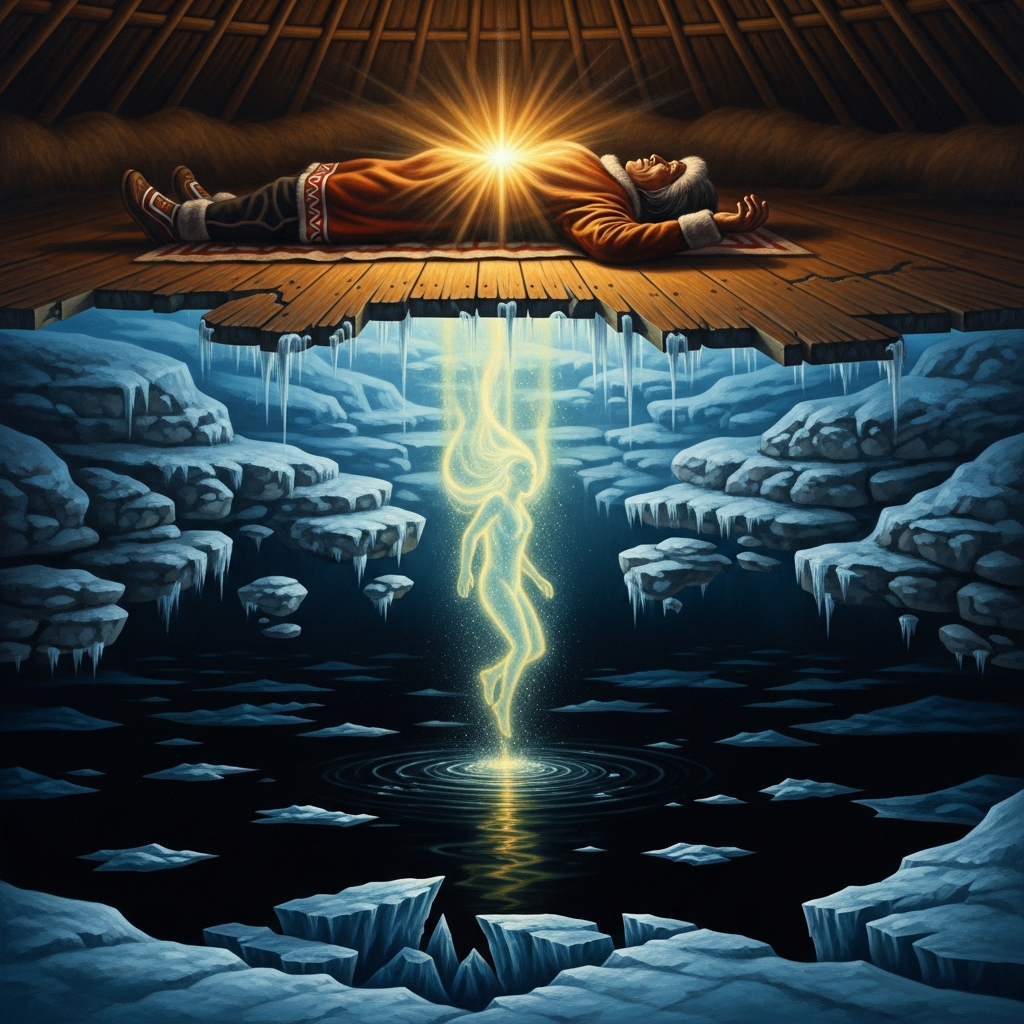
The angakkuq’s first training is learning to be alone.
He goes out onto the ice alone — not to hunt, not to travel, not to accomplish any practical purpose. He goes out to be in Sila’s territory without the mediation of community or task. This can last weeks. He is cold. He has minimal food. He is as close to the threshold between survival and death as a human being can be while still surviving.
In that state, the boundary between his awareness and Sila’s awareness becomes permeable. He begins to hear what the wind is saying — not in words, but in information. The animal movements ahead of the storm. The open water at the sea-lead’s edge. The direction of the caribou herd three days’ travel north. The location of his missing neighbor’s soul.
This is not extra-sensory perception in the sense of miraculous information delivery. It is more like becoming so quiet and receptive that information that was always available becomes accessible. Sila was always communicating. The problem was the human noise of need and fear and purpose.
Aua described it once more to Rasmussen, late at night, in a way that Rasmussen said he has not forgotten:
Sila is the air, and also what lives in the air, and also what thinks through us when we think truly. When you feel suddenly very awake — more awake than usual, for no reason — that is Sila. It is reminding you that you are already in it.
The wind is blowing outside the snowhouse.
It has no opinion about you.
It holds you in being anyway.
Echoes Across Traditions
Entities
- Sila (the cosmic breath-force)
- the angakkuq (Inuit shaman)
- the inua (spirit-person within each thing)
- the wind as Sila's voice
- Nanuq the polar bear as Sila's most visible embodiment
Sources
- Rasmussen, Knud, *Intellectual Culture of the Iglulik Eskimos* (Copenhagen, 1929) — the definitive source for Aua's description of Sila
- Merkur, Daniel, *Powers Which We Do Not Know: The Gods and Spirits of the Inuit* (Idaho, 1991)
- Laugrand, Frédéric and Oosterens, Jarich, *The Sea Woman: Sedna in Inuit Shamanism and Art in the Eastern Arctic* (Alaska, 2008)