Gilgamesh and Enkidu: The First Great Friendship
Standard Babylonian version (Tablet of Sin-leqi-unninni) c. 1200 BCE; Old Babylonian tablets c. 1750 BCE; Sumerian sources c. 2100 BCE · Uruk, the Cedar Forest, the Bull of Heaven's rampage, the road to the edge of the world, the Waters of Death, the island of Utnapishtim
Contents
A king and a wild man become brothers. When Enkidu dies, Gilgamesh tears off his royal robes and walks into the wilderness to find immortality — and does not find it.
- When
- Standard Babylonian version (Tablet of Sin-leqi-unninni) c. 1200 BCE; Old Babylonian tablets c. 1750 BCE; Sumerian sources c. 2100 BCE
- Where
- Uruk, the Cedar Forest, the Bull of Heaven's rampage, the road to the edge of the world, the Waters of Death, the island of Utnapishtim
Before they were friends, they were enemies.
Gilgamesh is king of Uruk. Two-thirds divine, one-third mortal — or so the epic describes him, a formula that seems to mean: more than human, but not enough. He has built the walls of Uruk, the great cedar gates, the temples that scribes will later describe as still standing and still worth seeing. He is the most powerful man in the world.
He is also, in the epic’s first tablets, a tyrant.
He demands the first night with every bride in Uruk. He exhausts the young men of the city with his energy and his demands. He has no equal, and without an equal he has no brake on himself, and the people of Uruk cry out to the gods: you made him this way. You made him too strong. Make something to match him.
The gods go to Aruru, the mother-goddess, and ask her to create a counterpart.
She wets her hands, pinches off clay, and throws it down into the wilderness.
Enkidu rises.
He is the inverse of Gilgamesh in every dimension.
Gilgamesh is the product of civilization — walls, law, kingship, the city’s accumulated knowledge. Enkidu knows nothing of cities. He runs with the gazelles. He drinks from the waterholes beside the wild animals. His body is covered in hair. He has never held a weapon or worn clothes or eaten cooked food. He is, in the epic’s framing, what a man would be if civilization had never happened.
A trapper sees him at the watering hole. He is disturbed — this figure who fills in the pit-traps and rescues animals from snares. He reports to his father, who sends him to Uruk, who sends him back with a temple prostitute, a woman named Shamhat, whose instructions are simple: find the wild man, sleep with him, civilize him.
Shamhat goes to the watering hole and finds Enkidu. They are together for seven days. When they rise, the animals smell the change on him and scatter. He tries to run with the gazelles and cannot keep up. He has been altered in ways that cannot be reversed.
He is no longer part of the wild world. He is not yet part of the human one.
Shamhat takes him to Uruk.
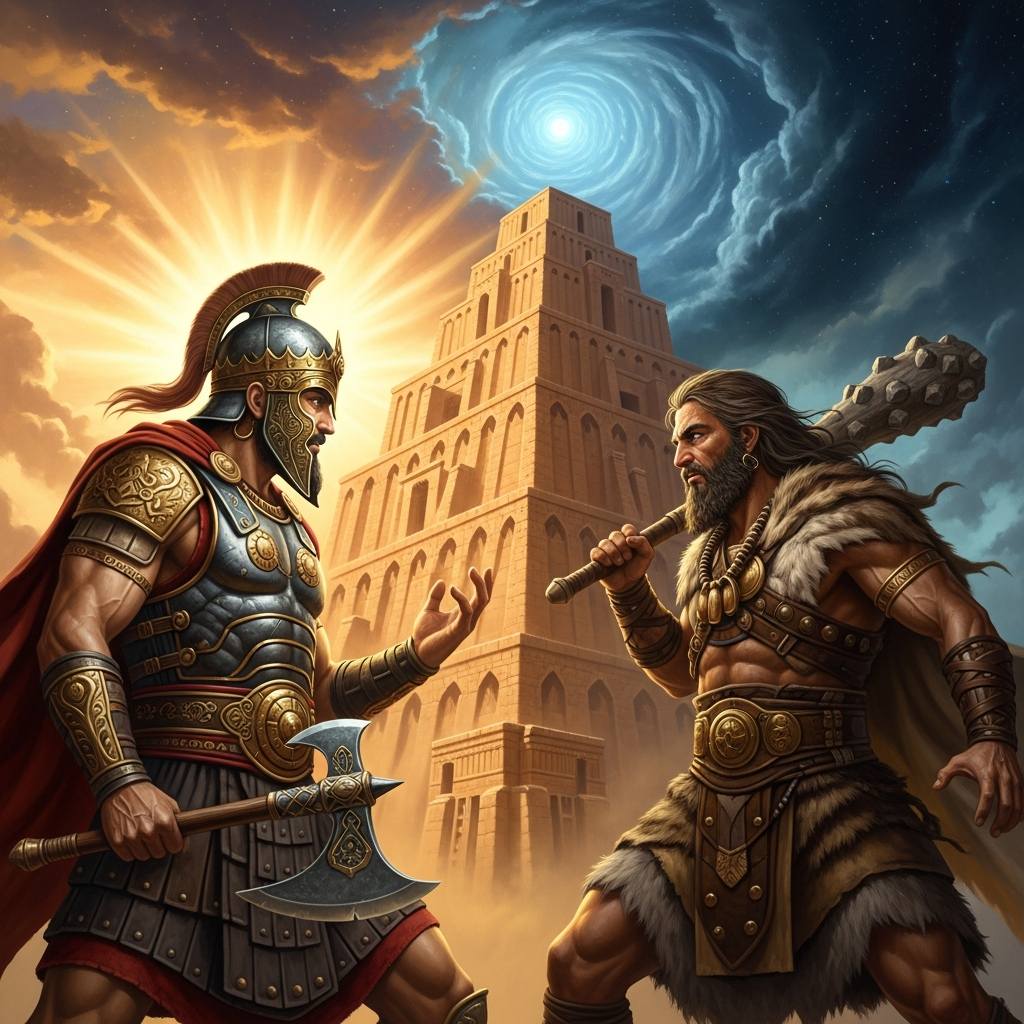
The first meeting between Gilgamesh and Enkidu is a fight in the marketplace.
Gilgamesh is on his way to a bride’s house to exercise his royal privilege. Enkidu blocks the door. They grapple in the street for what the epic describes as a long time — the walls shaking, the doorposts trembling — until Gilgamesh pins Enkidu, and then does something unexpected.
He stops.
He offers his hand.
The two men embrace. Gilgamesh’s mother Ninsun, who has been watching, says the words that will define the epic: Enkidu, who has no father, no mother, whose hair was cropped like a fieldworker’s — I will love him as a son. From this moment, Enkidu is not a wild man and not a stranger. He is family.
They immediately begin planning how to get themselves killed together.
The plan is the Cedar Forest. Humbaba guards it — a monster appointed by Enlil, a being whose voice is the flood and whose breath is fire and whose face is a mass of intestine-shaped coils that drive men mad. The Cedar Forest is at the edge of the known world, and Humbaba is its guardian, and nobody goes there.
Gilgamesh wants to go.
Enkidu is afraid. He has heard about Humbaba since childhood, in whatever childhood a wild man has, and he tells Gilgamesh plainly: this thing is real, it is not metaphor, it will kill us. The elders of Uruk say the same thing. Ninsun prays to Shamash the sun-god for protection.
Gilgamesh goes anyway. Enkidu goes with him.
This is what the friendship means in practice: Enkidu cannot stop Gilgamesh from the foolish thing. What he can do is go alongside him. The loyalty is not to the plan. It is to the person.
They kill Humbaba. They return to Uruk in triumph.
Then Ishtar makes her offer.
The goddess of love and war looks at Gilgamesh fresh from battle and proposes marriage. Gilgamesh refuses. He refuses with an eloquence that is also a provocation — running through the list of her former lovers and what became of them. The horse broken to harness. The shepherd turned to wolf. Tammuz, the vegetation god, condemned to weeping year after year.
Ishtar is humiliated. She goes to her father Anu and demands the Bull of Heaven — a divine weapon, a creature that when it snorts creates sinkholes that swallow three hundred warriors at a time.
Anu releases it.
The Bull rampages through Uruk. Enkidu seizes it by the horns. Gilgamesh drives his sword into the back of its neck between the horns. The Bull falls. The two men take its heart to the sun-god as an offering.
Enkidu tears out the thigh of the Bull and throws it at Ishtar.
The gods meet in council.
One of them must die for killing the Bull of Heaven, for killing Humbaba. It cannot be Gilgamesh — he is two-thirds divine, he has a destiny, the city walls need finishing. It will be Enkidu.
Enkidu falls ill on his bed. He rails against the trapper who saw him at the watering hole, against Shamhat who found him there, against the door of the Cedar Forest he helped to hew. He rages against the fact of dying in a bed. He wanted to die in battle.
Gilgamesh sits beside him.
The death takes twelve days. By the sixth day, Enkidu cannot lift his head. On the twelfth day, he dies.
This is where the epic turns.
Gilgamesh, who has never seen death, who has been the cause of death in other people, who has slaughtered Humbaba and the Bull without flinching, is destroyed by what happens to Enkidu’s face.
He does not move from the body. He circles it like a lion. He orders all the artisans of Uruk — the silversmiths, the jewelers, the stonecutters — to fashion a statue. He places rich offerings beside the body. He stays for seven days, waiting, the texts say, for Enkidu to get up.
He does not get up.
On the seventh day, a worm falls from Enkidu’s nostril.
Gilgamesh tears off his royal robes. He puts on the skin of a lion. He goes out into the wilderness.
He walks to the edge of the world looking for Utnapishtim — the one mortal who was granted immortality by the gods after surviving the flood. If Utnapishtim has it, Gilgamesh reasons, he can get it. He does not have a clearer plan than this. He walks for a long time.
He crosses the waters of death. He finds the island. He finds Utnapishtim.
Utnapishtim tells him the truth plainly: the gods have kept death for mankind and kept life for themselves, and that decision was made long ago and will not be reversed. But there is a plant at the bottom of the sea, he says, that will at least restore youth to an old man.
Gilgamesh dives. He retrieves the plant — it cuts his hands like thorns as he pulls it up, and he clutches it bleeding and triumphant. He starts home.
He stops to rest beside a pool of cool water. He sets the plant on the bank and wades in.
A snake smells the fragrance. The snake takes the plant. It sheds its skin as it goes. It has shed its old self and become new. Gilgamesh sits on the bank dripping, his hands cut from the thorns, the plant gone, everything gone.
He weeps. Then he gets up and walks back to Uruk.
The epic ends where it begins: at the walls.
The last tablet has Gilgamesh showing Urshanabi, the ferryman who crossed him over the Waters of Death, the city he built. Look at the walls, how thick they are. Look at the terrace, how it was made. Look at the brickwork, fired in a kiln. The foundation was set by the Seven Sages.
This is the answer.
Not immortality. The walls. The work. The city still standing. Enkidu is dead and cannot be retrieved. The plant is gone and will not come back. But the walls Gilgamesh built before any of this happened — they are still here. The people asleep inside them are still here. That is what remains.
Siduri, the innkeeper at the edge of the world who tried to turn Gilgamesh back before he found Utnapishtim, had already told him the same thing in plainer language: When you see a child in your arms, wash your face, hold the hand of the child who holds your hand, let your wife delight in your embrace, for these are the works of mankind.
He did not listen then. He had to walk to the edge of the world and back to be ready to hear it.
Grief is the engine of every quest. The quest ends at home.
That is what the oldest story ever written is about.
Echoes Across Traditions
Entities
- Gilgamesh
- Enkidu
- Shamash
- Ishtar
- Humbaba
- Utnapishtim
- Ninsun
- Siduri


Sources
- Andrew George, *The Epic of Gilgamesh: A New Translation* (2003)
- N.K. Sandars, *The Epic of Gilgamesh* (1960, Penguin Classics)
- Jeffrey Tigay, *The Evolution of the Gilgamesh Epic* (1982)
- Benjamin Foster, *The Epic of Gilgamesh* (Norton Critical Editions, 2001)
- Thorkild Jacobsen, *The Treasures of Darkness* (1976)