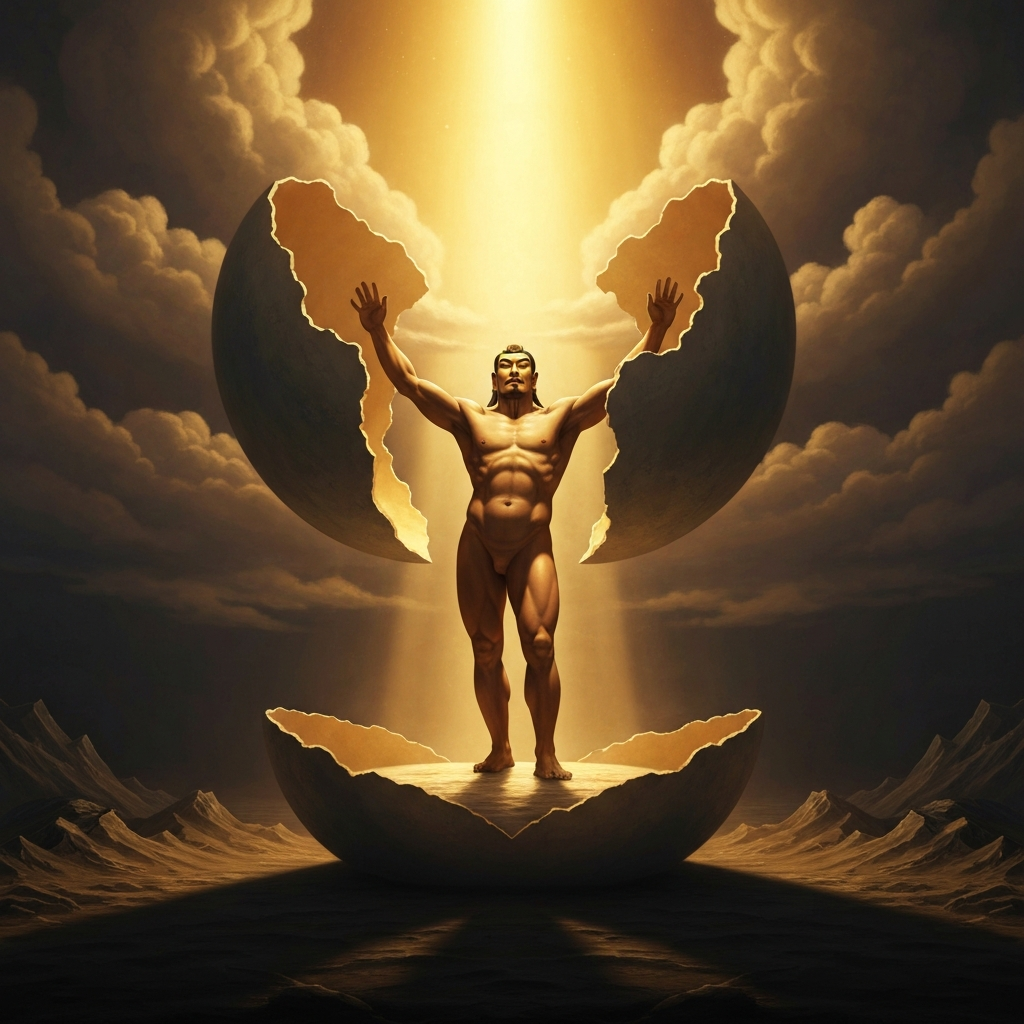
Cháng'é Drinks the Elixir and Flies to the Moon
Mythological age — after the shooting of the nine suns · The mortal household of Hòu Yì in ancient China, then the Moon Palace
Contents
While her husband the archer Hòu Yì is away, Cháng'é drinks the immortality elixir meant for both of them — and finds herself rising alone toward the cold light of the moon, leaving everything behind in a single swallow.
- When
- Mythological age — after the shooting of the nine suns
- Where
- The mortal household of Hòu Yì in ancient China, then the Moon Palace
The elixir is in a small clay jar on the highest shelf of the house.
Hòu Yì has explained its properties to Cháng’é before he leaves for the day: one full dose makes two people ascend to the moon. A half dose makes one person immortal but earthbound. He has not yet decided which they should do. He is, since his exile from heaven, a man trying to choose between kinds of life — the celestial life he was stripped of, or the mortal life he has been given. He needs time to decide.
Cháng’é knows all of this.
She also knows — and the texts do not tell us whether she knows it consciously or in the way we know things that we are not ready to name — that immortality for one person changes the mathematics of a marriage. She knows that Hòu Yì spent his divine life being the most capable person in every room, the person the world needed when no one else could do what needed doing. She knows what it costs to be that person. She knows, too, what it costs to be the person standing next to that person.
She looks at the jar on the shelf for a long time.
She takes it down. The accounts here diverge. One version says she takes it down because a villain named Peng Meng breaks into the house while Hòu Yì is away, threatening to steal it, and she drinks it rather than let it fall to a bad man. This version makes her a hero, or at least removes the ambiguity of choice. The more austere version — the one in the Huainanzi — gives her no villain, no justification, only the jar and the decision.
In that version, she opens the jar. She drinks. She drinks all of it.
The effect is immediate. She becomes lighter. Not metaphorically — literally, physically lighter, her feet leaving the floor, her body rising through the ceiling and into the night sky like smoke from a fire that is not extinguished but transformed. She rises through the cold air and keeps rising. She is afraid, the texts say. She is rising too fast, rising without preparation, and below her the house is getting smaller and the world is getting smaller and the outline of the land she has lived on is beginning to curve at the edges.
She flies toward the moon. There is nowhere else to go. The elixir has given her the moon as her destination and she has not chosen any other.
She arrives.
The Moon Palace is beautiful. The texts, trying to console her, insist on this — the Palace of Broad Cold, guang han gong, is luminous and still and architecturally perfect. There is a cinnamon tree that never stops flowering. There is a jade rabbit that pounds the herbs of immortality under the tree with a pestle, eternally, filling the air with the medicinal scent of something being prepared.
Cháng’é is cold. The texts say this too, the ones that are honest: the palace is cold, the moon is cold, the immortality she has purchased is a cold immortality in a cold palace with only a rabbit for company and the eternal sound of the pestle in the cinnamon-scented dark.
She looks down at the earth. She can see it from here. The blue-and-brown disk of it, so small she can cover it with her thumb. She can see, if she looks at the right angle, the small house where the jar sat on the shelf, now empty of everything she filled it with. She can see, or imagines she can see, Hòu Yì coming home to the empty house and looking at the shelf.
The jade rabbit pounds its herbs. The cinnamon tree flowers. The light of the moon is blue and absolute and hers.
She is immortal. She is free of dying. She is alone in a palace built from cold light, and the earth is small in the distance, and every month she turns her face toward it and the earth’s people look up and see her looking and call her: the woman in the moon, the woman who chose, the woman whose choice neither they nor she have yet entirely understood.
Echoes Across Traditions
Entities
- Cháng'é
- Hòu Yì
- the jade rabbit
- the Queen Mother of the West
- the immortality elixir
Sources
- Huainanzi (淮南子), chapter 6 — earliest version
- Lingxian (靈憲), Zhang Heng, c. 117 CE — adds the jade rabbit and toad motifs
- Many Tang dynasty poems elaborating the theme, including Li Bai and Li Shangyin
- Lihui Yang & Deming An, *Handbook of Chinese Mythology* (Oxford, 2008)