Contents
When the first human dies, the people beg to have death reversed — and the powers agree, sending a message by arrow that could undo it. But Coyote intercepts the arrow and refuses to let it pass, and so death becomes permanent.
- When
- The time when death was new — before it had been decided whether dying was permanent
- Where
- The village of the first people; the crossing point between the living and the dead
In the beginning, no one has died yet.
The people know what dying is — they have seen animals fall and not rise — but no person has died yet, and there is an understanding, not quite a promise, that it might not happen to people the way it happens to animals. Or that if it does happen, something could be done about it.
Then someone dies.
The whole village is devastated. They carry the body and call for the powers that govern such things. They say: this cannot be allowed to stand. Give them back. The powers hold a council.
The council debates through several days.
There are those who say: if every death can be reversed, the world will fill until nothing can move. If the dead return, there will be no room for the living. There are those who say: but the grief is too terrible. The grief of the living is argument enough. The dead should come back.
They decide to send a message. An arrow is shot from the land of the dead toward the land of the living, carrying the instruction: this one may return. If the arrow reaches the village, the dead person returns. That is the rule.
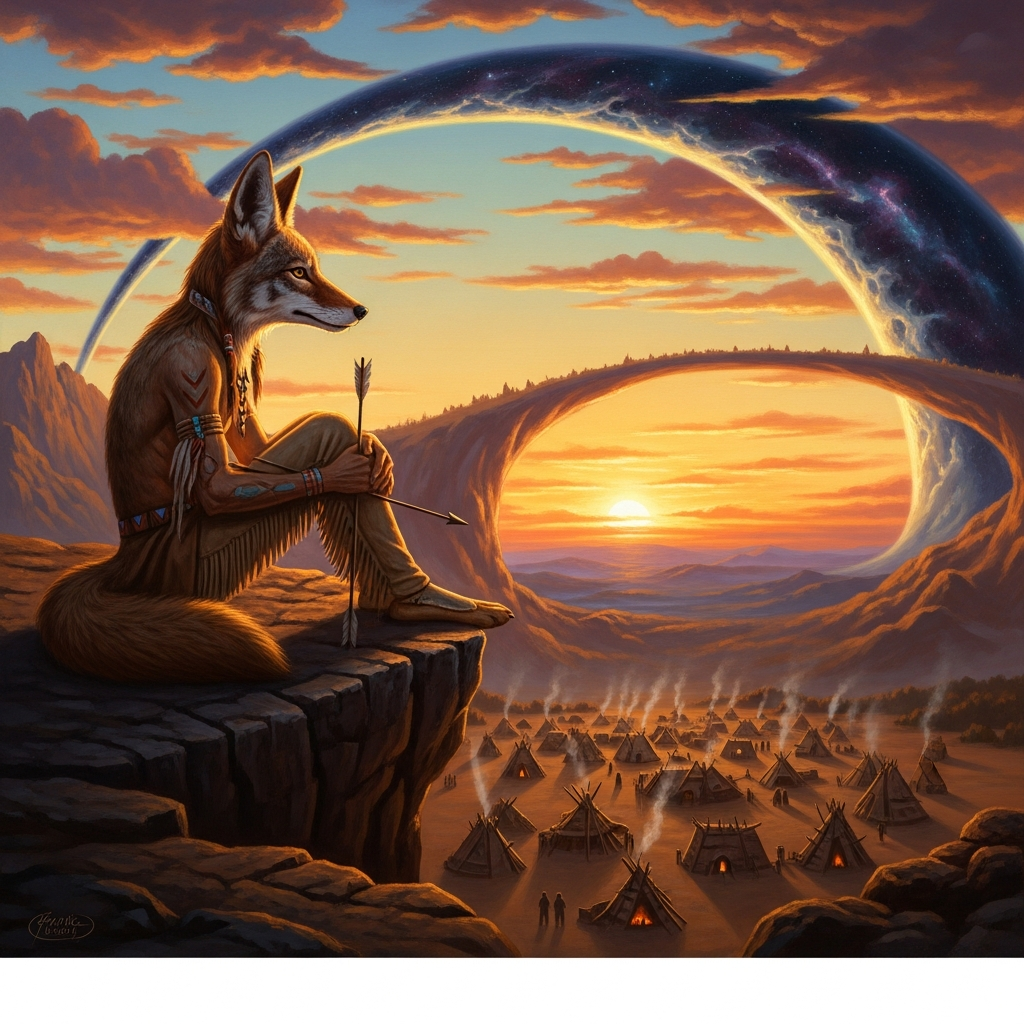
Coyote is sitting at the edge of the village.
He sees the arrow coming.
He has been thinking about this problem since before the council convened. He has thought about the world filling up. He has thought about what it will mean when there are more dead than living and the dead take up all the space that was meant for the new ones who haven’t been born yet. He has thought about his own son, who has already died, who he loves beyond anyone else, and he has thought: if my son cannot return, why should anyone return?
He catches the arrow.
He holds it. He does not throw it into the village. He turns it in his hands, the arrow that carries the instruction that could undo the first human death, and he holds it until the window closes — until it is too late, until the arrow no longer carries its power.
The dead person does not return.
Coyote understands, too late, what he has decided for all living things.
He goes and sits somewhere alone for a long time. The people are angry with him. Some versions of the story say he is soon after killed himself — a boulder falls on him, or he is struck by a weapon — and he discovers directly what death is like. He dies and after a while comes back, because Coyote always comes back. But the people he made mortal do not come back.
He carries this.
He carries it every time one of the people he loves dies and stays dead. He carries it every winter when the cold takes the old ones and every summer when the children fall to the river. He made this. He had a reason. The reason is the right one, the same reason the council almost chose.
The reason doesn’t make the grief smaller.
It just makes it the grief of a world that keeps going, which is the only grief that anyone can afford to carry and still stay alive.
Echoes Across Traditions
Entities
- Coyote
- the first person to die
- the powers who govern death
- the arrow of reversal

Sources
- Barry Lopez, *Giving Birth to Thunder, Sleeping with His Daughter* (Andrews McMeel, 1977)
- Jarold Ramsey, *Coyote Was Going There* (University of Washington Press, 1977)
- Ella E. Clark, *Indian Legends of the Pacific Northwest* (University of California Press, 1953)