Contents
The people are freezing in the dark until Coyote forms an alliance of animals, infiltrates the mountain beings who hoard fire, snatches a burning coal, and relays it from runner to runner across the mountains until it reaches the people.
- When
- Before human memory — the time when animals and people spoke the same language
- Where
- The Cascade Range plateau; the mountain where fire was kept; the river valleys below
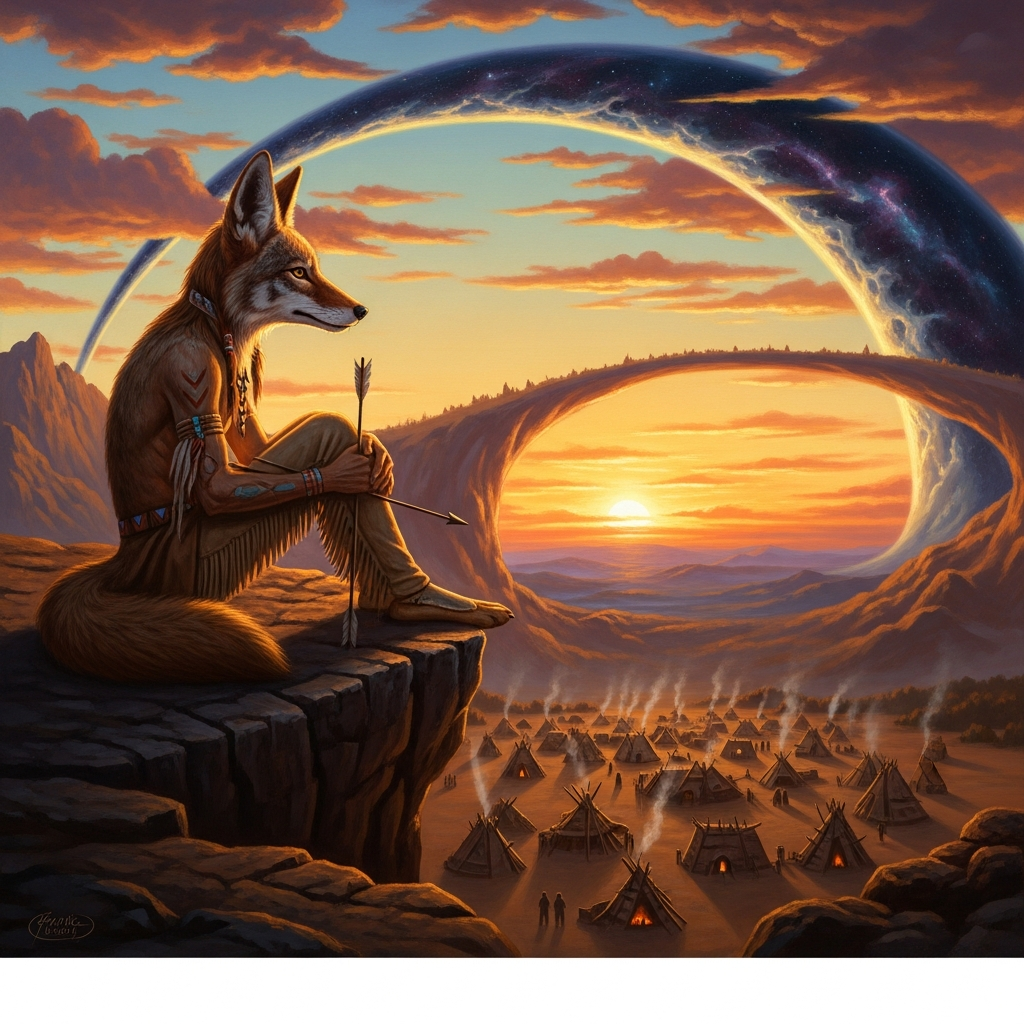
The people are cold.
This is before fire came to the lower world, before anyone below the high mountains knew that warmth was possible in the long dark of winter. The people huddle together at night and their children die and the old ones die and even the young and strong are always cold, always tired in the particular way of people who cannot get warm.
Coyote knows about fire.
He has traveled far enough in his wanderings to have seen the glow on the high peaks where the Fire Beings live — three old women who guard the flame they have always had, who sit around it in their lodge and keep it theirs. They know the power they hold. They will not share.
Coyote calls a council.
He sits down with the animals who live between the high mountains and the lower valleys and explains the plan. He will go up and make himself useful to the Fire Beings, gain their trust, get close enough to grab a coal. Then he will run. He will run as far as he can and when he is caught he will throw the fire to the fastest runner available.
He assigns positions. Squirrel waits just below the Fire Beings’ lodge. Chipmunk waits farther down the mountain. Frog waits at the river. Woodpecker waits in the trees.
Coyote goes up.
He presents himself at the door of the Fire Beings’ lodge as a harmless visitor, a storyteller, someone who admires old women. He is very charming. He tells them stories for many nights, sitting just close enough to the fire to pretend to be cold but not close enough to grab anything. He is waiting for the right moment.
The right moment comes when one of the old women falls asleep.
He grabs the coal and runs.
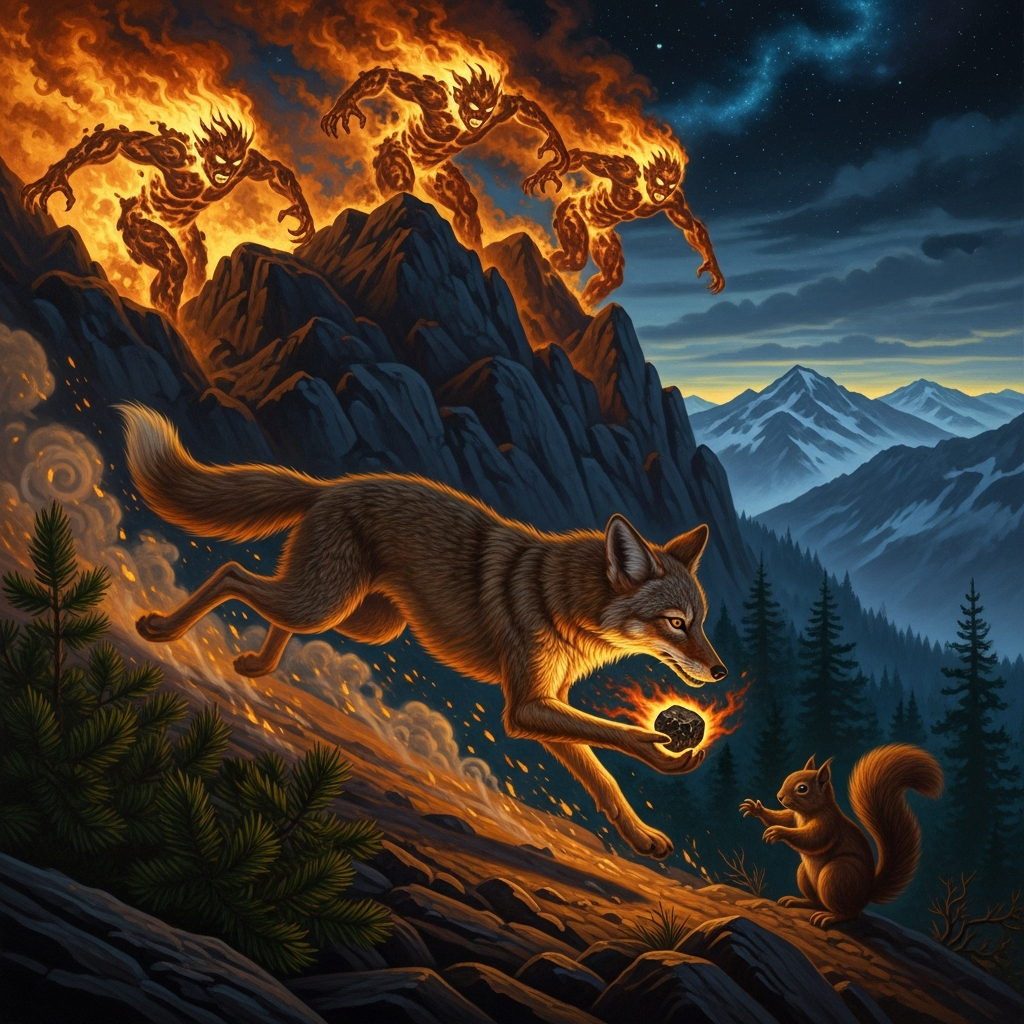
The old women scream. They are faster than anything; they are fire itself when they are angry. Coyote runs down the mountain with the coal cupped in his hands, burning, the fire scorching his fur, but he runs until his legs go out from under him and he throws the coal to Squirrel.
Squirrel catches it. The coal is hot — too hot — and Squirrel’s tail curls up over her back as she runs, which is why squirrels’ tails curl to this day. She passes it to Chipmunk, who is fast but not fast enough, and one of the old women catches her and rakes her back with burning claws before she can throw the coal to Frog. The marks on Chipmunk’s back are those claws.
Frog catches it and swallows it whole. The old women grab Frog’s tail and pull, and the tail comes off, which is why frogs have no tails. But Frog has swallowed the fire and she hops to the river and dives in, and the old women cannot follow into the water.
Woodpecker dives into the wood of a dead tree on the bank. The fire is in the wood now. It is safe.
Coyote arrives last, limping and smelling of burned fur.
He picks up two sticks and shows the people how to get the fire out of the wood by rubbing the sticks together the way he learned from watching Woodpecker. The fire comes. The people see it for the first time — the orange light, the warmth, the way it eats the wood and stays and can be kept — and they are not cold anymore.
The old women are still up on the mountain, but they are not angry for long. A fire that heats itself is finite. A fire that can be made anywhere, from any wood, is infinite, and infinity is too big to hoard.
Echoes Across Traditions
Entities
- Coyote
- the Fire Beings (mountain guardians)
- Frog
- Squirrel
- Chipmunk
- Woodpecker

Sources
- Ella E. Clark, *Indian Legends of the Pacific Northwest* (University of California Press, 1953)
- Barry Lopez, *Giving Birth to Thunder, Sleeping with His Daughter: Coyote Builds North America* (Andrews McMeel, 1977)
- Jarold Ramsey, *Coyote Was Going There: Indian Literature of the Oregon Country* (University of Washington Press, 1977)