Contents
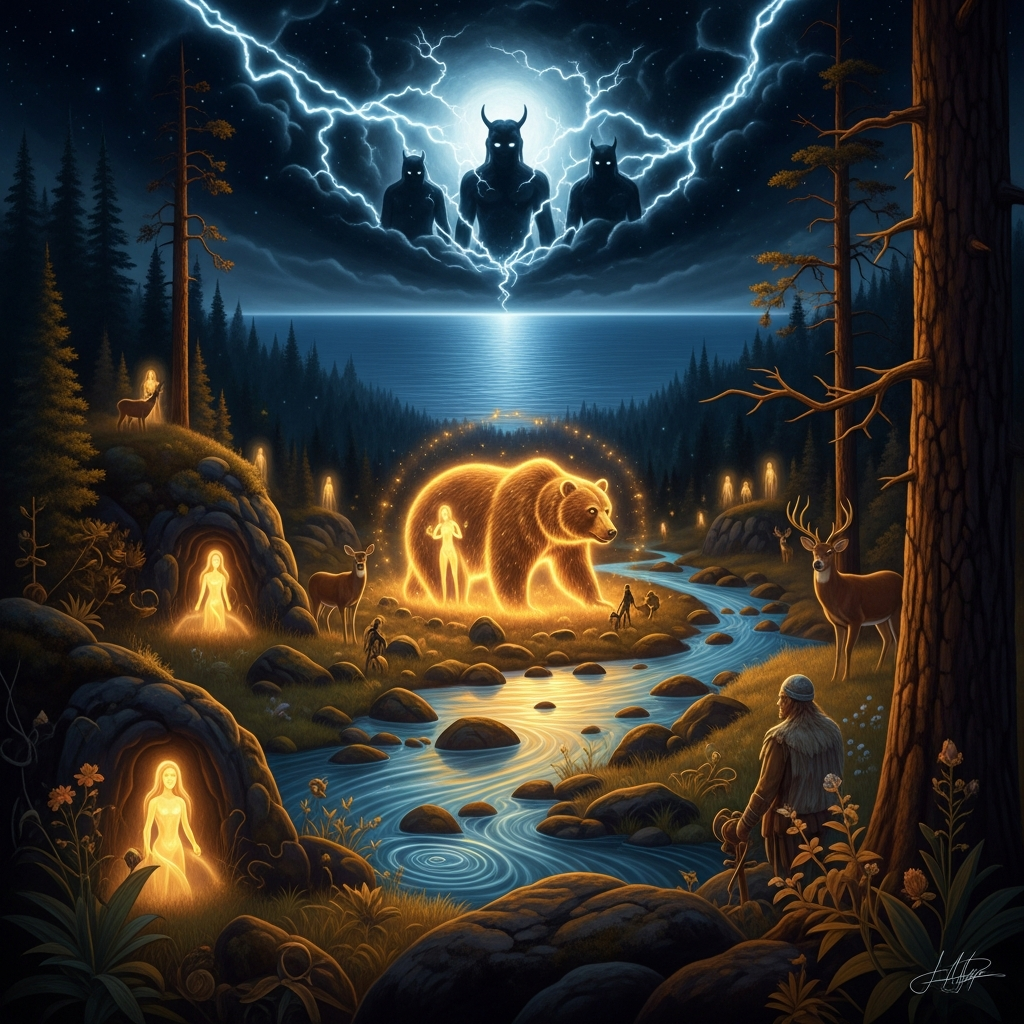
Nanabozho the trickster-transformer loves his nephew, and when his nephew is killed by the underwater spirits, he takes revenge — and in the process, permanently establishes death as the condition of human life, because the spirits agree to stop hunting the living only if Nanabozho stops hunting the dead.
- When
- The founding time of the world — after Nanabozho helped create the earth
- Where
- The Great Lakes — the forests and the deep cold lakes of Anishinaabe territory
Nanabozho loves his nephew Wolf more than anything.
This is significant, because Nanabozho is the child of a human woman and the West Wind, the transformer who helped bring the earth up from the flood, the trickster whose adventures created the landscape of the Great Lakes country. He is powerful and clever and generally difficult to hurt. His love for Wolf, who is simply a wolf and also his companion and kin, is the one place where he can be reached.
The underwater spirits know this.
Mishibizhiw — the Great Lynx, the underwater panther who rules the world beneath the lakes — and his companions have always been hostile to the world above the water. They pull people under. They cause drowning. They are the danger beneath the surface of every lake in Anishinaabe country, and they are jealous of Nanabozho’s power.
They take Wolf.
They wait until Wolf is traveling alone on the ice of a frozen lake and they come up through the ice and pull him down. When Nanabozho comes looking for his nephew and finds nothing but the signs of the struggle and a hole in the ice, he knows exactly what has happened.
He grieves.
He grieves in the way that only a being who is both human and supernatural can grieve: totally, without reservation, with an intensity that darkens the air around him. Then he begins to plan revenge.
He transforms himself into a tree stump on the shore of the lake, because tree stumps are invisible things that no one looks at. He waits for days in this form. The underwater spirits, feeling safe, eventually come to shore to sun themselves on the rocks — because the underwater spirits, like all beings, are not always vigilant. They come up and lie on the rocks in the sunlight.
Nanabozho strikes. He kills Mishibizhiw.
The death of the Great Lynx sends shockwaves through the water world. The lakes rise. The floods come. The underground rivers churn. The underwater spirits are furious and devastated, which means the weather in the world above is catastrophic.
The powers negotiate.
The terms of the settlement are: the underwater spirits will not be killed by Nanabozho. Nanabozho will not pursue the dead into their domain. The living will be taken from the world above by the underwater spirits, in the normal course of drowning and disease and accident, and the dead will stay where they go, which is not a place Nanabozho will be able to reach them.
Wolf stays dead.
Nanabozho accepts this.
He accepts it because the alternative is a permanent war between the above-world powers and the below-world powers, and the casualty in that war would be the world itself — the lakes and forests and people who are caught in the middle. He accepts it because there is no other choice. He accepts it with a grief that does not go away, that is present in every story where he appears from this point forward.
The Ojibwe say that death is the treaty that Nanabozho signed for Wolf.
The dead are somewhere. They are with the powers of the below-world, in the water, in the dark cold at the bottom of the lakes where Wolf went down. They are not gone. But they are not here.
The treaty holds.
Echoes Across Traditions
Entities
- Nanabozho (also Wenabozho, Manabozho)
- the nephew (Wolf)
- Mishibizhiw (the Great Lynx, the underwater panther)
- the underwater spirits
Sources
- Henry Rowe Schoolcraft, *Algic Researches* (Harper, 1839)
- Basil Johnston, *The Manitous: The Spiritual World of the Ojibway* (HarperCollins, 1995)
- Louise Erdrich, *Books and Islands in Ojibwe Country* (National Geographic, 2003)