Contents
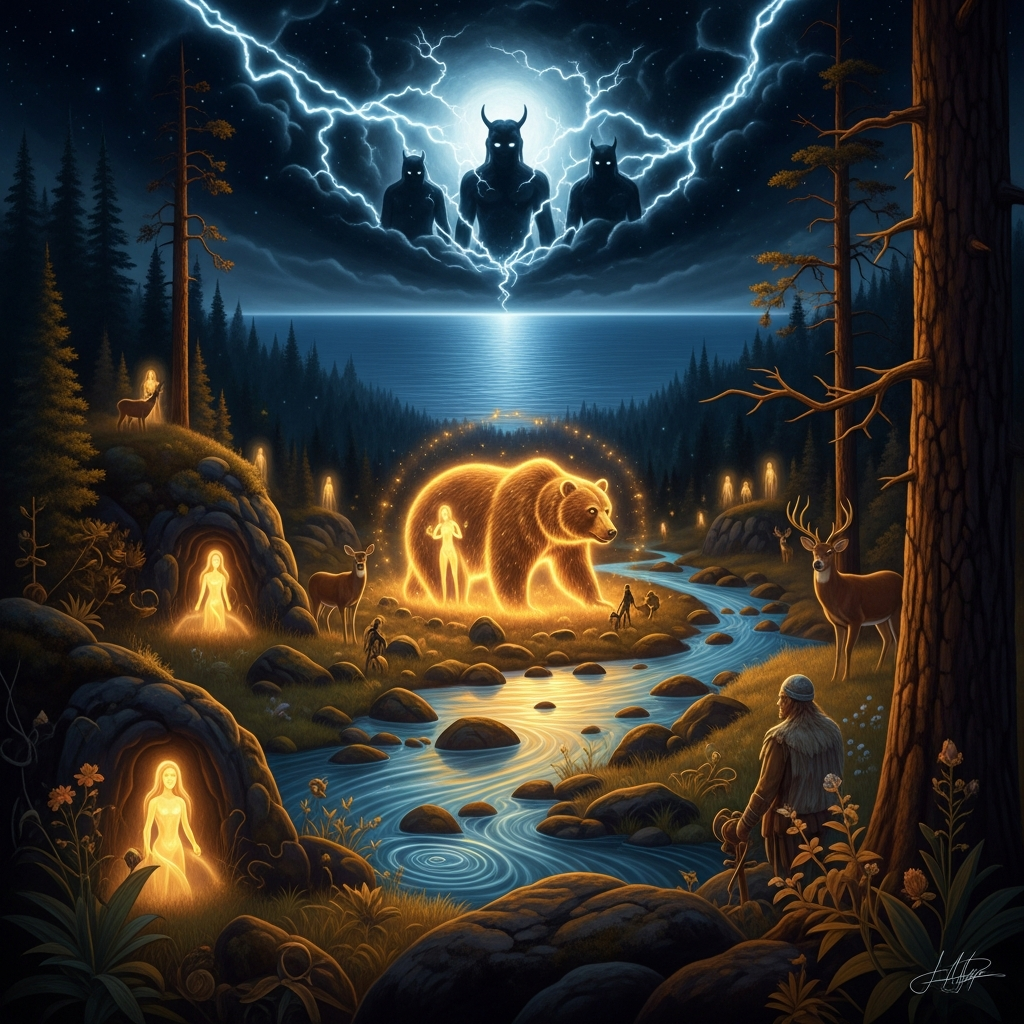
A young man follows a wounded bear into the forest and watches it dig roots and pack them into its wounds — and the bear, knowing it is being watched, turns and teaches the man the medicine plants before dying, giving the Bear Clan their responsibility as healers.
- When
- Founding time — when the clan responsibilities were established
- Where
- The hardwood forests of the Great Lakes region
He does not intend to follow the bear.
He is a young man out hunting when he sees the bear moving slowly through the undergrowth, moving in the wrong way — not with the fluid speed of a healthy bear but with the careful, weighted movement of something that is injured. He follows at a distance, not to kill it (he would not kill a bear in this condition, moving wrongly through the trees), but because injured things sometimes lead you somewhere.
The bear leads him to a clearing.
In the clearing, the bear stops. It digs at the earth beside a clump of plants — the young man watches from the edge of the trees, not moving, not breathing loudly. The bear digs up a root. It is methodical about this: not frantic, not desperate, but deliberate, the way a person is deliberate when they know what they’re looking for. It packs the root against the wound on its shoulder. It eats some of the root’s leaves. It moves to another plant and does the same thing.
Then it looks at him.
The bear has known he was there the whole time. Bears always know. The young man stands still, because there is nothing else to do, and the bear looks at him with the particular attention of a being that has decided something.
It begins to teach him.
Not in words. In repetition and gesture and presence: the bear moves to each plant in the clearing and indicates it, repeats its use, allows the young man to approach and touch and smell. The young man learns the shape of each plant, the smell of its root, the depth at which it grows, the season in which it is most potent. He learns this the way you learn anything important: through the direct transmission of presence, through doing rather than being told.
The bear dies in the clearing when the teaching is finished.
The young man stays with it for a long time before he moves. He thanks it properly — in the words that acknowledge what a bear person gives when it gives its knowledge and its life. He buries the remains with care.
He brings the knowledge back to his people.
The Bear Clan — his clan, the people who carry the bear’s responsibility — receives it as their inheritance. The Bear Clan heals. This is their function in the social structure of the Anishinaabe nation: as other clans carry the responsibilities of leadership, of war, of ceremony, the Bear Clan carries the responsibility of medicine. The knowledge that came from the bear in that clearing is the foundation of generations of healing practice.
Every medicine person knows this story.
Not as a legend about something that happened once, but as the account of where their knowledge comes from and who taught it. The bear in the clearing did not teach a young man — the bear in the clearing taught every healer who would come after him, through the young man who followed an injured bear into the forest and had the sense to stay quiet and watch.
The plants the bear used are still there.
They still work.
Echoes Across Traditions
Entities
- the bear person
- the young man of the Bear Clan
- the medicine plants
- the Bear Clan healers
Sources
- Basil Johnston, *Ojibway Heritage* (McClelland and Stewart, 1976)
- Basil Johnston, *The Manitous: The Spiritual World of the Ojibway* (HarperCollins, 1995)
- Robin Wall Kimmerer, *Braiding Sweetgrass* (Milkweed Editions, 2013)