Contents
The Midewiwin — the Grand Medicine Society — was given to the Anishinaabe people by the Great Spirit through Nanabozho to restore health and extend life, and its degrees of initiation carry the accumulated healing knowledge of ten thousand years.
- When
- Founded in mythic time; practiced continuously to the present
- Where
- The Great Lakes region — originally associated with Madeline Island (Mooningwanekaaning), Lake Superior
Nanabozho sees that the people are dying too soon.
This is after the establishment of the world, after the flood and the earth-building, after death has been made permanent through the treaty with the underwater spirits. The people are dying from illness, from injury, from the kinds of suffering that come from not knowing how to address the spiritual sources of physical disease. Nanabozho goes to the Great Spirit and says: this is too much. They need help.
The Great Spirit gives him the Midewiwin.
The Midewiwin is not a religion in the sense of a set of beliefs. It is a practice — a medicine society, a structured community of knowledge holders who have been initiated into progressively deeper understanding of the relationship between the physical and spiritual sources of health and illness.
The first degree teaches the origin stories and the basic ceremonies, the use of tobacco and herbs, the way to address the manidoog who govern health. The second degree goes deeper: more herbs, more songs, the particular knowledge of specific illnesses and their treatment. The third and fourth degrees — and for some bands, the fifth, sixth, seventh, and eighth — carry knowledge that requires years of preparation to receive and a lifetime to understand.
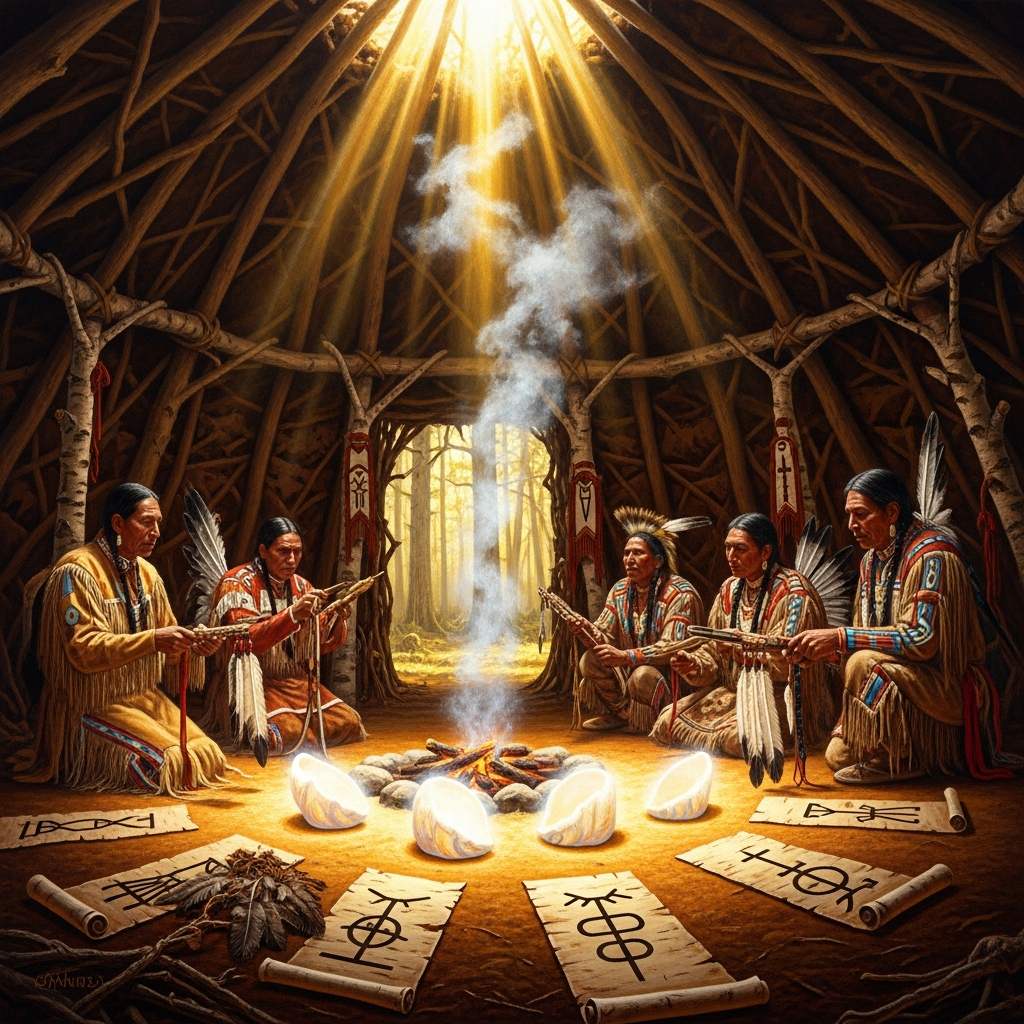
The initiation is specific. The candidate is placed in a ceremonial lodge. The Mide practitioners — the senior members — “shoot” the candidate with the sacred megis shell, a small white cowrie shell that is the physical symbol of the Mide power. The shooting is not metaphorical: the shell appears to enter the candidate, who falls down in a kind of ritual death. They are brought back. This is the pattern of every degree: a death and a resurrection, each one carrying more knowledge than the last.
The scrolls are part of it.
The Midewiwin knowledge is encoded in birchbark scrolls incised with symbols that represent the ceremonies, the songs, the degrees, the maps of the four worlds that structure Anishinaabe cosmology. These are not writing in the Western sense — they are memory aids, the visible structure of what the initiated person knows internally, the external record of an internal map. The scrolls cannot be read by someone who doesn’t already know what they mean.
The knowledge lives primarily in the initiated people, not in the scrolls.
The missionaries called the Midewiwin witchcraft and worked to destroy it. The government agents called it a seditious gathering and banned it. The boarding schools that took Ojibwe children from their families for generations were explicitly designed to cut the transmission from grandparent to grandchild, from Mide practitioner to apprentice, that kept the society alive.
It survived anyway.
The elders who carried the knowledge passed it in secret, in abbreviated form, in whatever form was possible. The scrolls were hidden in places the agents didn’t know about. The ceremonies were conducted in private. When the suppression eased and then was lifted by the American Indian Religious Freedom Act of 1978, the Midewiwin came back fully into public practice — not reconstituted from scratch, but continuing from where it had been forced underground.
Nanabozho asked the Great Spirit for something to help the people survive illness.
He got a society that survived attempted obliteration.
The healing was always the same.
Echoes Across Traditions
Entities
- Nanabozho
- the Mide medicine people
- the sacred megis shell
- the Mide scrolls (wiigiwaam bajiishkibiigan)
Sources
- Walter Hoffman, *The Mide'wiwin or 'Grand Medicine Society' of the Ojibway* (Bureau of American Ethnology, 1891)
- Basil Johnston, *Ojibway Heritage* (McClelland and Stewart, 1976)
- Ignatia Broker, *Night Flying Woman: An Ojibway Narrative* (Minnesota Historical Society Press, 1983)