Old Man Coyote Makes the World
Crow (Apsáalooke) oral tradition; recorded by Robert Lowie, *Myths and Traditions of the Crow Indians* (1918) · The primordial waters; the Crow homeland (eastern Montana / Wyoming)
Contents
Before the world, there was only water and a lone duck. Old Man Coyote descended from above and told the duck to dive. The duck brought up mud. Old Man Coyote kneaded it and breathed on it and made the earth. Then he made two men from mud — but they were lonely, so he made women. The Crow people come from these first people, and Old Man Coyote is still out there, still making things, still making mistakes.
- When
- Crow (Apsáalooke) oral tradition; recorded by Robert Lowie, *Myths and Traditions of the Crow Indians* (1918)
- Where
- The primordial waters; the Crow homeland (eastern Montana / Wyoming)
In the beginning there is only water.
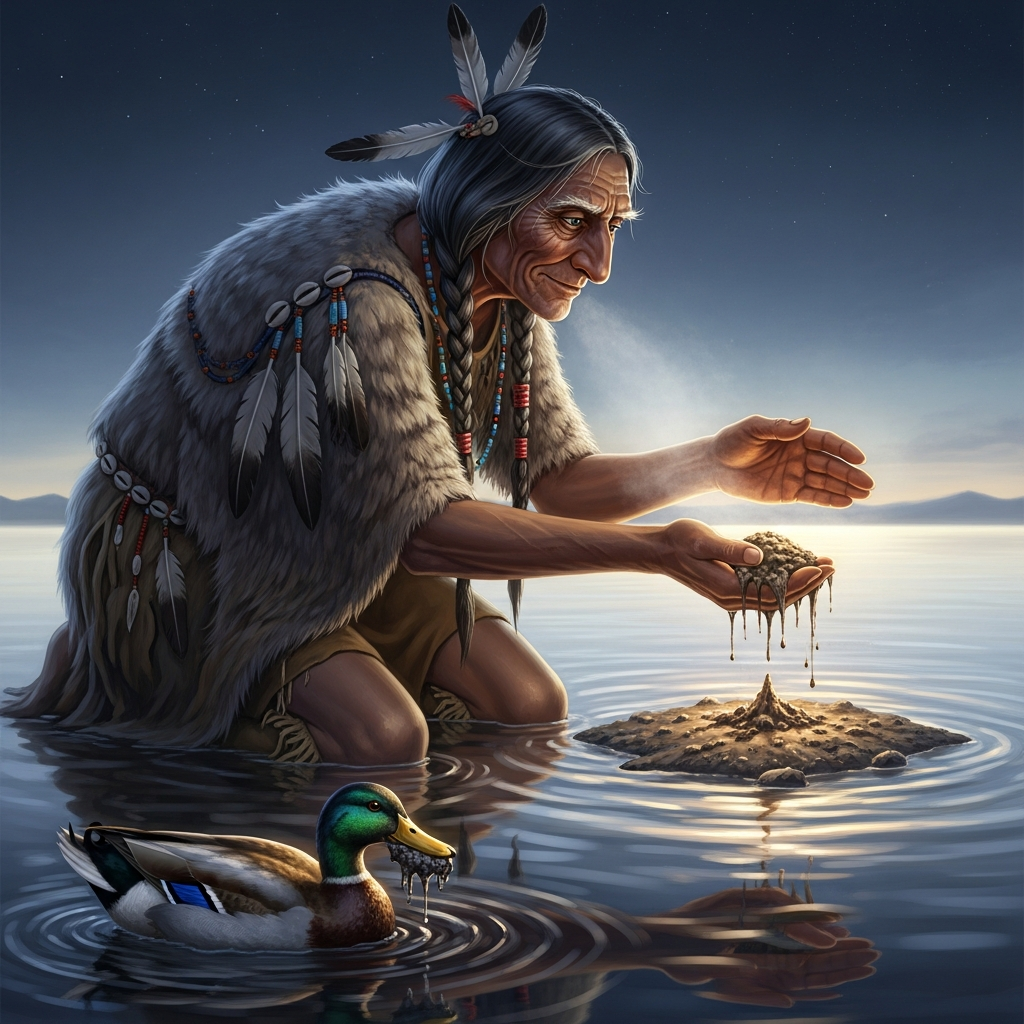
Old Man Coyote floats above it, or descends through the sky above it — the tradition is not precise about where he was before, only about where he arrives. He looks down at the water and does not see the earth, because there is no earth. He looks across the water and sees a duck.
He tells the duck to dive.
This is Old Man Coyote’s characteristic move: he sees what can be done and instructs the nearest creature to do it. Not because he is incapable — he will make the earth himself, once the raw material arrives — but because the making of the world requires collaboration, and Old Man Coyote understands this instinctively. He is not the all-powerful god of a monotheistic tradition; he is an enormously clever and occasionally foolish being who knows what he doesn’t know, and one of the things he doesn’t know is where the bottom of the primordial water is. The duck knows.
The duck dives. It goes down for a long time. The water surface is still and Old Man Coyote waits, which is one of the things he is worst at, and eventually the duck surfaces with mud in its bill.
Old Man Coyote takes the mud.
He works it between his palms. He blows on it. He speaks to it — the words he speaks are not recorded by the tradition, which understands that the creative words belong to the act and cannot be separated from it — and the mud grows. He sets it on the water and it spreads. He walks around the edge of it and it spreads further. He works and the world grows.
This is the part of the story that distinguishes Old Man Coyote from the remote deity of a creation ex nihilo.
He makes the world by hand. He is present to the making of it in a way that leaves his fingerprints all over it, which is why the world has the particular texture it has: the unexpected ridges, the rivers that run the wrong way, the mountains placed in positions that seem arbitrary. Old Man Coyote made the world through improvisation, and improvisation produces a specific kind of beauty — not the symmetry of a planned design but the asymmetry of a making that responded to what it encountered.
He makes the world large enough to walk on.
Then he is not satisfied. He looks at what he has made and adjusts it. He sees a river running in a direction that seems wrong and redirects it. He sees a flat plain that is too flat and builds mountains in it. He walks across the whole earth he has made, observing and correcting, and the Crow tradition carries the memory of this in its landscape: every unusual feature of the land between the Rockies and the plains carries the possibility of being an Old Man Coyote correction.
Then he makes people.
He takes mud again — the same mud he made the world from, which is appropriate, since people are the world thinking about itself — and he makes two men. He breathes life into them. They stand up. He looks at them and is pleased, for a moment, with what he has made.
Then he watches them.
The two men walk around. They look at the world Old Man Coyote has made. They pick things up and put them down. They eat the food that is available. They talk to each other, which is good. But after a while, Old Man Coyote sees something in the way they move through the world: they are not unhappy exactly, but they are not entirely alive, either. Something is missing from the animation of their lives.
He watches for a while longer.
Then he understands. He makes women.
The Crow telling is economical here: Old Man Coyote understands, and makes, and the world becomes complete in a way it was not before. The men are no longer moving through the world with the watchful stillness of beings waiting for something to happen. The world is complete enough now to generate its own events.
Old Man Coyote does not leave after the creation.
This is what distinguishes him from the remote god of many other creation stories: he stays. He is still in the world, still making things, still correcting his mistakes and creating new ones. The Crow relationship with Old Man Coyote is not the relationship of a created being to its creator but the relationship of a people to a very old relative who is simultaneously the source of everything and an ongoing embarrassment.
He is wise, but not wise enough to stop himself from being curious about things he should not be curious about. He is powerful, but not powerful enough to foresee all the consequences of his actions. He wants things for himself in ways that sometimes improve the world and sometimes make it worse. He is, in the Crow understanding, the model of an intelligent being operating without complete information — which is to say, the model of every being in the world.
The stories that follow the creation tell him making mistakes, being tricked, tricking others, being punished, recovering. He does not learn from every punishment. He makes the same mistake in different forms. He is recognizable in this to anyone who has tried to change a habit or correct a pattern of behavior and found that the pattern returns wearing a different coat.
The Crow people — the Apsáalooke, the Children of the Large-Beaked Bird — are his people in the way that children are the children of a parent who was not entirely responsible.
They come from the first people he made in the mud of the earth he shaped from the water he sent a duck to dive into. The origin is humble in material and glorious in principle: they are made of the same substance as the world, shaped by the same hands that shaped everything else, given life by the same breath that gave the earth its form.
The eastern Montana homeland — the Bighorn Basin, the Bighorn Mountains, the Yellowstone River country — is the world Old Man Coyote walked across and adjusted until it was right, or as right as he was going to get it. Every canyon and hot spring and unusual rock formation is potentially an Old Man Coyote story waiting to be told. The land is not simply the place the people happened to end up. It is the place that was made by the same being who made the people, who walked it himself and found it worth keeping.
Robert Lowie, who recorded these stories in 1918, was a Columbia-trained anthropologist with a positivist framework that had limited patience for cosmological claims. He recorded the stories anyway, because the stories were there and someone needed to write them down while the elders who carried them were still alive. What he could not record was the tone in which they were told — which is, by all accounts, a tone of affection rather than reverence, the tone you use for a story about someone you love who also regularly makes things worse.
Old Man Coyote is still out there.
He is still making things and making mistakes. The river that floods the wrong valley, the winter that comes late and lingers, the unexpected gift that arrives from no apparent source — all of these are possibly his work. The Crow people do not fear this. They live in a world made by a being who is genuinely trying, and genuinely fallible, and genuinely theirs.
It is not a bad world to live in.
Echoes Across Traditions
Entities
- Old Man Coyote (Isaahkawuattee)
- The Duck
- The First Man and First Woman
- The Crow People (Apsáalooke)
Sources
- Robert H. Lowie, *Myths and Traditions of the Crow Indians*, 1918
- Joseph Medicine Crow, *From the Heart of the Crow Country: The Crow Indians' Own Stories*, 1992
- Frederick Hoxie, *Parading through History: The Making of the Crow Nation in America*, 1995
- Peter Nabokov, *Two Leggings: The Making of a Crow Warrior*, 1967
- Ella E. Clark, *Indian Legends from the Northern Rockies*, 1966