The Manidoog: Persons Who Are Not Human
All times — the manidoog are always present · The Great Lakes region — the forests, lakes, and rivers of Anishinaabe territory
Contents
The Ojibwe world is filled with manidoog — spiritual persons who inhabit animals, plants, rocks, weather, and sacred objects. They are not supernatural beings hovering above the world; they are the animate power present in the world, available to those who approach with respect.
- When
- All times — the manidoog are always present
- Where
- The Great Lakes region — the forests, lakes, and rivers of Anishinaabe territory
The question is not whether the manidoog exist.
That question has been settled for ten thousand years of Anishinaabe life in the Great Lakes country. The question — the interesting question, the one that shapes the whole of Anishinaabe ethics and ceremony — is how to be in good relationship with them.
Because the manidoog are everywhere.
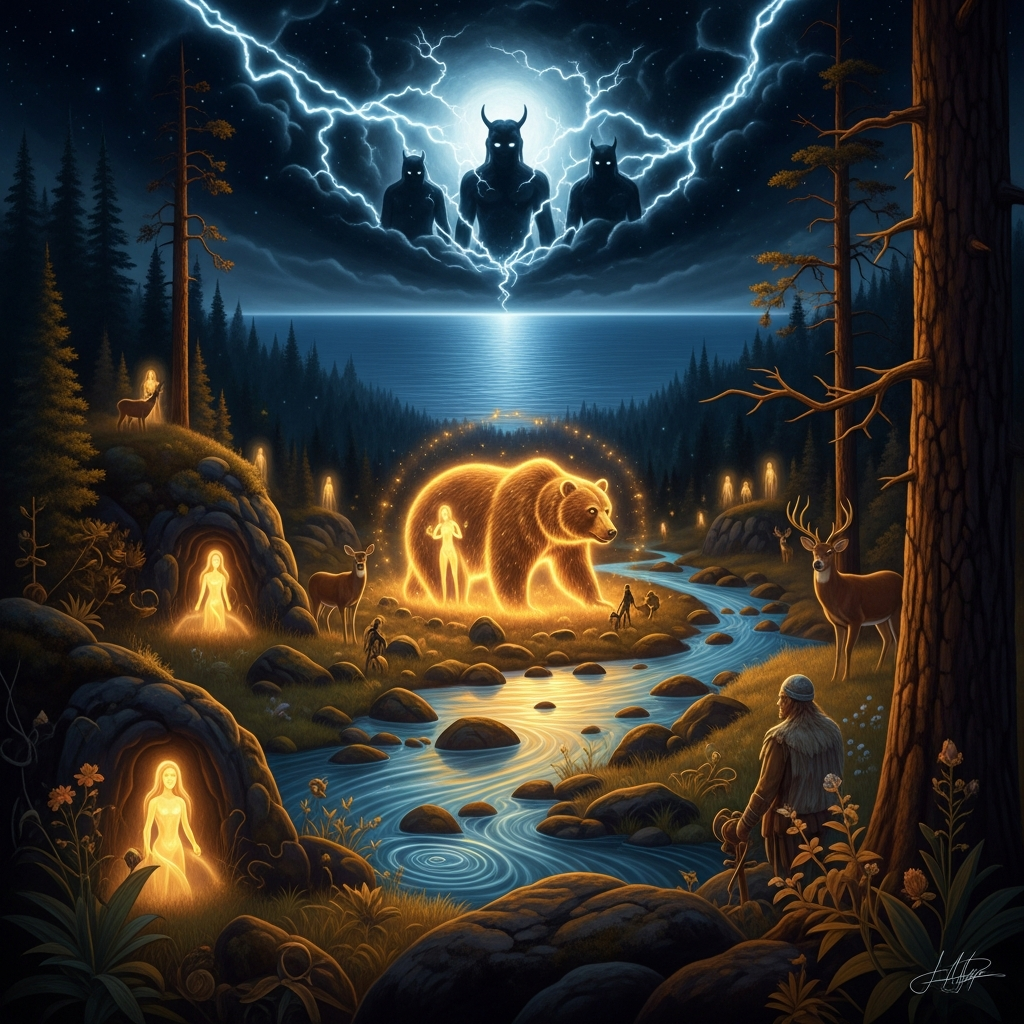
The thunderers are manidoog. They live in the west, in the place where the storms form, and when you hear thunder over Lake Superior you are hearing persons speaking. The bear is a manidoo — the bear person, who chose to live close to the human world and who teaches healing and strength. The herbs that grow in the forest have their own manidoog, their own animate power: tobacco is a manidoo of connection, sage is a manidoo of purification, cedar is a manidoo of protection.
The rocks are persons.
This is not metaphor. The Ojibwe word for certain kinds of especially old rocks — the great granite outcrops of the Canadian Shield, worn smooth by a glacier ten thousand years ago — is a word that describes a grandfather or grandmother. The rock has been there longer than any human person. It has seen more. It deserves the acknowledgment that age and witness require.
Gitchi Manitou — the Great Mystery, the great spirit power — is not a god who stands apart from all this animate world. Gitchi Manitou is more like the animating principle of which all the individual manidoog are expressions. The great power is in everything because it is what makes everything alive.
The medicine person’s work is primarily relational.
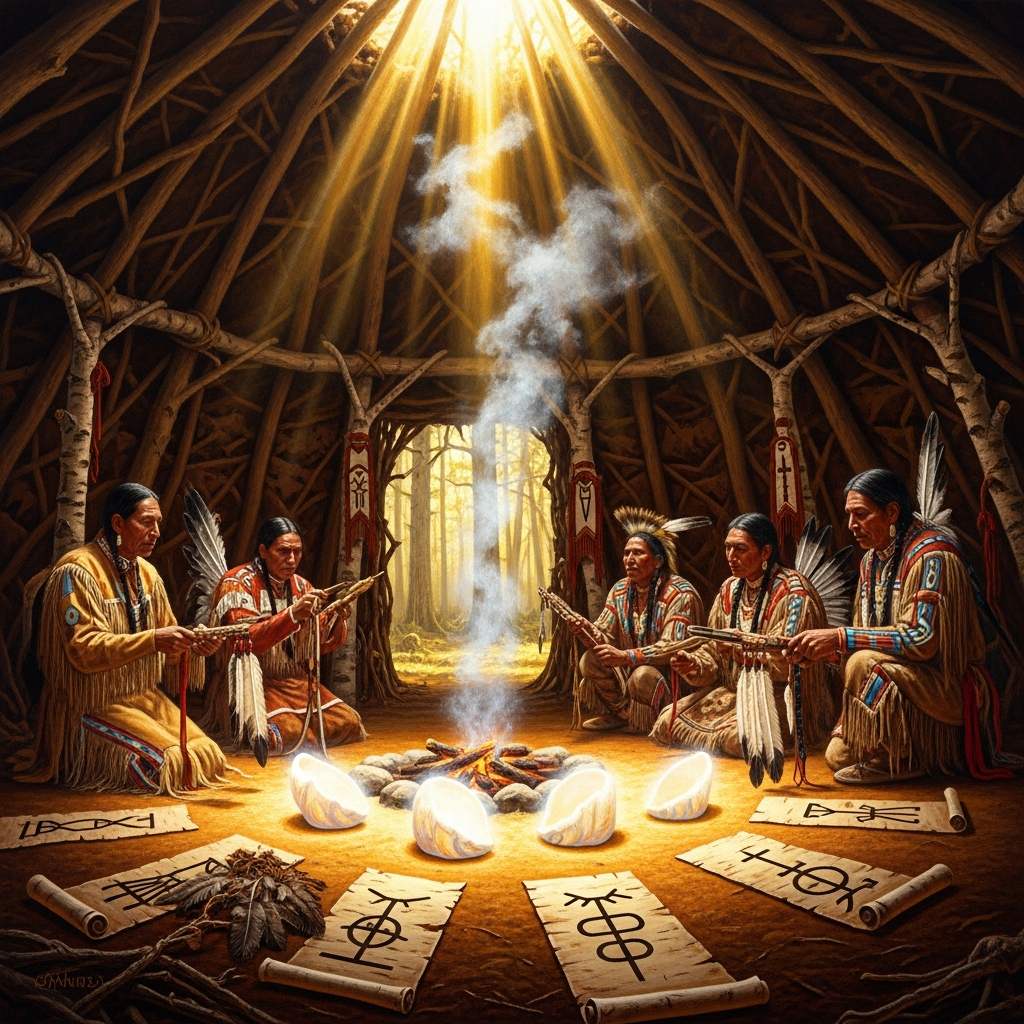
When a person is sick, the healer’s task is to identify which relationship is broken — with which manidoo, through which neglect or transgression — and to restore it. The healing ceremony is fundamentally a ceremony of reestablishment: the tobacco is burned to carry the acknowledgment upward, the drum calls the attention of the manidoog who need to hear, the songs are the language of right relationship.
You approach a manidoo the way you approach a powerful elder: with tobacco, with respect, with honesty about what you need and why you’re asking. The manidoo is not obligated to help you. The help, if it comes, is a gift, not an automatic consequence of the right words.
The Anishinaabe philosopher A. Irving Hallowell studied Ojibwe ontology in the mid-twentieth century and coined the phrase “other-than-human persons” to describe what the Ojibwe already described perfectly in their own language. He wanted to be precise: not spirits in the supernatural sense, not deities in the theological sense, but persons — beings with interiority, agency, and relational obligations.
The forest is full of persons.
The lake is a person.
Every time an Ojibwe hunter takes a deer, he acknowledges the deer as a person who has given itself: the prayer before the kill, the proper care of the remains, the gratitude that is not ceremonial sentiment but factual acknowledgment of a real transaction.
The manidoog require nothing more than this: to be seen, to be acknowledged, to be treated as what they are.
In exchange, the world works.
Echoes Across Traditions
Entities
- the manidoog (spirit persons)
- Gitchi Manitou (the Great Spirit)
- the medicine person
- the bear manidoo
- the thunderers
Sources
- A. Irving Hallowell, *The Ojibwa of Berens River, Manitoba* (Harcourt Brace, 1992)
- Basil Johnston, *Ojibway Heritage* (McClelland and Stewart, 1976)
- Robin Wall Kimmerer, *Braiding Sweetgrass* (Milkweed Editions, 2013)