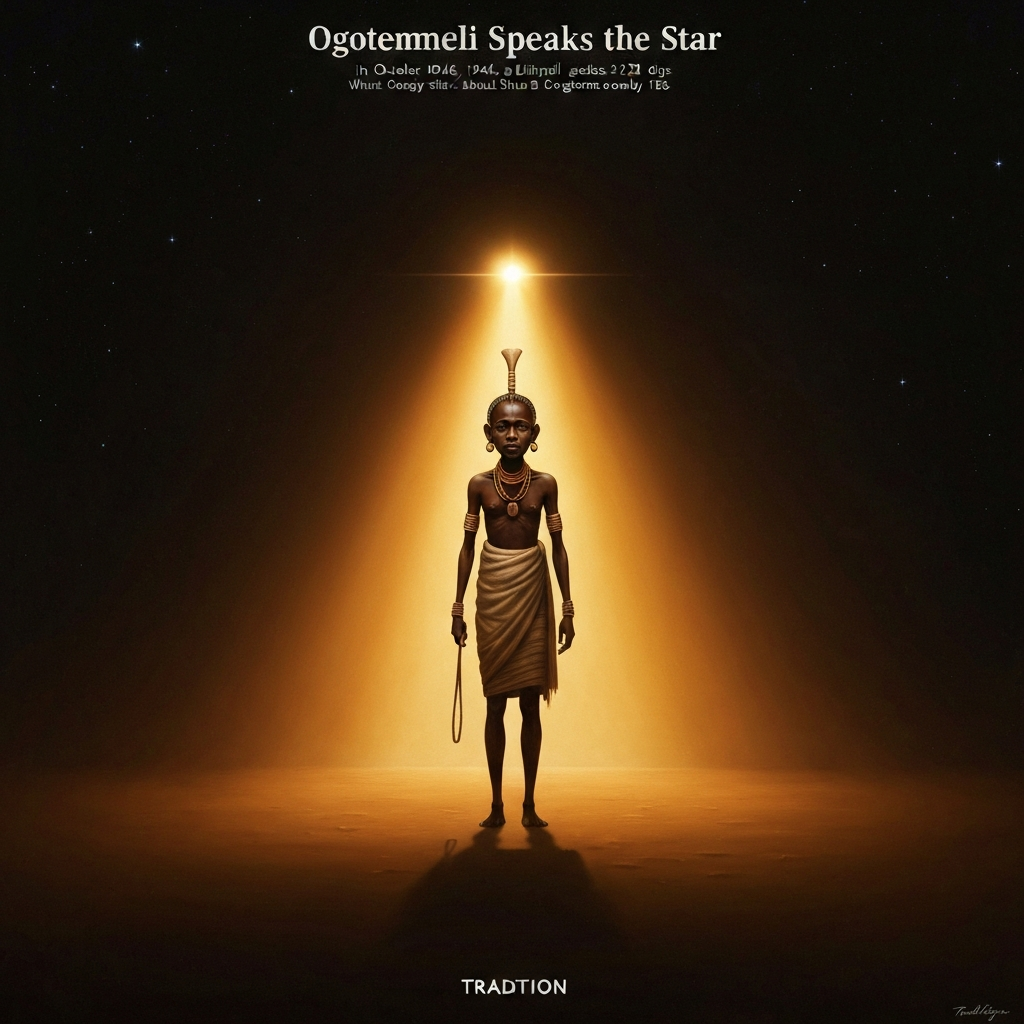
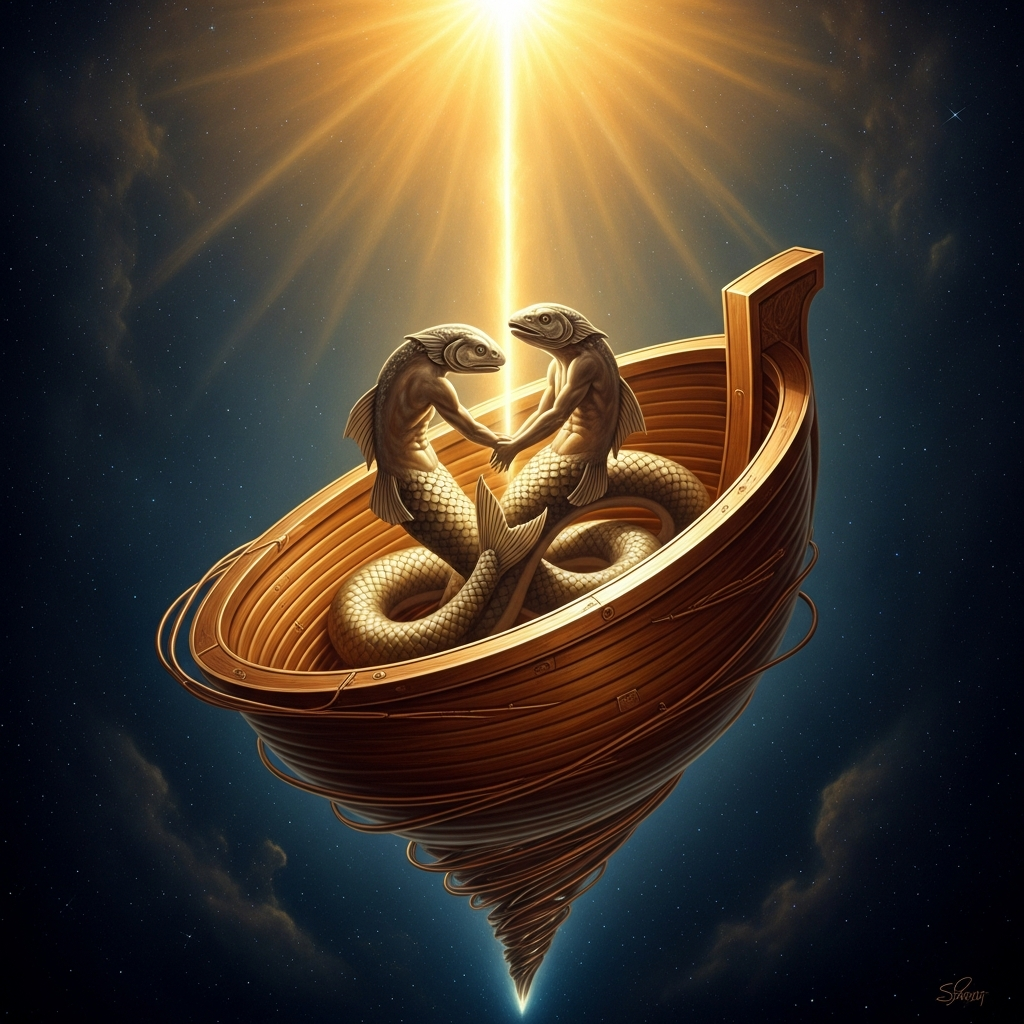
The Nommo Descend in a Cosmic Ark
Primordial time — before the first rains fell on the Bandiagara Escarpment · The Bandiagara Escarpment, Mali — the cliff country of the Dogon people
Contents
The primordial water spirits called the Nommo descend to earth in a celestial ark, bringing with them everything necessary for life — seeds, tools, the knowledge of weaving, and the word itself.
- When
- Primordial time — before the first rains fell on the Bandiagara Escarpment
- Where
- The Bandiagara Escarpment, Mali — the cliff country of the Dogon people
Before the rains, there is only sky and dry earth.
The god Amma has made the world in stages — spinning the cosmic egg, separating earth from sky — but something has gone wrong. The Pale Fox, born from a disordered act of creation, has spoken a word that should not have been spoken. The world is contaminated with that speech. Amma looks at what has gone wrong and decides to send a remedy.
He fashions an ark.
The ark is not what later cultures will imagine: no hull of gopher wood, no pairs of beasts arranged by kind. It is a granary — the same square shape, flat roof, the same proportions the Dogon will always build for storing millet — but suspended in the sky, spinning slowly at the center of Amma’s attention. Inside it, the Nommo prepare to descend.
The Nommo are eight. They are amphibious, half human and half fish or serpent, green and sinuous, their bodies the color of the sky reflected in deep water. They are the children of Amma and are themselves the principle of water. Wherever a Nommo goes, moisture follows. Rain, rivers, the fluid in the womb, the saliva that makes speech possible — all of this is the Nommo’s body, distributed through the world.
They carry everything.
The granary contains the four cardinal directions and the four intercardinal points. It contains seeds of every edible plant. It contains the tools of every craft: the adze, the spindle, the bellows, the hoe. It contains the knowledge of weaving, arranged as a helix around a central post — the pattern of the universe encoded in thread. Most importantly, the granary contains speech. Not mere sound, but the Word as the Dogon understand it — kize uzi, the thin speech of the divine, which carries moisture and fertility wherever it lands.
The ark begins to descend.
The descent is not smooth.
The Pale Fox — the disordered first son, the one born from Amma’s error and always running ahead of proper sequence — sees the ark and wants what is inside it. He grabs a fiber of the granary’s covering as it spirals down. The ark spins on its axis as it falls, the spiral of its descent tracing the pattern that the Dogon say underlies all creation: the helical turn of the cosmic seed, the twist of the weaving thread, the DNA-like structure that makes things replicate themselves.
The ark lands on the rock of the Bandiagara Escarpment.
The rock shatters into the cliffs and plateaus that the Dogon have always lived among, the terraced stone country where the millet grows in improbably thin soil and the granaries are built into the cliff faces. The first Ancestor — a human figure woven into the granary — steps out. The Nommo arrange themselves around him, cardinal and intercardinal, the compass of the world made of water-bodies.
The Ancestor speaks the first word on earth. It is the word for millet. From that word, the first grain falls. From that grain, the first field. From that field, the obligation to work — which is also the obligation to think, because for the Dogon, the cultivation of grain and the cultivation of thought are the same motion.
The Nommo teach in the language of water.
They teach the women to weave: the shuttle passes through the vertical threads as the Word passes through the air, crossing and recrossing, making meaning from intersection. They teach the men to work iron, and the forge becomes the miniature cosmos — the bellows breath is Amma’s breath, the hammer on the anvil is the sound of stars. They teach the children to speak, and speech is understood as the condensation of divine moisture into audible form: you cannot speak without saliva, and saliva is a gift of the Nommo, and so every word spoken on earth is a gift from the water beings in the sky.
The Pale Fox watches all of this from the edges.
He has stolen some speech — incomplete speech, speech without moisture, dry and disordered. With this stolen speech he makes divination possible: the marks he leaves in the sand at night, the tracks of his running, become the instrument through which the Dogon read the future. It is a paradox the Dogon have always understood. The disorder is not pure destruction. The Pale Fox, running through the fields, also fertilizes. The disordered word, read correctly, becomes a map.
The Nommo are never separate from the earth they have descended to.
The rain is their laughter. The river through the cliff country is their body. When a child is born, a Nommo enters the child with its first breath. When an elder dies, the Nommo withdraws, and the elder becomes what the Dogon call a water ancestor — a spirit who lives in the pool at the base of the cliff, available for consultation, part of the moisture that will rise again as rain.
The granary still turns.
In every Dogon village, the granary at the center of the compound replicates the ark: same proportions, same orientation, roof like a flat sky, the four corner posts like the Nommo at the cardinal points. When a woman grinds millet on the grinding stone, she is reenacting the descent. When the weaver throws the shuttle, the crossing threads repeat the pattern the ark made as it spiraled down. The myth is not history. It is the grammar of every action the Dogon perform in a day.
The Nommo are still here. They are in the water in the pot at the door. They are in the morning dew on the millet. They are in the saliva at the tip of the tongue, waiting to become a word.
Echoes Across Traditions
Entities


Sources
- Marcel Griaule, *Conversations with Ogotemmêli: An Introduction to Dogon Religious Ideas* (Oxford University Press, 1965)
- Marcel Griaule and Germaine Dieterlen, *The Pale Fox* (*Le Renard pâle*, Institut d'Ethnologie, 1965)
- Germaine Dieterlen, *Les Âmes des Dogons* (Institut d'Ethnologie, 1941)
- Walter van Beek, 'Dogon Restudied: A Field Evaluation of the Work of Marcel Griaule,' *Current Anthropology* 32(2), 1991