The Eight Ancestors in the World Egg
Before time — inside the primordial egg that contains all potentiality · The cosmic egg — the *aduno tal*, 'the egg of the world'
Contents
Inside Amma's cosmic egg, eight paired ancestor-spirits develop simultaneously — the blueprint of all human society, encoded in the original spinning seed before the world is created.
- When
- Before time — inside the primordial egg that contains all potentiality
- Where
- The cosmic egg — the *aduno tal*, 'the egg of the world'
Eight is the number of completion.
Not seven, as in the Hebrew rest after labor. Not nine, as in the Norse worlds stacked on the cosmic tree. Eight: because four is the number of earth — the four cardinal directions, the four winds, the four corner posts of the granary — and the completion of four is its doubling, which is to say its twinning. Eight is what you get when the earth contains itself as a twin.
Inside Amma’s world egg, before anything exists that can be described as existing, there are eight beings.
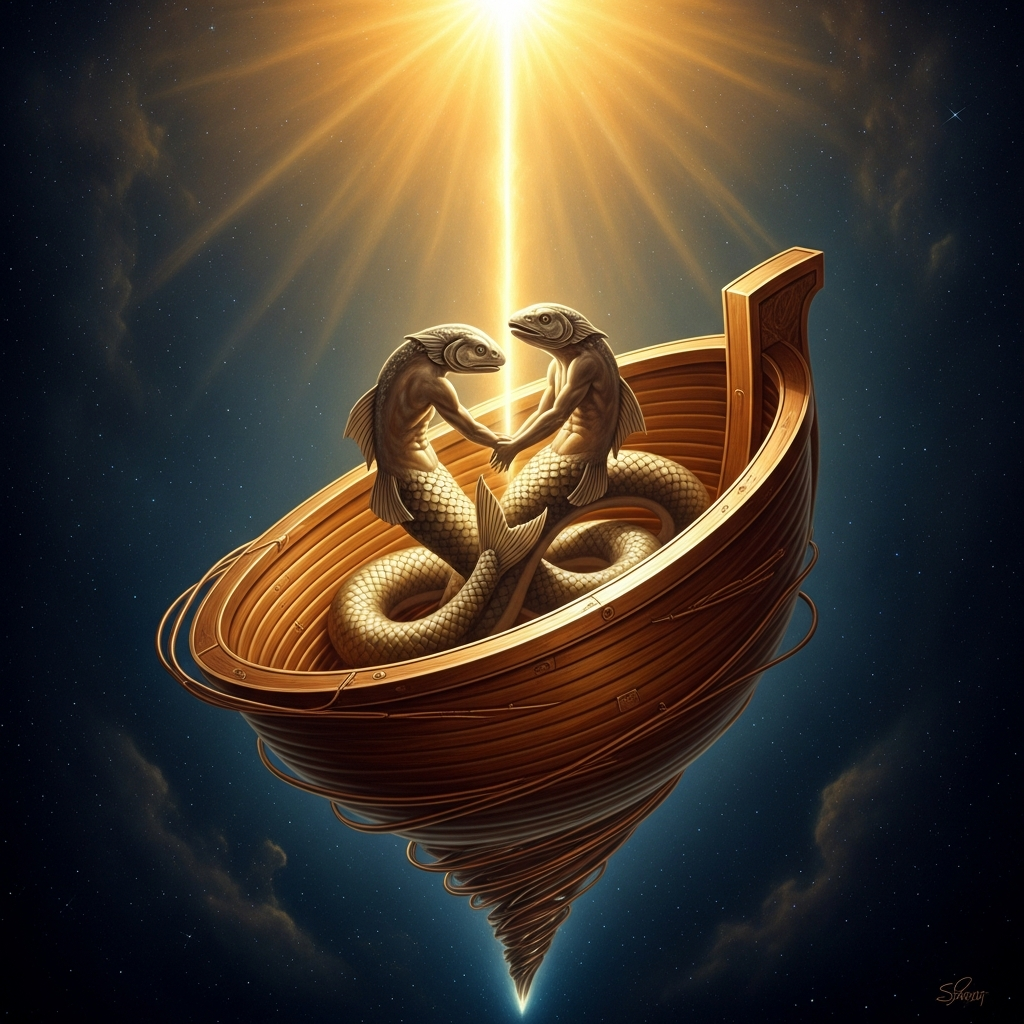
They develop in pairs: male-female inside each individual, then paired with a corresponding being who is its complement. The first four pairs are the four great ancestral lineages of the Dogon people. The second four represent the extension of that pattern into the world of work and knowledge. All eight are aspects of the Nommo — the water-spirit principle — and all eight are simultaneously human in form and amphibious in nature. They breathe water and air. They are at home in both the cosmic and the terrestrial.
The egg spins. The eight develop in stillness at the center of the spinning.
The ideal is twin-ness.
Every Dogon person is ideally born as a twin — not in the empirical sense that every birth produces two children, but in the theological sense that every person has a double: the soul-component that is the other gender of yourself, the one you were before you fell into single form. A twin birth is a lucky birth, a birth that has retained something of the original eight. The children of twin births receive special treatment. The death of one twin requires elaborate ritual to prevent the surviving twin from suffering the same incompleteness that torments the Pale Fox.
The ideal, in other words, is the state inside the egg.
What the egg represents is not just an origin point but an ongoing norm. The Dogon do not look back on the egg as a paradise lost and lamented. They look at the egg as a description of what a properly functioning human community should resemble. A community of eight clans, organized in twin pairs, each fulfilling its complementary function — the smith and the weaver, the farmer and the ritualist — is an attempt to re-create the egg on the surface of the earth.
The granary, which replicates the ark that the Nommo descended in, also replicates the egg. Its eight corners, its four principal posts, the way its two levels mirror each other — all of this is the egg built in wood and mud, maintained in the village, filled with the grain that is the seed of life.
The seventh ancestor is the pivot.
Among the eight, it is the seventh who receives the gift of speech — the full, divine speech, not the dry stolen speech of the Pale Fox. This seventh ancestor is the weaver, and weaving and speaking are the same act: the shuttle crossing the warp threads is the tongue crossing the air, making intersections that produce meaning. The pattern of cloth is a language. The pattern of speech is a weaving.
The seventh ancestor is also the one who teaches the smiths to make the adze and the hoe, the women to spin fiber, the children to understand the seasons. When the seven properly developed ancestors finally descend to earth — they descend after the Pale Fox, repairing what he disrupted — they bring these gifts. The eighth, the last, is the most powerful: the one associated with water itself, with the deepest level of Nommo nature, with the underground cisterns that keep the cliff villages alive during the dry season.
All eight are buried in the earth at death and return as spirit-forces in the soil, the water, the stone of the escarpment. When a Dogon elder dies, the community grieves, but also understands that one of the eight has been returned to circulation — that the ancestor who was a person is now the ancestor who is a force, available in the place where specific prayers and offerings are made.
The egg is also a teaching about time.
The Dogon have a ceremony called the Sigui that comes every sixty years — and sixty years is close enough to the orbital period of Sirius B that the connection is noted, though debated. During the Sigui, the entire Dogon nation spends seven years in a great processional movement from village to village, renewing the covenant with the Nommo and the ancestors. The great carved serpent masks, twelve feet tall, emerge from their hidden places and dance. The new generation is initiated. The old generation passes its knowledge to the young.
After the Sigui, the sixty-year cycle begins again. The eight ancestors are remembered again, in the right order, by the right people, in the right ritual sequence. The world egg is, figuratively, re-entered and re-spun.
The Dogon do not believe history is a line that goes in one direction and eventually ends. They believe it is a spiral — the same spiral the ark made as it descended, the same twist in the weaving thread, the same helix in the fonio seed. The eight ancestors are at the center of every turn of the spiral, present in every repetition, the completion the world is always moving toward and never quite reaching.
Eight is the number of completion.
The world is still spinning toward it.
Echoes Across Traditions
Entities
- Amma
- The Eight Nommo Ancestors
- The Pale Fox (Ogo)

Sources
- Marcel Griaule and Germaine Dieterlen, *The Pale Fox* (Institut d'Ethnologie, 1965)
- Dominique Zahan, *The Religion, Spirituality, and Thought of Traditional Africa* (University of Chicago Press, 1979)
- Walter van Beek and Jan Jansen, *Power and Knowledge in Africa* (Lit Verlag, 2000)