Contents
A West African people living in clifftop villages without telescopes possess detailed knowledge of Sirius's invisible companion star — and say they received this knowledge from amphibious beings who came from the sky.
- When
- c. 3000 BCE to the present — the star knowledge predates modern astronomy by millennia
- Where
- The Bandiagara Escarpment, Mali — the Dogon cliff country, 1,100 meters above the Niger Bend
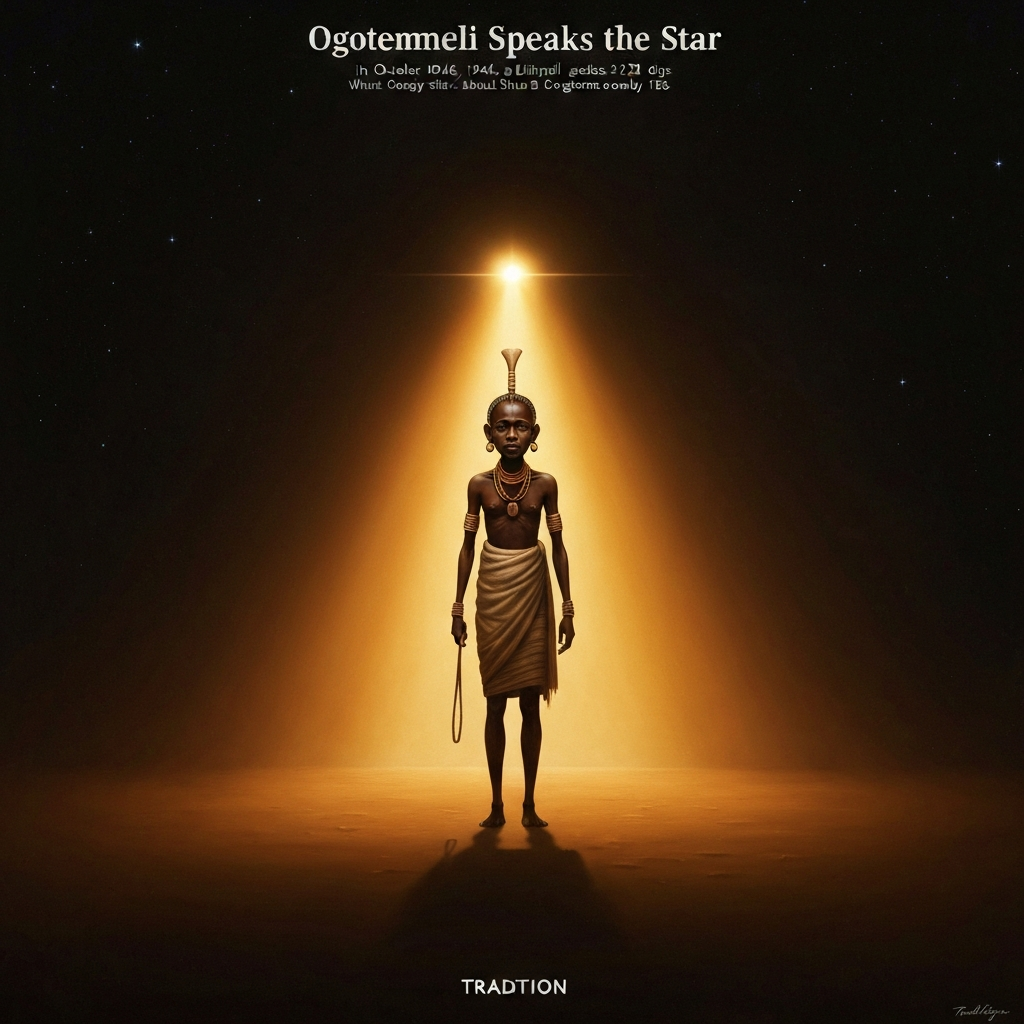
In the 1930s, a French anthropologist named Marcel Griaule sits with a blind elder named Ogotemmêli in the Dogon village of Sanga, in the cliffs above the Niger Bend, and listens to things that should not be possible.
Ogotemmêli is seventy-three years old. He has been blind since a hunting accident in middle age. He has never owned a telescope. The nearest university is several thousand miles away. The nearest published astronomical journal might as well be on another planet. And yet, over thirty-three days of conversation, he describes the star Sirius — which the Dogon call Sigi tolo, the star of the Sigui ceremony — with a precision that will not be confirmed by Western instruments for another generation.
He says there is a second star, invisible, that orbits Sirius. He calls it po tolo — the star of the fonio grain, the tiniest grain the Dogon cultivate. He says po tolo is composed of the heaviest substance in the universe, so heavy that all the men on earth together could not lift a piece of it the size of a fist. He says its orbit around Sirius takes fifty years.
Sirius B — the white dwarf companion of Sirius A, invisible to the naked eye, not directly observed by Western astronomy until 1862, not photographed until 1970 — has an orbital period of fifty years. It is composed of degenerate matter so dense that a teaspoon of it weighs approximately five tons.
Ogotemmêli says the Nommo told them.
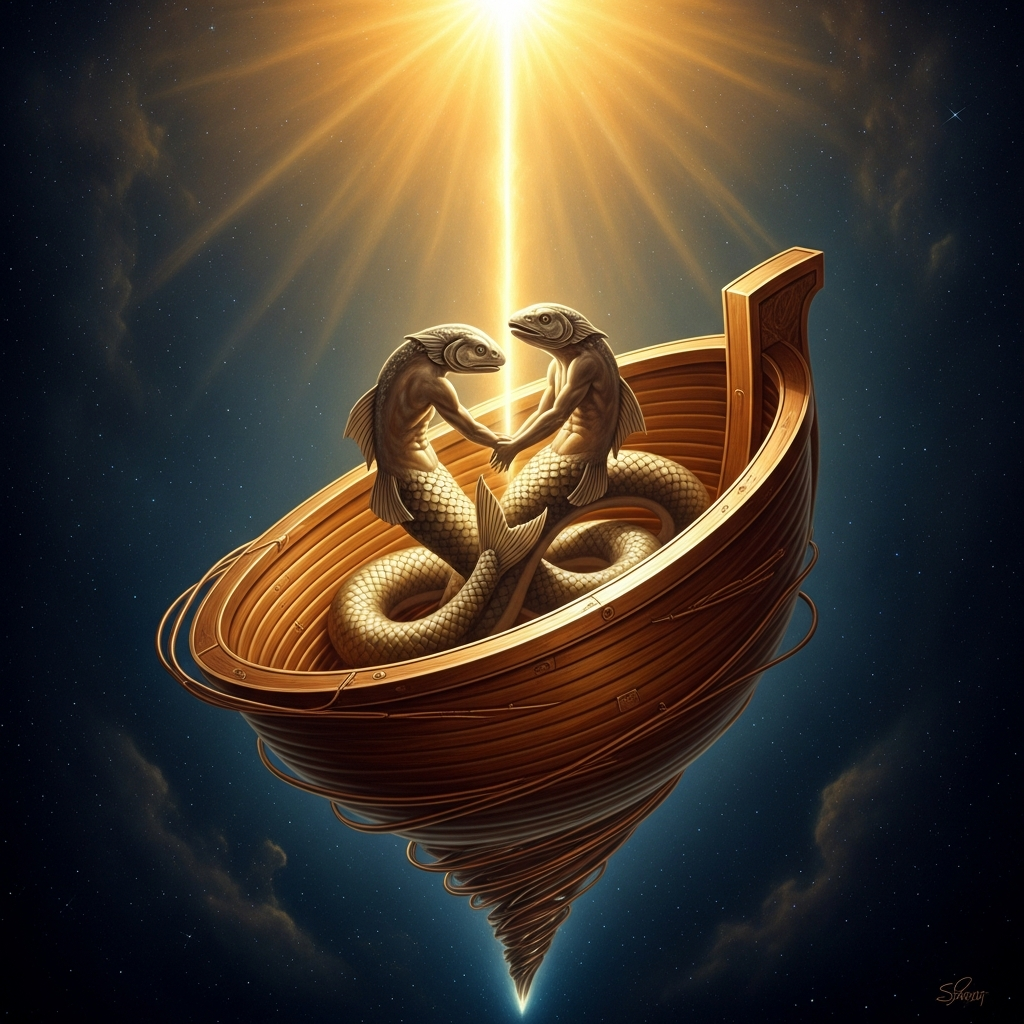
The Nommo are the water beings who descended in the cosmic ark. They are associated with Sirius because Sirius is, for the Dogon, the water star — sigi tolo rises just before the rainy season, announcing the coming of water to the dry cliff country. The Nommo’s home in the sky is the Sirius system. They came from there. They will return there. The knowledge they brought is star knowledge: not astrology, not poetry about stars, but calibrated astronomical fact.
Griaule publishes his findings in 1950, in a paper titled “A Sudanese Sirius System.” He and his colleague Germaine Dieterlen document not only the Sirius companion but also references to a third star in the system (emme ya tolo), Jupiter’s moons, and Saturn’s rings. The paper sits largely unnoticed for a decade, then detonates in 1976 when Robert Temple publishes The Sirius Mystery, arguing that the Dogon received their star knowledge from ancient contact with technologically advanced beings — the Nommo as literal extraterrestrials, the ark as a spacecraft.
The debate that follows is not really about extraterrestrials.
It is about what counts as valid knowledge, and who gets to be a knower.
The critics arrive.
Walter van Beek, a Dutch anthropologist who lived among the Dogon for years in the 1990s, re-interviews the villages Griaule visited and finds that most Dogon have no knowledge of Sirius B. The intricate cosmology Griaule documented seems to belong to a small group of initiated elders who may have been elaborating — or performing — a system they partly learned from Griaule himself, or from earlier contact with European and Arabic astronomical traditions. The Sigui ceremony, which Griaule said revolved around Sirius, does indeed revolve around a star, but van Beek’s informants are vague about which star.
Van Beek’s critique is serious. It does not close the question.
The Dogon initiated elders respond to van Beek’s challenges the way initiated elders everywhere respond to outsiders demanding secret knowledge: with silence, misdirection, and the assertion that of course uninitiated villagers would not know these things. The knowledge belongs to those who have passed through the Sigui ceremony, which happens every sixty years. Van Beek was not there for one.
There is a third possibility that neither Temple nor van Beek fully considers: the Dogon may have received genuine astronomical information through the Arabic scholarly networks that crossed the Sahara for centuries, transmitted through Timbuktu’s famous libraries, encoded in the ritual system because that is how the Dogon preserve important knowledge. Sirius B’s orbital period was calculated by European astronomers in the early nineteenth century from perturbations in Sirius A’s motion, a calculation that preceded the star’s direct observation by several decades. That calculation — and the remarkable density inference — may have reached West Africa through routes that do not require either spacecraft or supernatural revelation.
What the Dogon themselves say is simpler and stranger than any of these explanations.
They say the Nommo came from the sky. They say the Nommo lived in water and came from a star of water. They say the ceremony called Sigui, which involves the entire Dogon nation traveling from village to village over seven years, commemorates the Nommo’s descent and is timed to the cycle of po tolo. They say the knowledge is not observation or inference but gift — the Nommo gave it, it was received, it is kept.
The question of whether this is literally true in the way that Temple claimed is the least interesting question.
The more interesting question is this: how does a people living in clifftop villages without any technology beyond iron, fiber, and fire maintain, across centuries and through the mechanism of ceremony, a piece of astronomical information so specific that it matches the white dwarf companion of the night sky’s brightest star?
The answer may be simply: with great care. With ritual. With the same careful attention to the sky that Egyptian priests encoded in pyramid shafts, that Mayan astronomers encoded in temple windows, that Pacific Islanders encoded in navigational chants. The stars do not require a telescope to matter. They require only someone willing to watch them, night after night, generation after generation, as if life depends on what they say.
For the Dogon, life does.
The rainy season and the dry, the planting and the harvest, the great Sigui ceremony that restores the covenant with the sky — all of this turns on knowing when Sirius rises. The knowledge of the companion star may be an elaboration of that basic attentiveness, or it may be exactly what Ogotemmêli said it was.
The Nommo came from there. They knew.
Echoes Across Traditions
Entities


Sources
- Marcel Griaule and Germaine Dieterlen, 'A Sudanese Sirius System,' *Journal de la Société des Africanistes* 20(2), 1950
- Robert Temple, *The Sirius Mystery* (Destiny Books, 1976, revised 1998)
- Walter van Beek, 'Dogon Restudied,' *Current Anthropology* 32(2), 1991
- Kim Plofker, *Mathematics in India* and related comparative astronomical studies
- Per Holmberg, 'The Dogon and Sirius,' *Archaeoastronomy* supplement to the Journal for the History of Astronomy, 1996