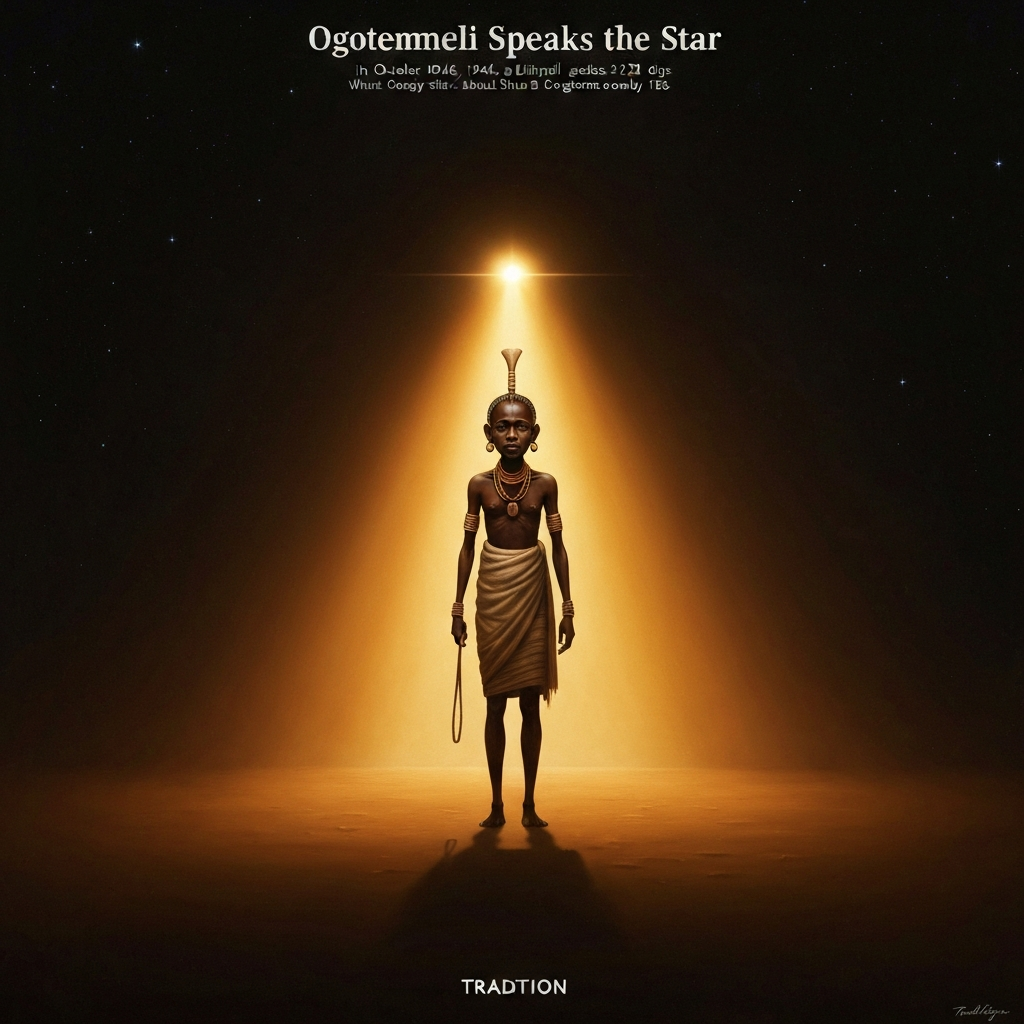
The Pale Fox and the Disorder of the World
Primordial time — before the ordering of creation · The cosmic egg — before the Bandiagara Escarpment existed
Contents
Amma's first son, the Pale Fox, is born from an act of cosmic disorder and becomes the principle of chaos itself — the trickster whose stolen speech makes both trouble and divination possible.
- When
- Primordial time — before the ordering of creation
- Where
- The cosmic egg — before the Bandiagara Escarpment existed
Everything begins wrong.
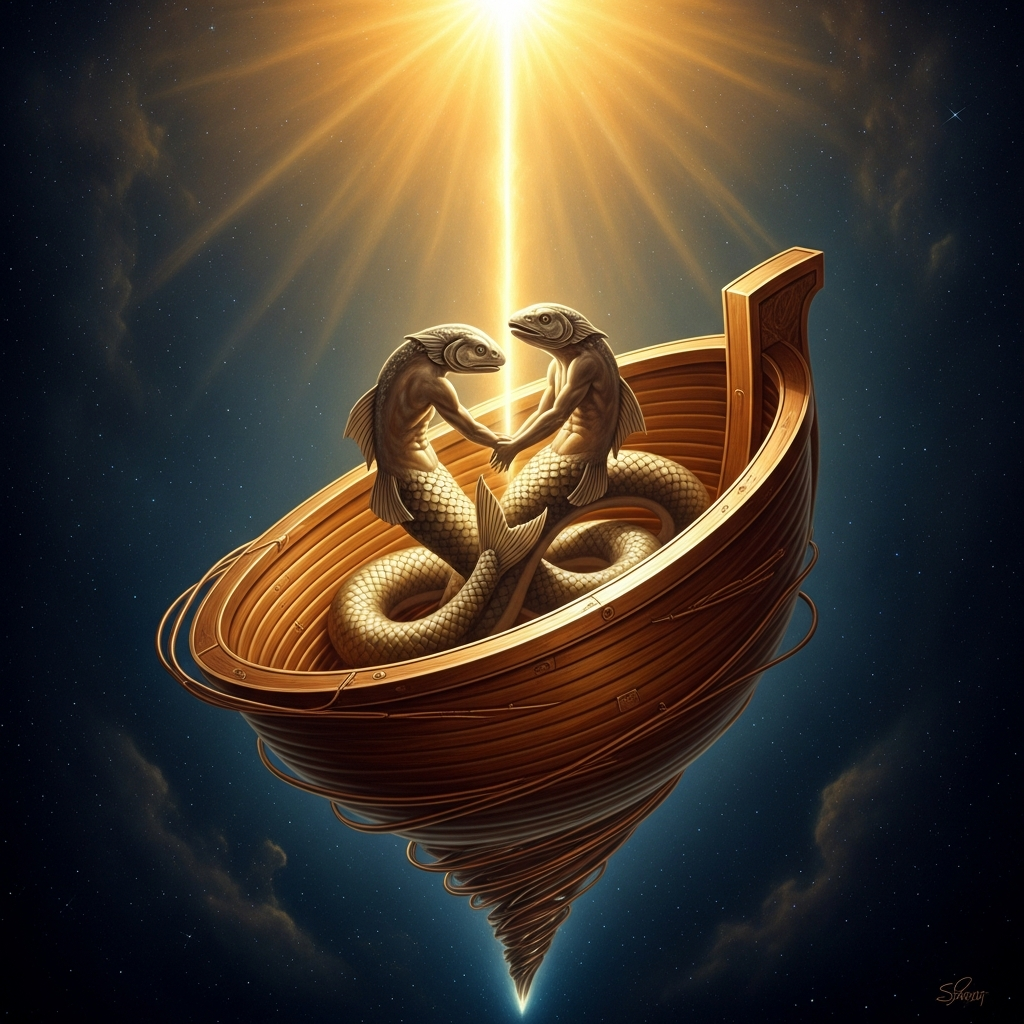
Amma, the creator god, makes the world egg and sets it spinning. Inside the egg, the eight ancestors develop in pairs, twin souls wound together, each male-and-female simultaneously, a model of the perfection that will eventually populate the earth. But one of the eight is impatient.
Ogo is the Pale Fox’s proper name. He is the firstborn, the eldest, and he cannot wait.
While still inside the egg, Ogo tears through the membrane of his placenta and escapes into the cosmos before he is ready, before his female twin has been fully formed inside him. He steals a piece of his own placenta — which is also a piece of the earth, because the placenta of a divine being is the earth itself — and uses it to create a disordered world, a shadow of the true creation, animated by stolen life but fundamentally incomplete.
He returns to find his twin gone. Amma has given her to another, to complete the creation the Pale Fox disrupted by his premature exit. Ogo will spend the rest of eternity searching for his female twin, his missing completion, and never finding her. The running is the chase that never ends. This is why foxes run: they are looking for what was lost before they were properly born.
Amma’s response to Ogo’s disruption is surgical.
He cuts off the Pale Fox’s tongue — or transforms him, depending on the telling. In some versions Ogo is stripped of speech entirely, left with only the capacity for dry, wordless tracks in the sand. In other versions he retains a degraded speech, a speech without moisture, stripped of the divine humidity that makes Dogon language sacred and fertile.
Either way, Ogo becomes the Pale Fox: the pale, dusty animal of the escarpment who moves at night through the millet fields, leaving footprints in the sand plots that diviners will read the next morning.
The divination plots are rectangular patches of sand, drawn and smoothed each evening near the village edge. On them, the diviner scratches signs and questions before nightfall: symbols for the client’s name, the problem, the alternatives. During the night the Pale Fox crosses the plot, drawn by the grain scattered as bait, leaving his tracks through the symbols. By morning his trail through the questions has become an answer. The disorder of his movement, read by trained eyes, becomes the only speech the Pale Fox can still make.
This is the great Dogon paradox of disorder: the Pale Fox is the source of divination, which is to say the source of the community’s access to knowledge about the future. The very disorder that contaminated creation has been converted into a tool of knowing. Amma did not destroy his disordered firstborn. He transformed him into something useful — painful, incomplete, always running — but useful.
The Pale Fox is always in the fields.
At night, if you stand at the edge of a Dogon village on the Bandiagara Escarpment and listen, you may hear movement in the dry millet stalks, the quick three-beat padding of something light and purposeful. This is not metaphor. The Pale Fox is a real animal — the sand fox, Vulpes pallida, the pale fox of the Sahel — and it does cross divination plots, and Dogon diviners do read its tracks. The myth and the practice are the same thing.
But the fox is also the principle that the Dogon call bummo: the movement that cannot be stopped, the restlessness at the heart of creation. The world is not a completed thing, serene and static. It is animated by the Pale Fox’s running. Every time a crop fails unexpectedly, every time a marriage breaks down, every time a healthy child is born blind, the Pale Fox has been through there. Not maliciously — the Fox has no intention. He simply runs. His running disturbs order the way wind disturbs water. The disturbance is not destruction. It is the condition of things.
The Dogon say: if the Pale Fox had never torn through the cosmic egg, the world would be perfect. It would also be finished. Nothing would happen. The eight ancestors would have emerged from the egg in their perfection and the world would have unrolled like a weaving already complete, no surprises, no variations.
The Pale Fox made the world imperfect. He also made it continue.
Every night the diviner smoothes the sand.
He draws the signs with care — the gesture of a man re-ordering what the Fox disordered the night before, smoothing over last night’s tracks to make room for new ones. He scatters the millet and withdraws. The night happens. The Fox crosses. The village sleeps inside the cycle of disorder and reading that has been running since before memory.
In the morning the diviner reads the tracks.
Where the Fox’s right forepaw landed is yes. Where his left forepaw turned the symbol marks hesitation. Where he sat and looked back — and the Fox always looks back, always turns to see what he has left — that is the sign of return, of something that left and will come back. The diviner composes the answer from the chaos of the Fox’s passage the way a reader composes meaning from the randomness of ink marks on paper.
The client listens.
The Pale Fox, by now on the far side of the escarpment, does not know what answer his tracks gave. He is already running toward the next field, looking for the twin he lost before he was born, leaving the trail of his incompleteness across the dark sand of the world.
He runs as he has always run: too fast, too soon, without the moisture that would make his speech true. But his running leaves marks. And the marks, read in morning light by patient eyes, become wisdom.
Disorder serves. It always has.
Echoes Across Traditions
Entities


Sources
- Marcel Griaule and Germaine Dieterlen, *The Pale Fox* (*Le Renard pâle*, Institut d'Ethnologie, 1965)
- Marcel Griaule, *Conversations with Ogotemmêli* (Oxford University Press, 1965)
- Barbara DeMott, *Dogon Masks: A Structural Study of Form and Meaning* (UMI Research Press, 1982)