Contents
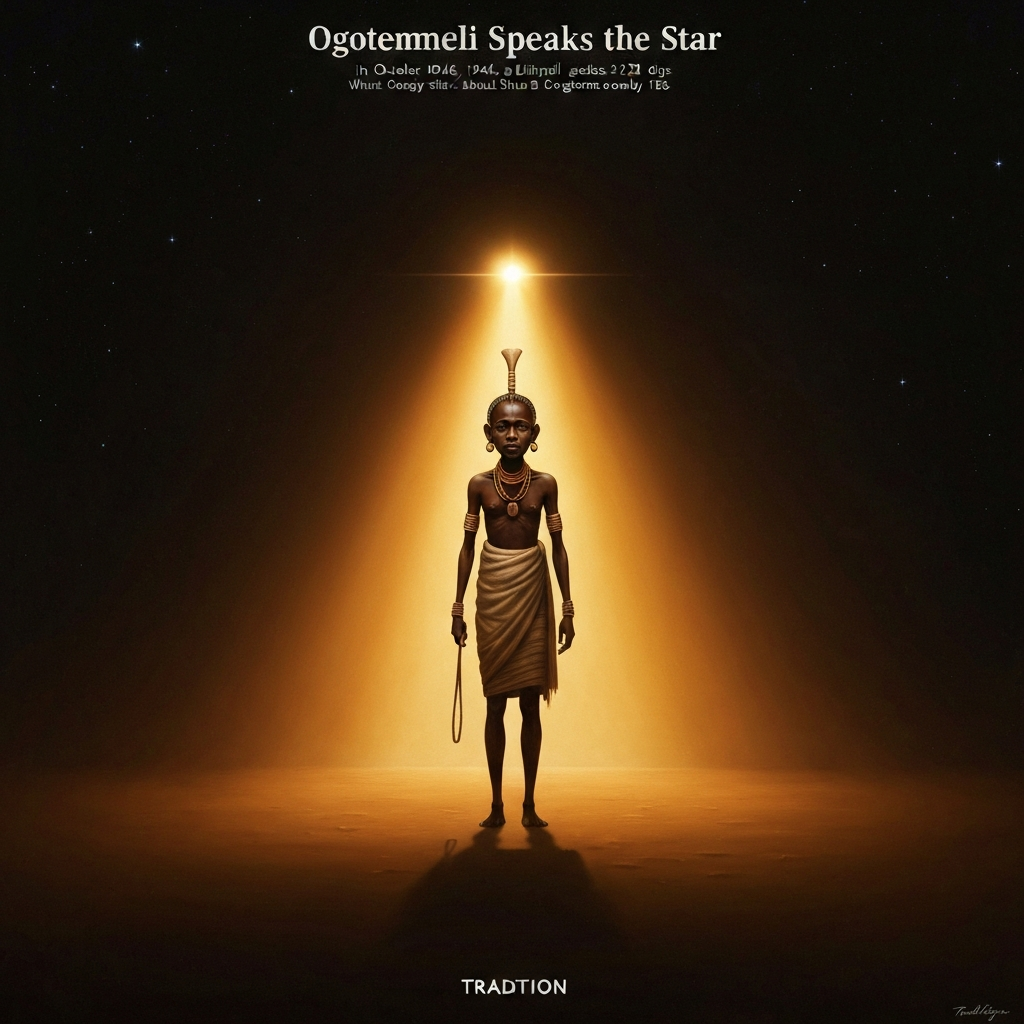
Before light, before form, Amma the creator god speaks — and from the vibration of the divine Word, the first moisture condenses, the egg forms, and the Nommo begin their long preparation to descend.
- When
- Before all time — the primordial silence before the first word
- Where
- The void — before the Bandiagara cliffs, before the Niger River, before the sky
There is no world yet. There is Amma.
Amma is not inside space because there is no space. He is not before time because there is no before. He is the condition inside which space and time will become possible. The Dogon do not say what Amma is made of, because the question assumes a material universe that does not yet exist. Amma simply is. He contains.
Then Amma vibrates.
The word the Dogon use for this first motion is sometimes translated as speech, sometimes as thought, sometimes as will — but these translations import Western distinctions that the Dogon do not make. In the Dogon understanding, to think something and to speak it are the same act. There is no private thought that is then externalized as language. The thought is the speech. The speech is the act. The act is the thing.
When Amma vibrates, moisture appears.
The moisture is the first thing that exists outside Amma.
It condenses from the vibration the way dew condenses from the night air — not manufactured, not willed into existence through effort, but falling out of a change in conditions. The conditions change because Amma spoke. The moisture is the first evidence that something has been said.
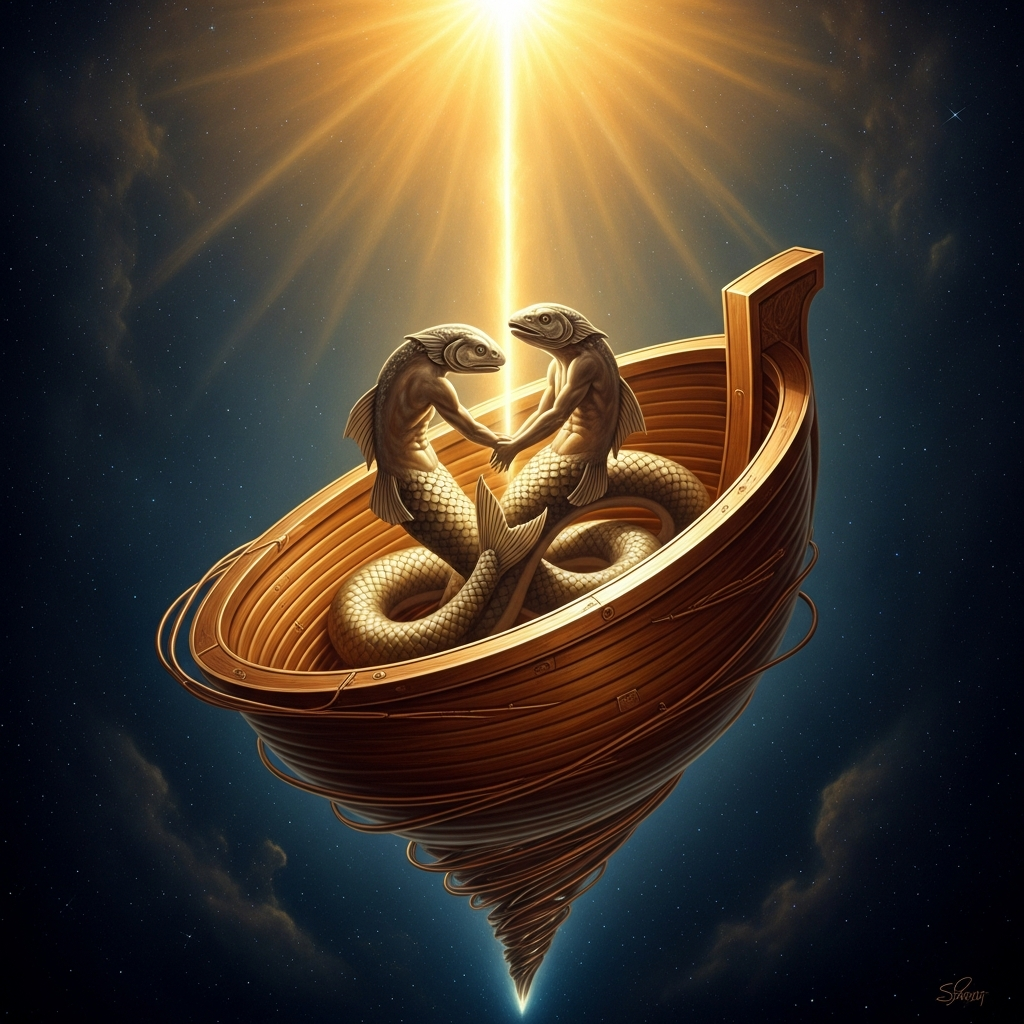
The moisture gathers. It forms a drop. The drop is the cosmic egg — aduno tal — and it is spinning from the first moment, carrying the rotation of the original vibration the way a spinning top carries the force of the initial throw. Inside the egg, the eight ancestors begin to develop.
This is the first act of creation, and it establishes the structure of all subsequent acts. Everything that will happen in the Dogon understanding of the universe will follow this pattern: vibration, then moisture, then form. The rain that comes before the harvest is the same pattern. The speech of the elder that settles a dispute condenses something out of the air of a conflict and forms a resolution. The weaving shuttle that the seventh ancestor teaches is vibration made into form, the loom as the material embodiment of the divine process.
But Amma’s first speech is not his only speech.
The world egg develops and spins, and inside it the eight ancestors grow toward the readiness that will allow them to descend. The Pale Fox tears his way out prematurely, disrupts the sequence, and Amma must speak again — this time a corrective word, a word that addresses disorder rather than inaugurates order.
This second speech is the instruction to the Nommo. Amma tells the Nommo what the world needs to become. He tells them about agriculture and iron-working and weaving and the sacred names of the clans. He gives them the speech to take to earth — the kize uzi, the thin speech, the divine speech that carries moisture within it.
The Dogon distinguish between several kinds of speech.
Kize uzi is the highest: the divine speech, the speech of Amma, the speech that creates. Wherever the divine speech lands, something grows. The elder who has been properly initiated and who speaks with full authority speaks kize uzi — not because the elder is divine, but because the elder has become a vehicle for the divine speech by long discipline and correct living.
Below that is the speech of ordinary humans — adequate, functional, but dry. It describes the world rather than creating it. It communicates rather than transforms.
Below that is the speech of the Pale Fox — speech without moisture, dry and disordered, which does not create but disrupts. And yet even that speech has its use, in divination, in the creative disorder of the world.
Amma does not stop speaking.
This is the Dogon understanding that most distinguishes them from cosmologies in which creation is a completed event. For the Dogon, Amma is still speaking. The world is still being created. Every generation, in the Sigui ceremony, participates in the ongoing speech of creation by renewing the covenant with the Nommo and re-enacting the descent of the granary ark. Every morning, when the diviner smoothes the sand and the Pale Fox crosses it and the diviner reads the tracks and explains to the client what is happening in their life — that is a moment of Amma’s speech arriving at the surface of the world through the disordered traces of his firstborn.
The Dogon attention to speech is therefore not merely cultural or political. It is cosmological. Words matter because words make things. The wrong word in the wrong situation does not merely offend — it corrupts. The right word in the right ritual context does not merely inform — it heals, creates, restores.
The master of speech in a Dogon community is the hogon — the elder who is simultaneously the political and ritual leader of the village. The hogon lives slightly apart from the village, is not permitted to touch the ground except on specific occasions (he must not contaminate the earth’s sacred speech with his footfall), and is the human person most responsible for maintaining the quality of speech that keeps creation going.
He is the one in whom Amma’s speech has been most fully received.
When he speaks at the village council, the community understands that something is being created as well as decided. When he names a child or blesses a granary or settles a land dispute, the vibration that was Amma’s first motion passes through this old man’s body and completes, momentarily, the circuit between the cosmic egg and the dry savanna.
Amma speaks.
The moisture condenses.
Something is made.
Echoes Across Traditions
Entities


Sources
- Marcel Griaule, *Conversations with Ogotemmêli* (Oxford University Press, 1965)
- Marcel Griaule and Germaine Dieterlen, *The Pale Fox* (Institut d'Ethnologie, 1965)
- Dominique Zahan, *The Bambara* (Brill, 1974) — comparative West African cosmology