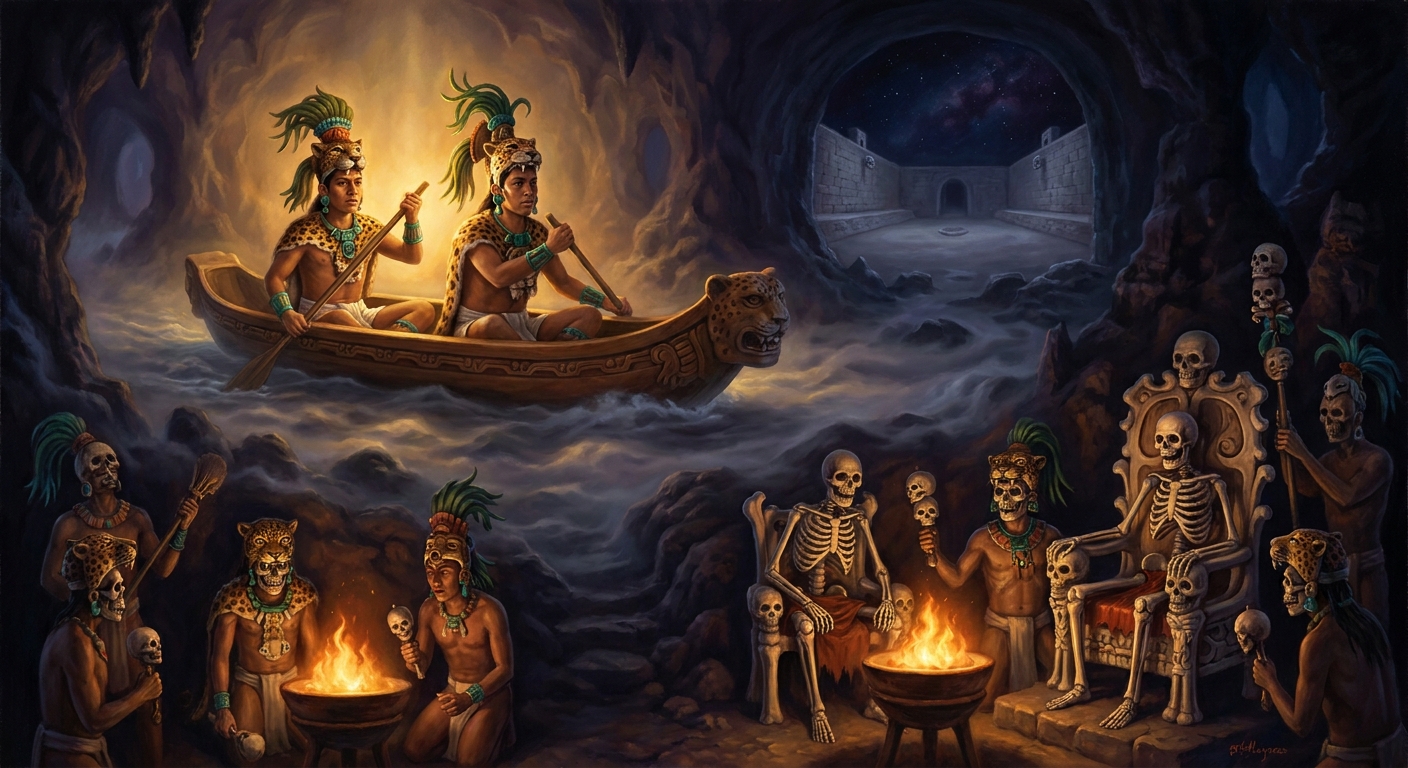
The Hero Twins in the House of Darkness
Mythic time — Classic Maya tradition · The House of Darkness, first of the houses of Xibalbá
Contents
The lords of Xibalbá confine Hunahpú and Xbalanqué in the House of Darkness — a lightless room where the only rule is that their burning pine torches must still be lit at dawn — and the twins outwit the test with fireflies and red macaw feathers.
- When
- Mythic time — Classic Maya tradition
- Where
- The House of Darkness, first of the houses of Xibalbá
The lords of Xibalbá give the twins their first lodging.
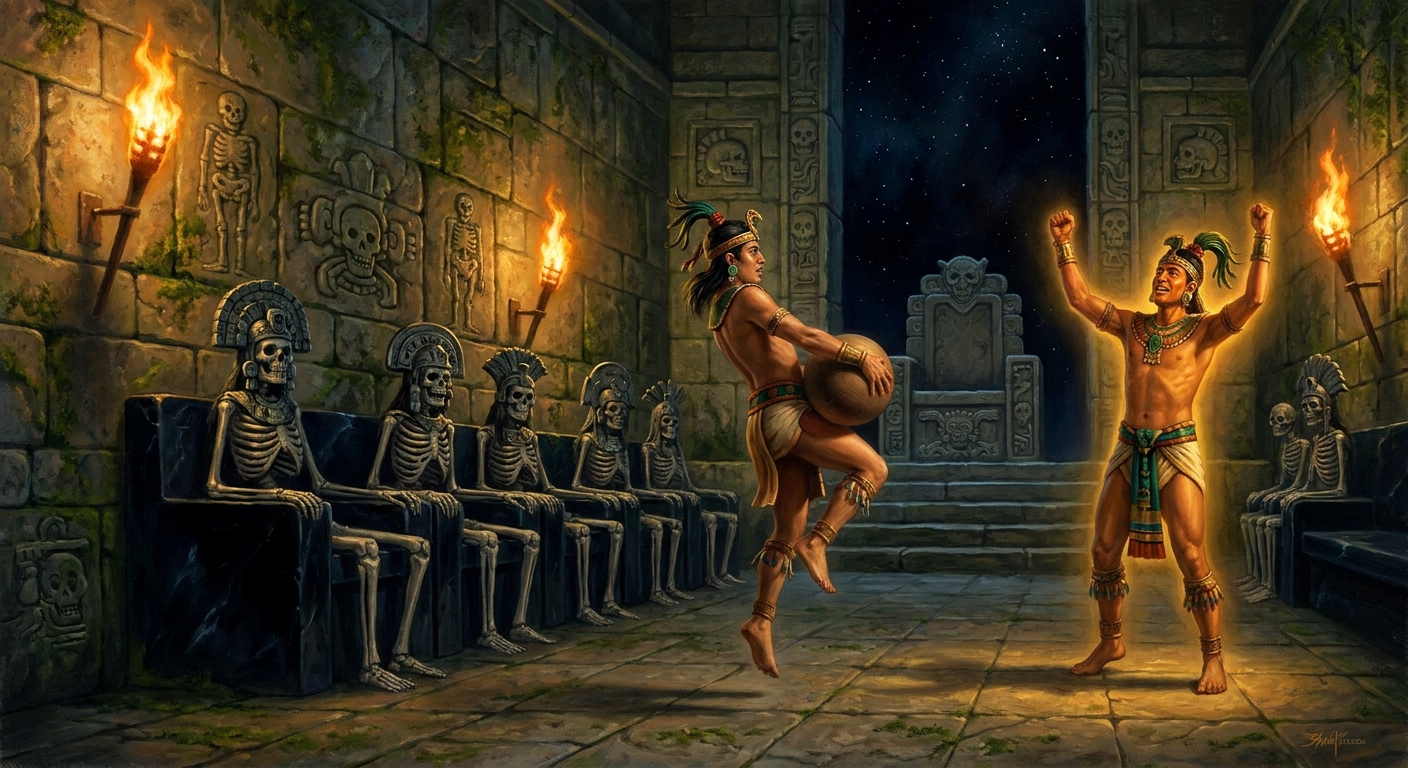
Go into the Dark House and rest there tonight, they say. There are torches and cigars here for your comfort. The messenger delivers two pine torches, burning bright, and two cigars already lit. Return them in the morning. Return them unburned, intact, the same as you receive them.
This is the rule. This is the trap.
The House of Darkness is exactly what its name describes: a house with no light in it, no windows, no cracks in the walls through which the sky might be seen. The torches they are given are the only light. In the dark, with the torches burning, the room feels navigable — a confined space lit by two fires. But the torches are consuming themselves in the burning. By morning they will be stubs, and the stubs are evidence of expenditure, and expenditure is failure, and the lords of Xibalbá have killed other visitors for less.
The twins sit in the Dark House and they do not panic.
Hunahpú and Xbalanqué think.
The test is designed around a misunderstanding they can exploit. The lords of Xibalbá want to see the torches burning at dawn. They want the fire visible. What they have not specified — because they assumed it was obvious — is that the fire must be the same fire they lit, in the same torches, consuming the same wax.
The twins find fireflies.
The macaw’s red tail feather, placed at the end of the pine torch, glows in the dark the color of fire. It does not burn down. It does not consume itself. It gives the appearance of flame to anyone who does not come close enough to feel the heat.
The twins put the tail feathers at the tips of the torches.
They keep the fireflies for the cigars — a firefly at the lit end of each cigar, glowing orange in the darkness with the exact pulse of a burning ember. They sit in the Dark House through the night with their fake torches and their firefly-lit cigars and the servants of Xibalbá who watch from outside the door see, in the cracks of light that escape the walls, the glow of fire. They report to the lords: the torches are burning. They are using the light.
Dawn comes.
The lords summon them to appear. The twins come out of the Dark House carrying the unburned torches, the unsmoked cigars, intact as the moment they received them. The lords are incredulous. They look at the torches. They look at the cigars. They look at the twins.
Why have you not burned them? they say.
The twins do not explain themselves. They hand back what they were given, whole, and they wait.
The lords had expected the torches to be stubs. The torches are not stubs. The test that was supposed to demonstrate the twins’ expenditure — the slow burning down of their resources, their energy, their time — has instead demonstrated their resourcefulness. They have passed the night in total darkness and emerged holding more than they went in with, because they have not spent anything they could not replace.
This pattern will repeat.
Each house of Xibalbá tests a different kind of endurance: cold, razors, fire, blood, bats. Each test is designed to wear the twins down, to make them burn through whatever they have — warmth, composure, flesh, life — until there is nothing left to burn. The lords know that in a long enough siege, any resource runs out. Their usual guests, human beings who wander into Xibalbá through illness or accident, are already depleted by the journey and run out quickly.
The twins have a different relationship to their resources.
They know what the lords are actually measuring. They know how substitution works — how a macaw feather substitutes for flame, how a firefly substitutes for a burning coal, how intelligence substitutes for physical endurance. They cannot defeat Xibalbá by being stronger than death. They can only defeat it by being smarter than what death expects.
In the House of Darkness, with fireflies in the dark, they begin their education in exactly what it takes to return from the place that does not give things back.
Echoes Across Traditions
Entities
- Hunahpú
- Xbalanqué
- One Death
- Seven Death
- the lords of Xibalbá
Sources
- Popol Vuh, translated by Dennis Tedlock (Simon & Schuster, 1985)
- Allen J. Christenson, *Popol Vuh: The Sacred Book of the Maya* (University of Oklahoma Press, 2007)
- Karl Taube, *Aztec and Maya Myths* (University of Texas Press, 1993)