Contents
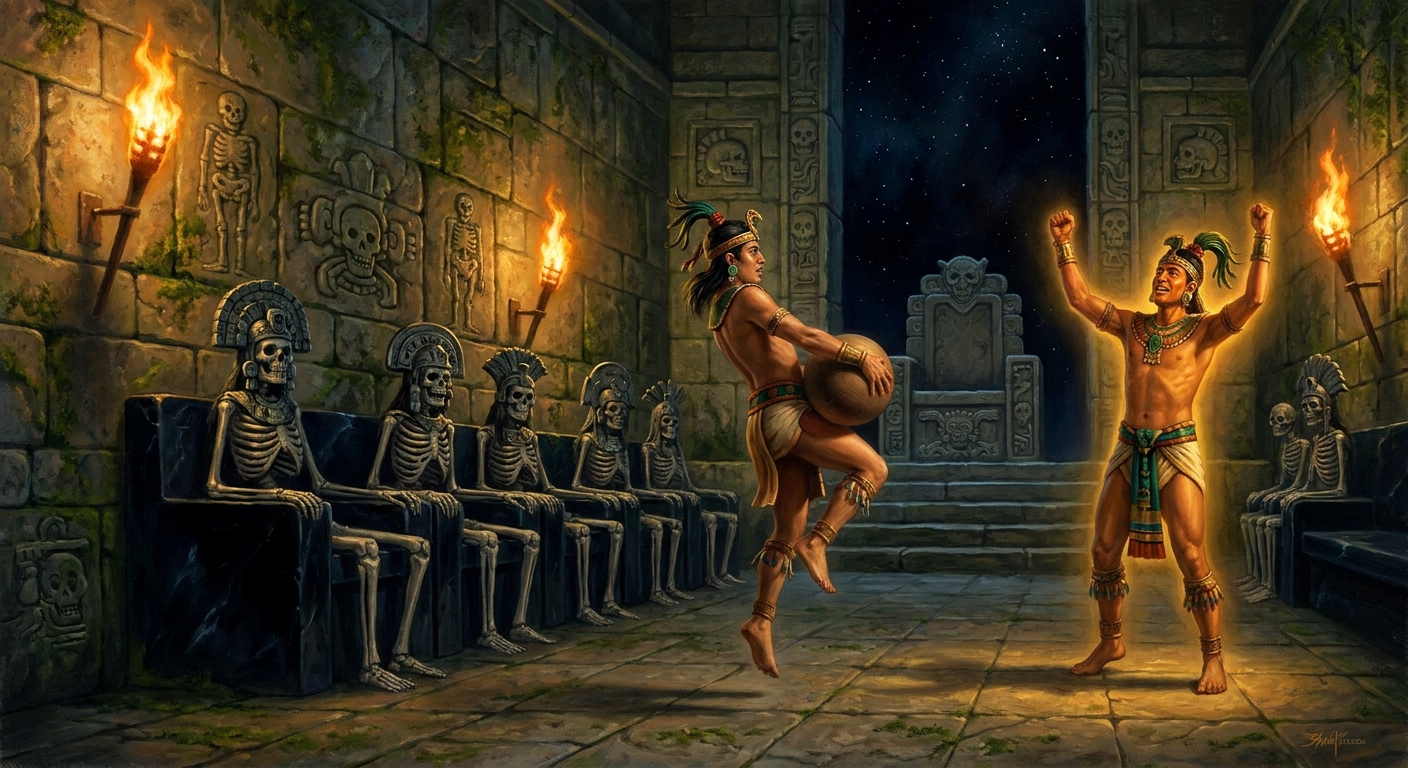
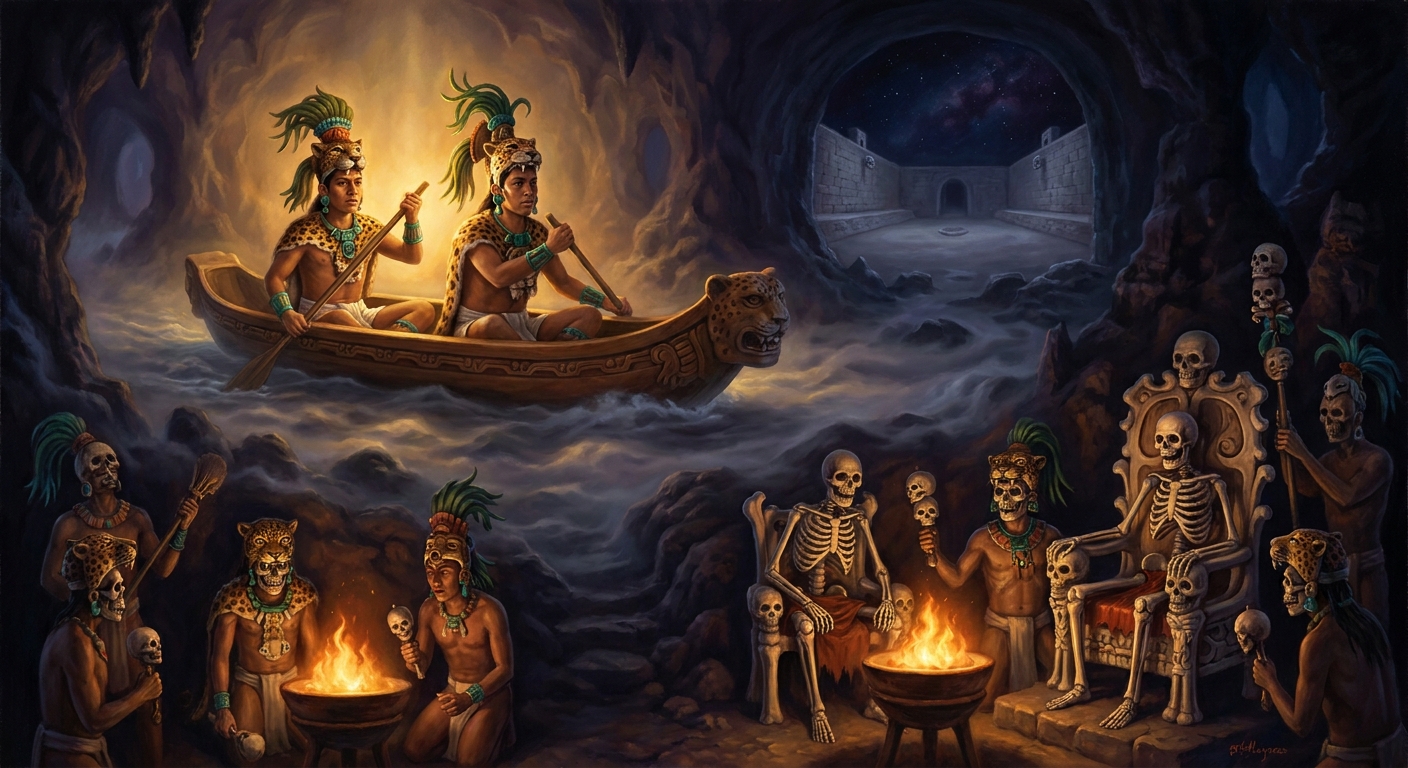
The Hero Twins spend a night in Xibalbá's House of Cold where the ice never melts and the wind has edges, then survive the House of Jaguars and the House of Fire, each time refusing to be destroyed by what the lords send against them.
- When
- Mythic time — Classic Maya tradition
- Where
- The houses of Xibalbá: the Cold House, the Jaguar House, the Fire House, the Razor Wind House
The second house is cold.
Not the cold of a mountain night, not the cold of an unheated room in the dry season — this is a manufactured cold, the cold that Xibalbá keeps as a weapon, the cold that comes from the concentrated absence of warmth, ice and hail piled in the corners and the walls breathing frost. The lords of Xibalbá send the twins into the Cold House and the twins sit down in the middle of it and do not freeze.
How?
The Popol Vuh says they kept themselves alive on pine cones and logs — gathering whatever combustible material existed in the cold room and generating their own heat through the night. When the lords’ servants came to check on them at dawn, the twins were sitting in a room full of spent pine cones, surrounded by the ash of their small fires, warm. The ice in the corners had pulled back a little from the small heat the twins had generated, which was not much, but was enough.
They were not dead. That is the sum of it.
The Jaguar House is next.
This house is full of jaguars — the big cats pacing back and forth across the stone floor, hungry, their breath hot in the enclosed space, their eyes pale in the dark. The Popol Vuh says the twins threw bones to the jaguars, distracting them, giving them what they were going to want anyway, depriving the cats of the anticipation that makes predation into a game.
The jaguars crunch the bones and are satisfied.
At dawn the twins walk out of the Jaguar House intact.
The Fire House does not burn them because they do not permit themselves to be overwhelmed by it — they manage their position within the fire rather than being consumed by it, the way a skilled user of fire moves through a hot landscape by reading where the fuel is thickest. The Fire House scorches them but it does not kill them. At dawn they walk out singed but alive.
The Razor Wind House — the Blade House, as some translations call it — is full of blades that move on their own, cutting the air from all directions, oscillating like the inside of a machine. Here the twins do something direct: they speak to the blades. Do not cut our flesh. Only cut the animals. And the blades, hearing this, sweep the animals that are present but leave the twins alone.
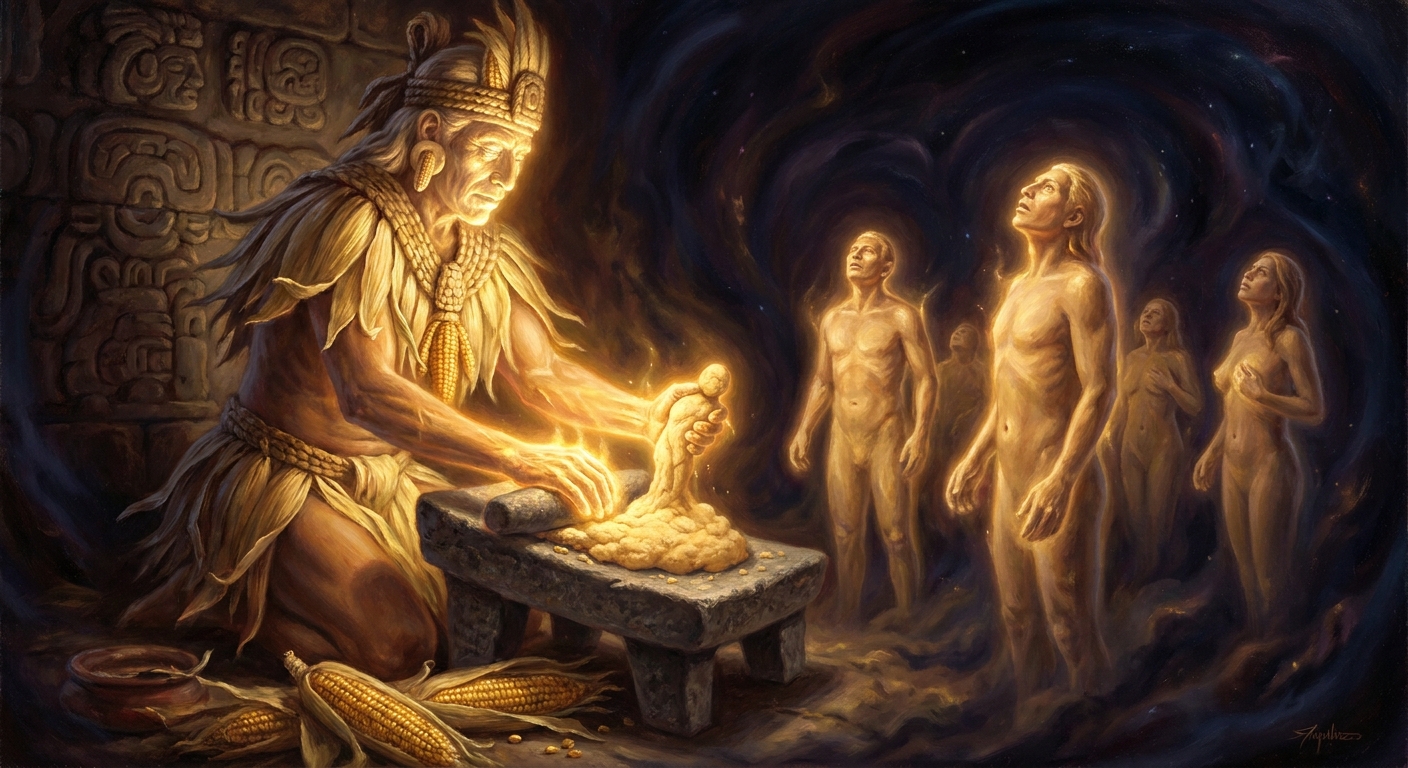
This may seem like a cheat. In the logic of the Popol Vuh, it is not. The blades are objects with agency — the same agency as the pots and grinding stones that rebelled against the wooden people. Objects in this world have awareness and respond to being addressed. The twins address everything: the cold, the jaguars, the fire, the razors. They refuse to treat any element of Xibalbá as mere obstacle. Everything is in some sense a subject that can be negotiated with.
The lords of Xibalbá watch from outside and they are disturbed.
Each morning they expect to find the twins dead or diminished. Each morning the twins emerge from whatever house they were put in, carrying themselves with the same focused calm they had the day before. Nothing is reducing them. The cold did not take their warmth. The jaguars did not take their flesh. The fire did not take their composure. The blades are circling around them without contact.
The lords confer. They are running out of houses.
There is still the Bat House, and the bat house will cause real harm — it is in the Bat House that Hunahpú will lose his head, a loss that will require its own resolution. But the lords of Xibalbá are learning something they had not expected to learn: that there are kinds of endurance that do not depend on being physically impervious to harm, that the twins are not invulnerable but that they are resourceful in a way that invulnerability does not quite describe.
The houses of Xibalbá were built to destroy people.
The twins are not being destroyed. They are being educated.
Each house teaches them something about what Xibalbá is, what it wants, how it reasons. When the ball game comes — and it comes — they will play it with everything they have learned in the cold and the fire and among the jaguars, and the lords will find that the game itself, which they thought they controlled, has been transformed by the players.
Echoes Across Traditions
Entities
- Hunahpú
- Xbalanqué
- the lords of Xibalbá
Sources
- Popol Vuh, translated by Dennis Tedlock (Simon & Schuster, 1985)
- Allen J. Christenson, *Popol Vuh: The Sacred Book of the Maya* (University of Oklahoma Press, 2007)
- David Freidel, Linda Schele, and Joy Parker, *Maya Cosmos* (William Morrow, 1993)