The Ball Game That Decides Who Lives
Mythic time — Classic Maya tradition · The ball court of Xibalbá, the Maya underworld
Contents
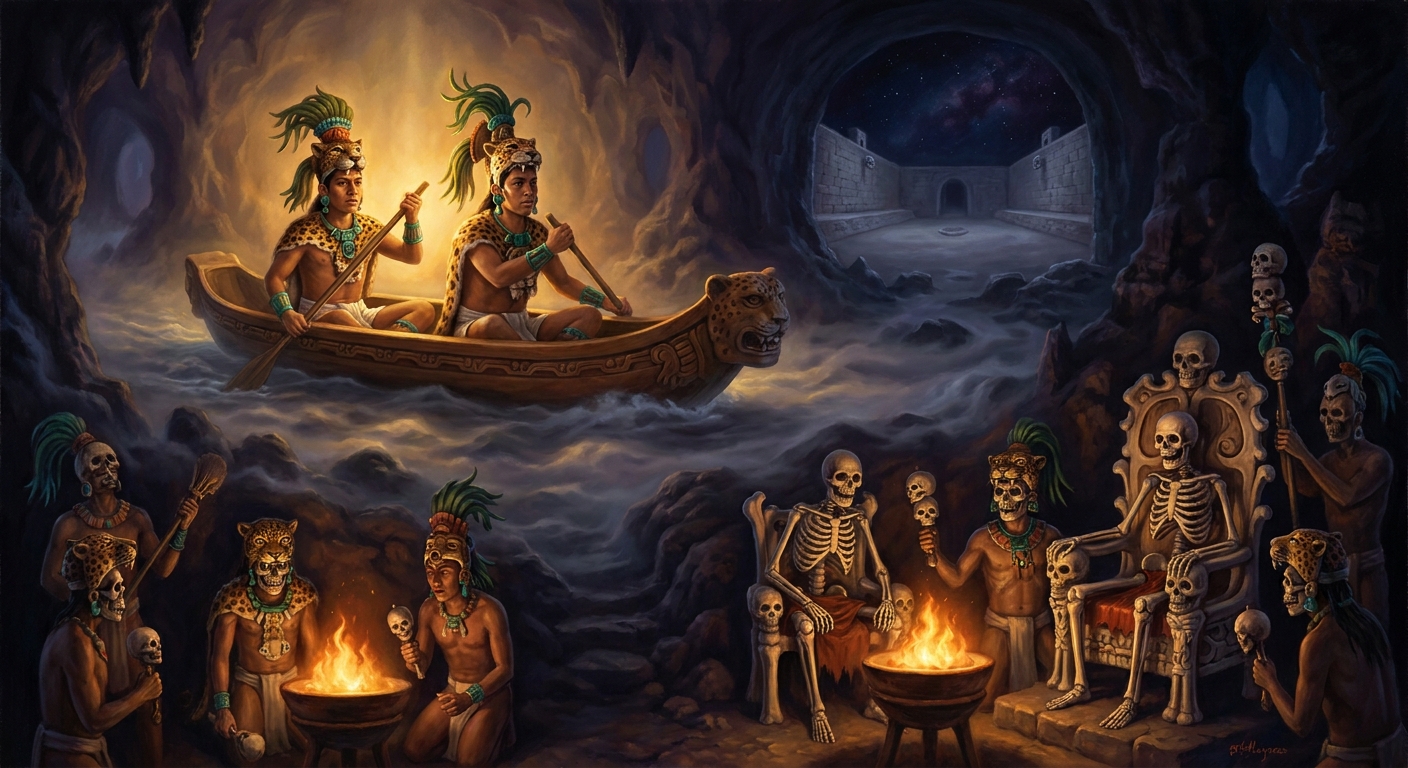
In the ball court of Xibalbá, the Hero Twins play against the lords of death for stakes that could not be higher — and Hunahpú loses his head to the bat Camalotz before a game even begins.
- When
- Mythic time — Classic Maya tradition
- Where
- The ball court of Xibalbá, the Maya underworld
They play during the day.
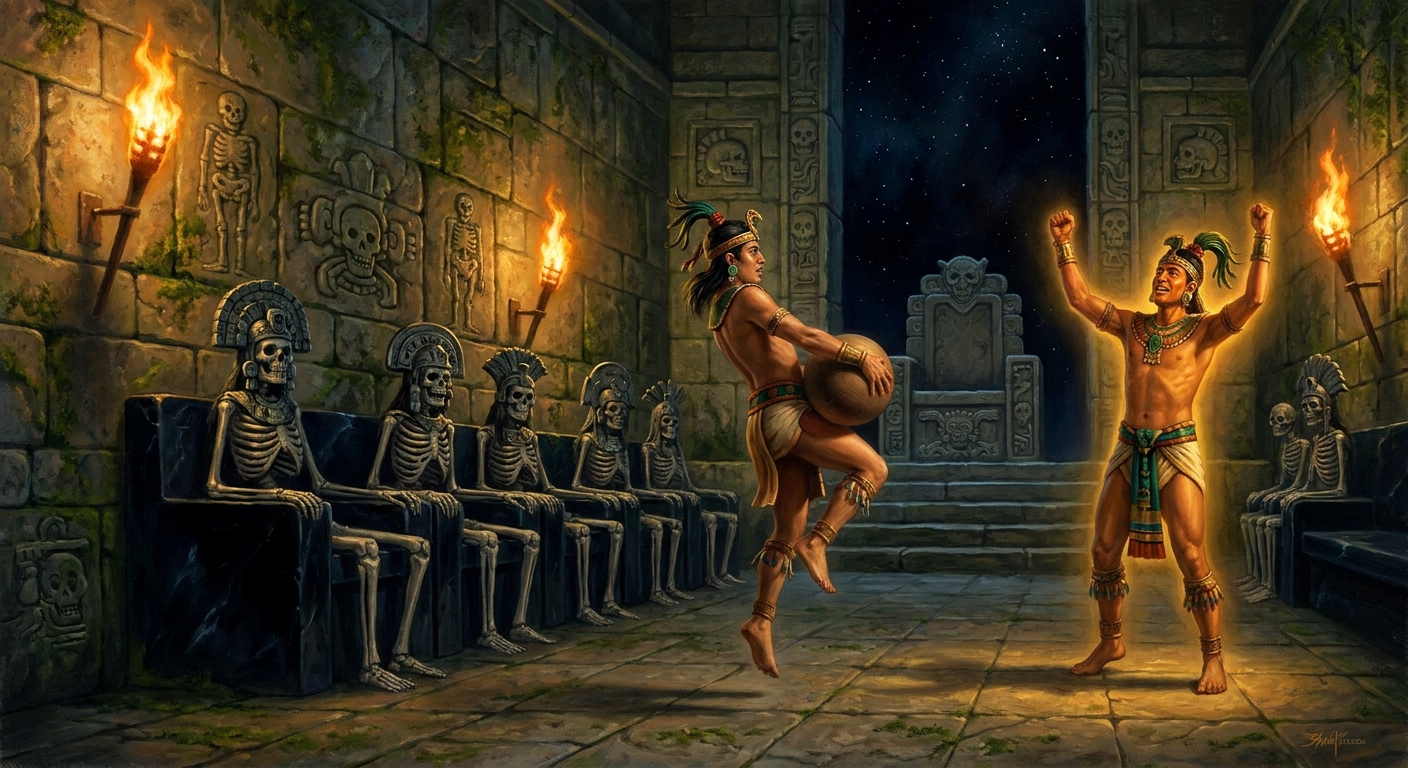
The lords of Xibalbá have their own ball court and their own game, and the stakes of this game are never stated because they do not need to be: the brothers of the previous generation played here and lost, and what they lost was everything. Hunahpú and Xbalanqué play with more skill, more caution, more knowledge of where the traps are. They do not kick the lordly skull that the lords try to substitute for the rubber ball, recognizing the trick before it can work.
But the nights in Xibalbá are still dangerous.
The Bat House is the last of the houses, and it is different from the others. The House of Cold could be survived by generating warmth; the House of Jaguars by feeding the jaguars before they hunger; the House of Fire by managing position. The Bat House is the domain of Camalotz — the Death Bat, the Sudden Bloodletter, whose name in some readings means sudden decapitator — and Camalotz is not a test you pass by being clever. He is a force.
The twins spend the night in the Bat House inside their blowguns, curled inside the tubes, trying to take up as little space as possible, hoping to pass the night in the small protected cylinders without encountering the bat. This works. The night passes. Near dawn, Hunahpú, thinking the bat has quieted, thinks dawn has come, peers out of his blowgun to see if it is safe.
The bat is waiting. In one pass Camalotz takes his head.
The head flies across the Bat House and out through the ventilation hole and lands on the ball court of Xibalbá. The lords of Xibalbá find it there at dawn and they are delighted. They hang it above the ball court to serve as the ball for the day’s game. Now they will surely lose, the lords say. They cannot play without a head.
Xbalanqué is alone in the Bat House with a headless body.
He does not panic. He calls for the animals — a coati, according to some versions, comes in the night, or a turtle, or a squash vine — and they help him find a round object that can substitute for the missing head. A squash. Xbalanqué places it on the stump of his brother’s neck and speaks over it and it becomes, functionally, a head — features and all, the mouth closing and opening, the eyes looking forward.
Hunahpú has a squash for a head.
They go out to play.
The ball game begins and Xbalanqué manages it carefully. He hits the ball in a direction that takes it toward the playing alley, toward the wall, toward a specific point — and a rabbit, stationed there in advance, runs at the moment the squash-head ball hits nearby, making it look as though the ball has bounced far and rolled away into the distance. All the lords of Xibalbá run after the rabbit.
In the confusion, Xbalanqué switches the squash for Hunahpú’s real head — retrieved from wherever Camalotz left it, rolled back across the court, reattached. The real head goes back on the neck. The squash is kicked into the game as a ball. The lords return from chasing the rabbit.
The ball is now a squash. The twins play with a squash.
And then the squash breaks — split by a kick, spilling seeds and white pulp across the stone floor. The lords of Xibalbá do not understand what they are seeing. The ball has come apart. The game is over. The twins have survived the Bat House, survived the decapitation, survived the ball game — and the lords are running out of ways to kill them.
They have one more plan.
It requires the twins to cooperate in their own death, and the twins will cooperate — because they already know, in the way that the Popol Vuh’s logic requires its heroes to know, that what looks like death in Xibalbá is not necessarily death at all. It is transformation. It is what the corn does when it goes underground.
Echoes Across Traditions
Entities
- Hunahpú
- Xbalanqué
- Camalotz
- One Death
- Seven Death
- the lords of Xibalbá
Sources
- Popol Vuh, translated by Dennis Tedlock (Simon & Schuster, 1985)
- Allen J. Christenson, *Popol Vuh: The Sacred Book of the Maya* (University of Oklahoma Press, 2007)
- Michael D. Coe, *The Ball Game in Mesoamerica* in Sport and Society in Latin America (Greenwood, 1988)