How Death Itself Was Tricked
Mythic time — Classic Maya tradition · The ball court and the ceremonial center of Xibalbá
Contents
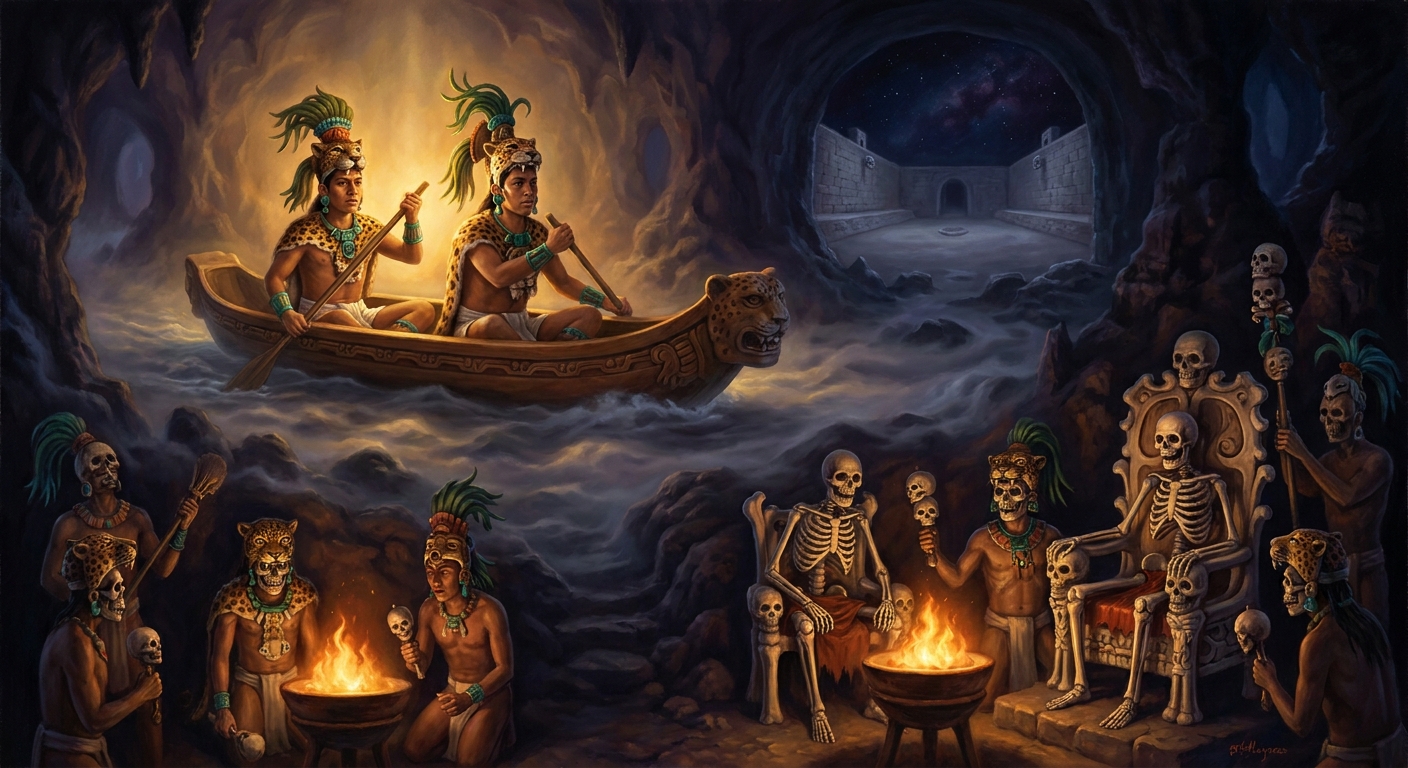
The Hero Twins allow themselves to be killed and burned and scattered into the river — then reassemble, return disguised as wandering performers, dance for the lords of Xibalbá, sacrifice each other and restore each other to life, and finally sacrifice the lords themselves, who do not come back.
- When
- Mythic time — Classic Maya tradition
- Where
- The ball court and the ceremonial center of Xibalbá
The twins know what is coming.
They have survived every house. They have survived the ball game and the decapitation and the squash-head replacement. The lords of Xibalbá are running out of ways to kill them through confinement and terror, so they shift to direct violence: they build a great pit of coals and invite the twins to leap over it. A drinking party first, to loosen their guard, to fill them with fermented drink until their legs are uncertain.
The twins take the drink but they do not lose their clarity. They walk toward the pit. They look at the pit. They know what is in it and what it will do to them. And then they do the thing the lords of Xibalbá absolutely do not expect: they leap into the fire themselves, before they can be pushed.
We have defeated you, they say, and jump.
The lords of Xibalbá grind their bones.
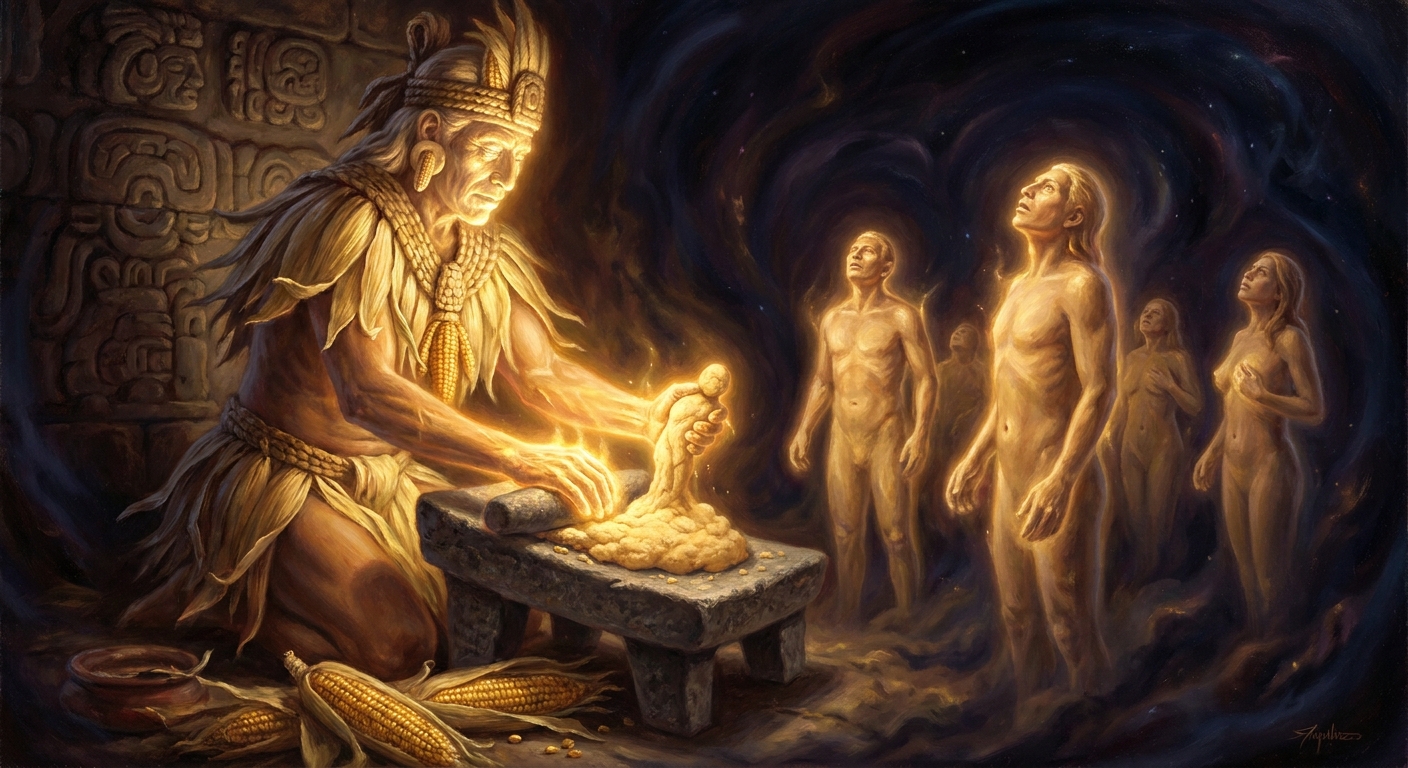
They grind the bones fine as the corn-dough from which the first people were made, and they scatter the powder into a river — the rivers of Xibalbá that no one is meant to cross back. On the fifth day the twins appear in the river as catfish. On the sixth day they grow back into people, disguised as wandering performers, two young men who do miracles for audiences: they burn down houses and they restore them, they sacrifice animals and they restore them, they cut each other’s heads off and they restore each other.
They travel through Xibalbá performing.
The lords of death hear about the performers.
There are people traveling in Xibalbá, the servants report, who do astonishing things — they dance, they perform, they make death reversible. The lords summon them.
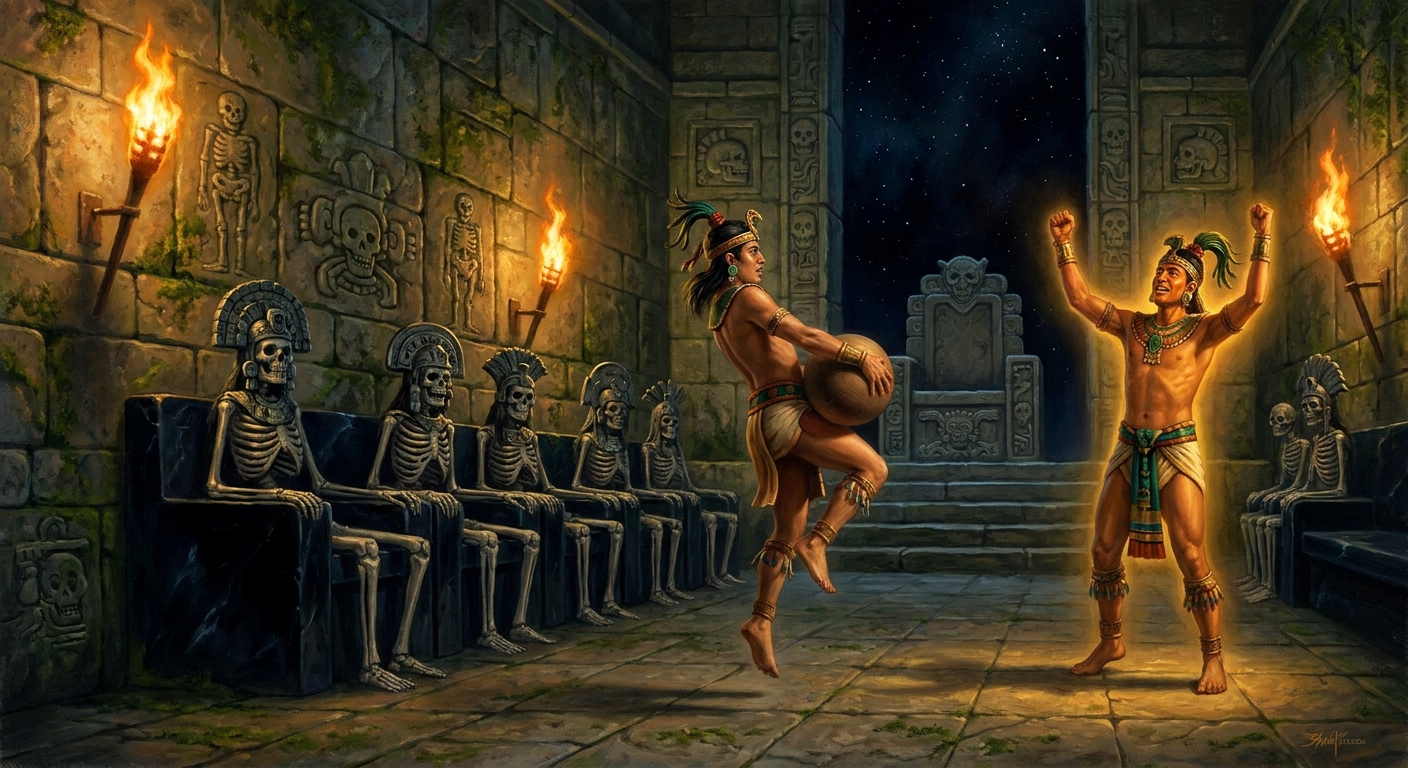
The twins arrive before the lords and they do not identify themselves. They are just performers. They dance the dance of the weasel, the dance of the armadillo, they do the poor dances of road performers, they do the dance of the owl. The lords of Xibalbá are entertained. They ask for more: do the sacrifice.
The twins sacrifice a dog and bring it back to life. The lords are amazed. They sacrifice a man and bring him back. The lords are astonished. Now, say One Death and Seven Death, do it to us. Sacrifice us, and bring us back.
This is the moment the twins have been building toward.
They sacrifice One Death. They sacrifice Seven Death. They do not bring them back.
The other lords of Xibalbá panic. They surrender. They beg. They offer anything. The twins tell them the terms: Xibalbá will exist but it will be diminished. The lords of death will no longer receive great men, great ballplayers, great warriors. They will receive only the wicked, only those who deserve Xibalbá, only the sinners and the violent and those who died shamefully. Xibalbá will no longer have power over all the dead — only a portion.
The lords accept the terms.
The fathers — Hun Hunahpú, buried beneath the ball court — are called for, but they cannot fully come back. The Popol Vuh says: They did want their hearts to arrive at the face of the sky. They were still there below, those who spoke to them, their fathers and uncles. The fathers stay below. Their faces are remembered in the faces of the sons who look up.
The twins rise.
They go up through the levels of the earth and the levels of the sky, and they rise to the highest level, and they become the sun and the moon. Hunahpú is the sun. Xbalanqué is the moon. They take the four hundred boys who died before them and those boys become the Pleiades, the cluster of stars that signals the planting season.
Everything in Xibalbá that tried to end them has instead become the occasion for their transformation. The cold and the fire and the jaguars and the bat and the ball court and the fire pit — none of it stopped them. All of it refined them. They arrive in the sky not despite what happened below but because of it.
The corn rises. The sun rises. Death has been tricked.
Echoes Across Traditions
Entities
- Hunahpú
- Xbalanqué
- One Death
- Seven Death
- the lords of Xibalbá
Sources
- Popol Vuh, translated by Dennis Tedlock (Simon & Schuster, 1985)
- Allen J. Christenson, *Popol Vuh: The Sacred Book of the Maya* (University of Oklahoma Press, 2007)
- Markman and Markman, *The Flayed God: Mesoamerican Mythological Tradition* (Harper, 1992)