Hunahpú and Xbalanqué Rise Into the Sky
Mythic time — the era just before the current sun begins; Classic Maya tradition · The levels of the sky above Xibalbá; the horizon where the sun first rose
Contents
Having defeated the lords of Xibalbá, the Hero Twins ascend through the layers of the cosmos and become the sun and moon — their journey below the earth the condition of their blazing return above it.
- When
- Mythic time — the era just before the current sun begins; Classic Maya tradition
- Where
- The levels of the sky above Xibalbá; the horizon where the sun first rose
They address their fathers first.
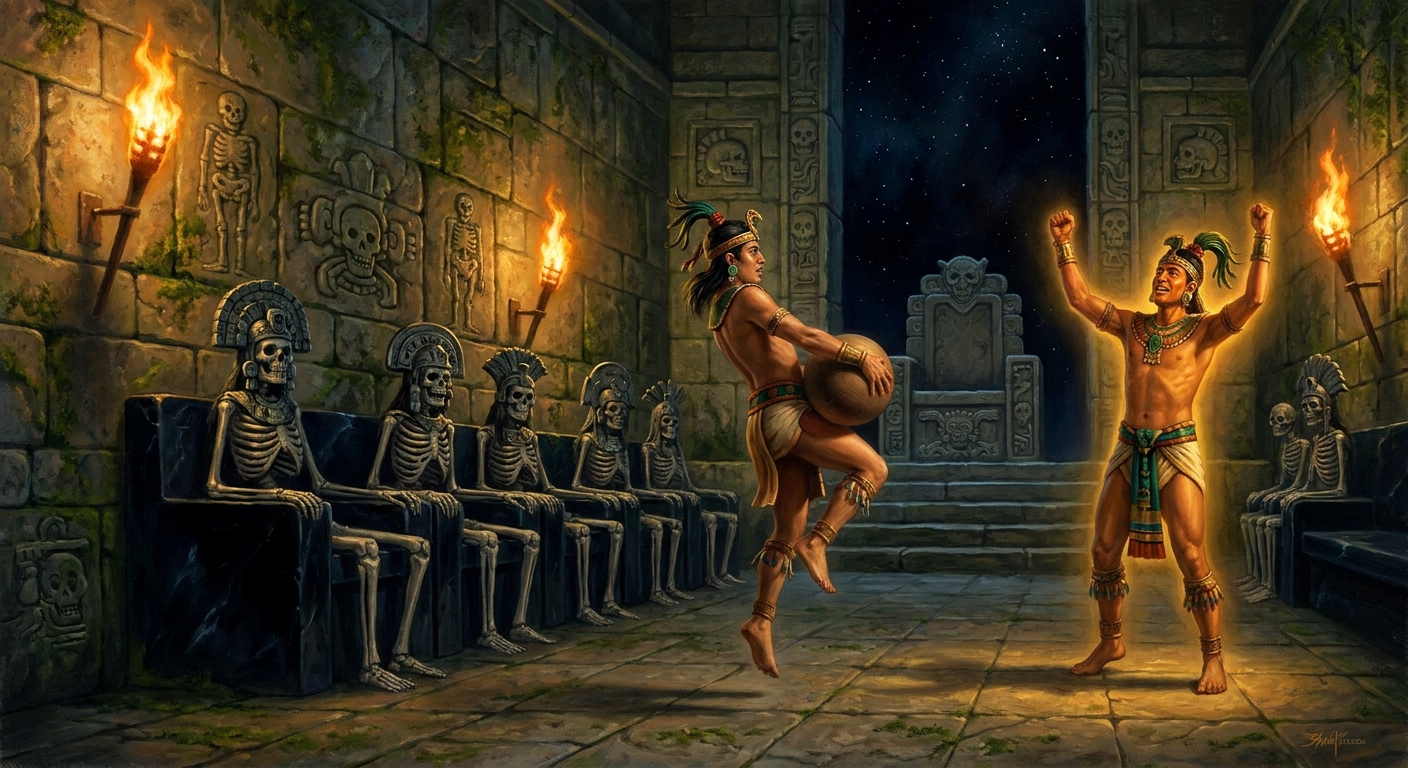
Before ascending, Hunahpú and Xbalanqué go to the place beneath the ball court where Hun Hunahpú and Vucub Hunahpú are buried. They speak to them. They tell them what has been accomplished. They invite them to come up, to come out, to rejoin the world above.
But something will not let them fully return.
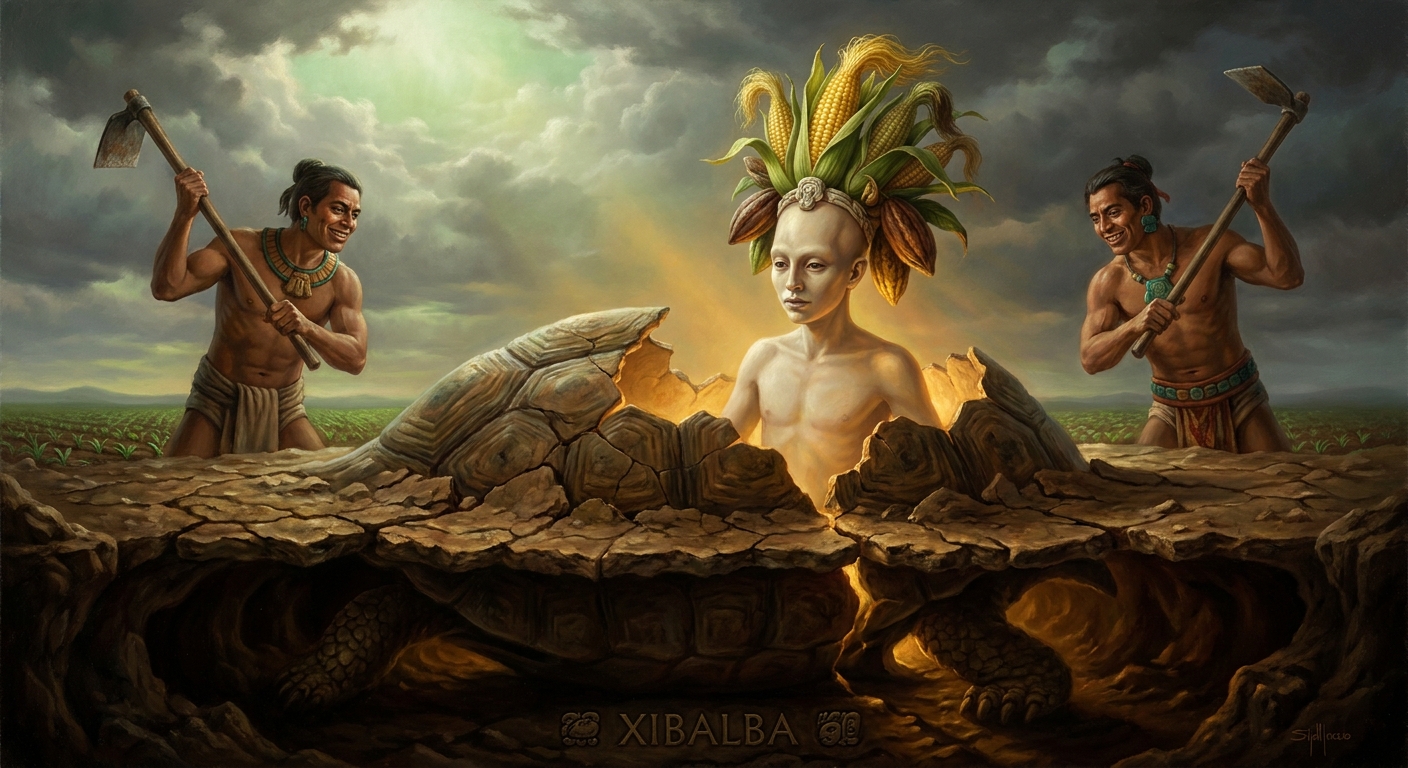
The fathers cannot leave Xibalbá entirely — the Popol Vuh says their hearts were consoled, that their faces were honored from that time on, that people called on them. Hun Hunahpú becomes a kind of patron of the ball court, of the corn that rises from below, of the cycle that keeps the dead connected to the living. His face is the face of the maize plant. He is there in every ear of corn that is harvested and every kernel that is planted. He is below and he is the condition of what is above.
It is not possible for them to come up by themselves, the twins say, but they can be honored.
They leave him honored.
The twins rise.
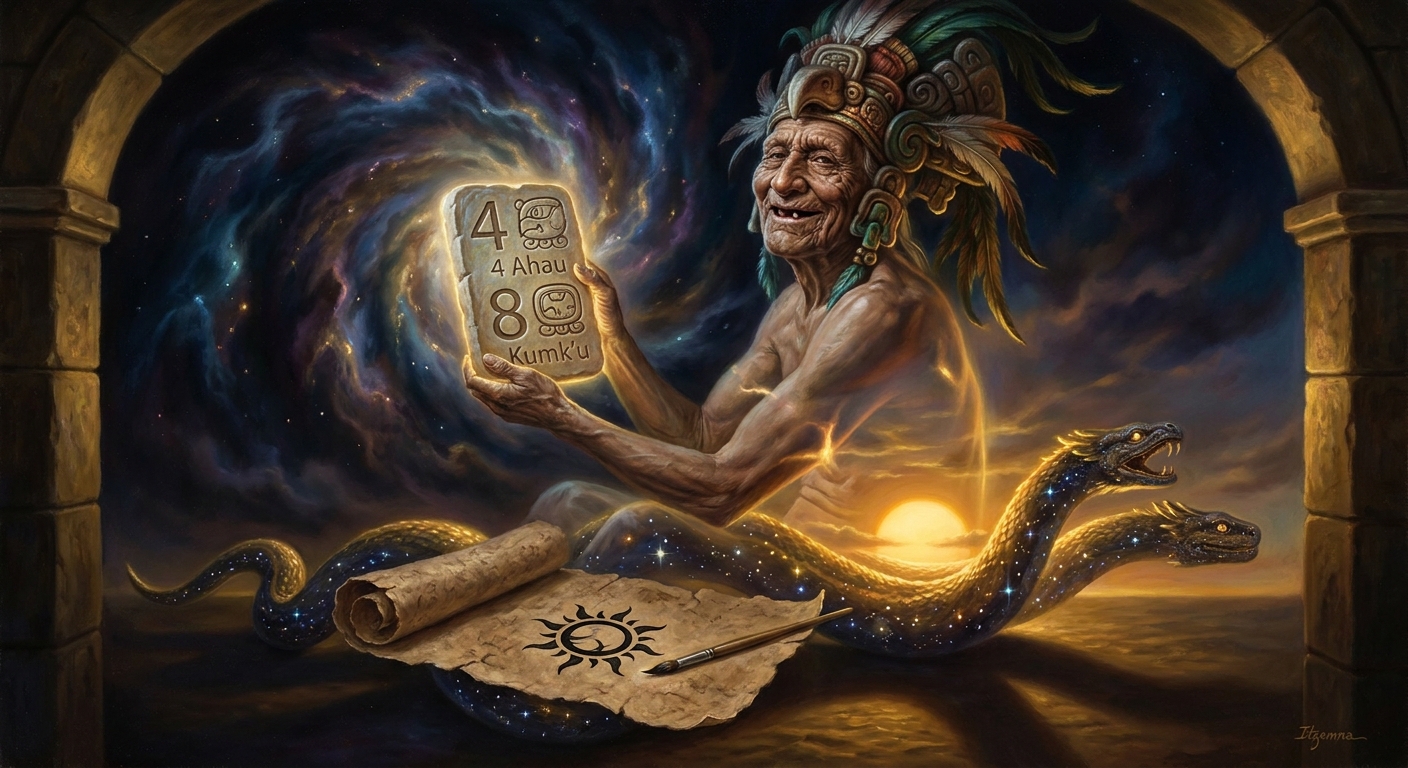
The ascent is not described in detail in the Popol Vuh — the text moves quickly from the defeat of the death lords to the moment of arrival in the sky, because what matters is not the mechanics of the journey but the transformation at its end. Hunahpú becomes the sun. His face is round and blazing. He moves across the sky from east to west each day, and his passage is not a simple passage — it is a repetition of everything he endured below, a daily re-enactment of the journey through Xibalbá, the nightly descent, the morning return.
Xbalanqué becomes the moon.
The four hundred boys — the young men killed by Zipacná earlier, buried under the mountains, drowned in drink — become the Pleiades. They are there in the dry season sky before planting, their rising marking the time to prepare the fields. They are the companions of the corn. They are the boys who died first and are now the signal for when new things can begin to grow.
The world that receives them is not yet fully organized.
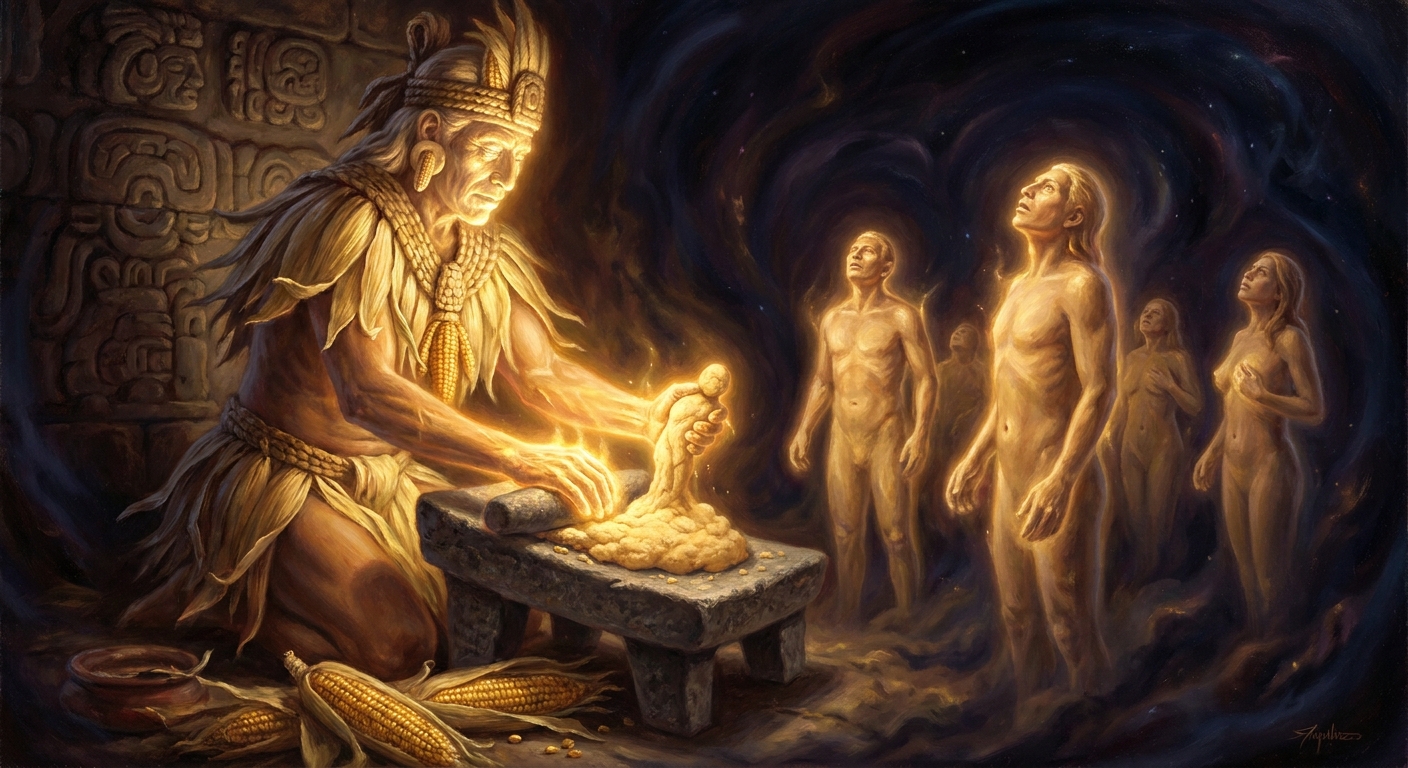
The four corn-people — the first true humans, shaped from white and yellow corn by Xmucane — are still waiting in the darkness before the first dawn. They have been waiting since they were made, praying, burning copal, facing the directions. They are the people who will be the ancestors of the Quiché Maya, and they are waiting for the sun.
When the sun first rises over the mountains, all the animals cry out together: the foxes and coyotes, the parrots and the jaguars, all raise their voices in the direction of the light. The four first men weep. They burn copal incense before the sun with trembling hands, because the light they have been told about and the light they are now seeing are different things, and the difference between knowing and seeing is one of the things that makes them fully human.
The sun rises. The moon rises. The Pleiades rise.
The ball game that began when the lords of Xibalbá noticed the sound of play on the court above them and sent their messengers up through the earth has concluded in the transformation of the players into light. The heavenly bodies are what the ball game makes. The cosmos is organized around competition and survival and the willingness to enter the dark and come back.
Hunahpú in the sky is the same being who sat in the House of Darkness with a firefly at the tip of his cigar, waiting for dawn.
He is still waiting. He is still returning.
Every morning the proof.
Echoes Across Traditions
Entities
- Hunahpú
- Xbalanqué
- the 400 Boys
- Hun Hunahpú
Sources
- Popol Vuh, translated by Dennis Tedlock (Simon & Schuster, 1985)
- Allen J. Christenson, *Popol Vuh: The Sacred Book of the Maya* (University of Oklahoma Press, 2007)
- Anthony F. Aveni, *Skywatchers of Ancient Mexico* (University of Texas Press, 1980)