The Tuatha Dé Danann Arrive in Ireland
Mythological prehistory; texts compiled c. 11th–12th c. CE; traditional date c. 1700 BCE · Ireland, arriving from the four mysterious northern cities
Contents
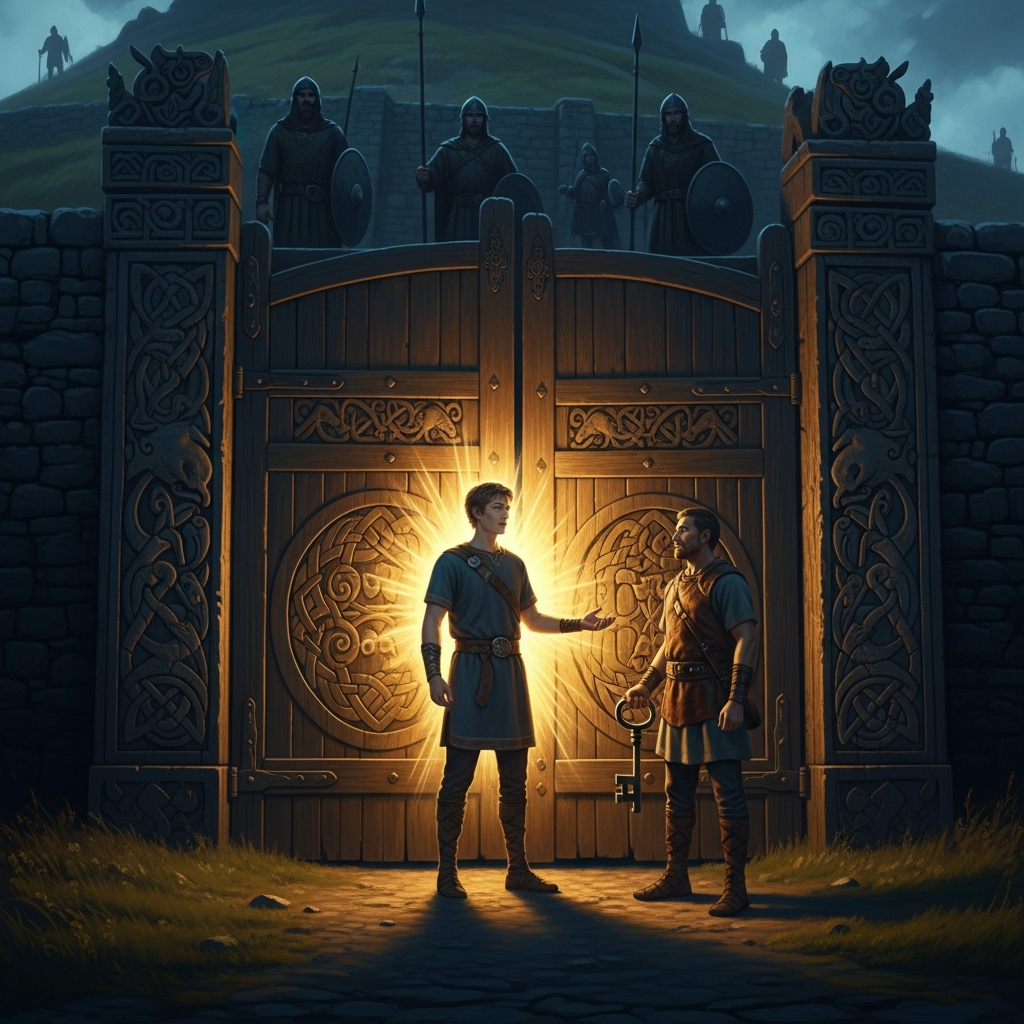
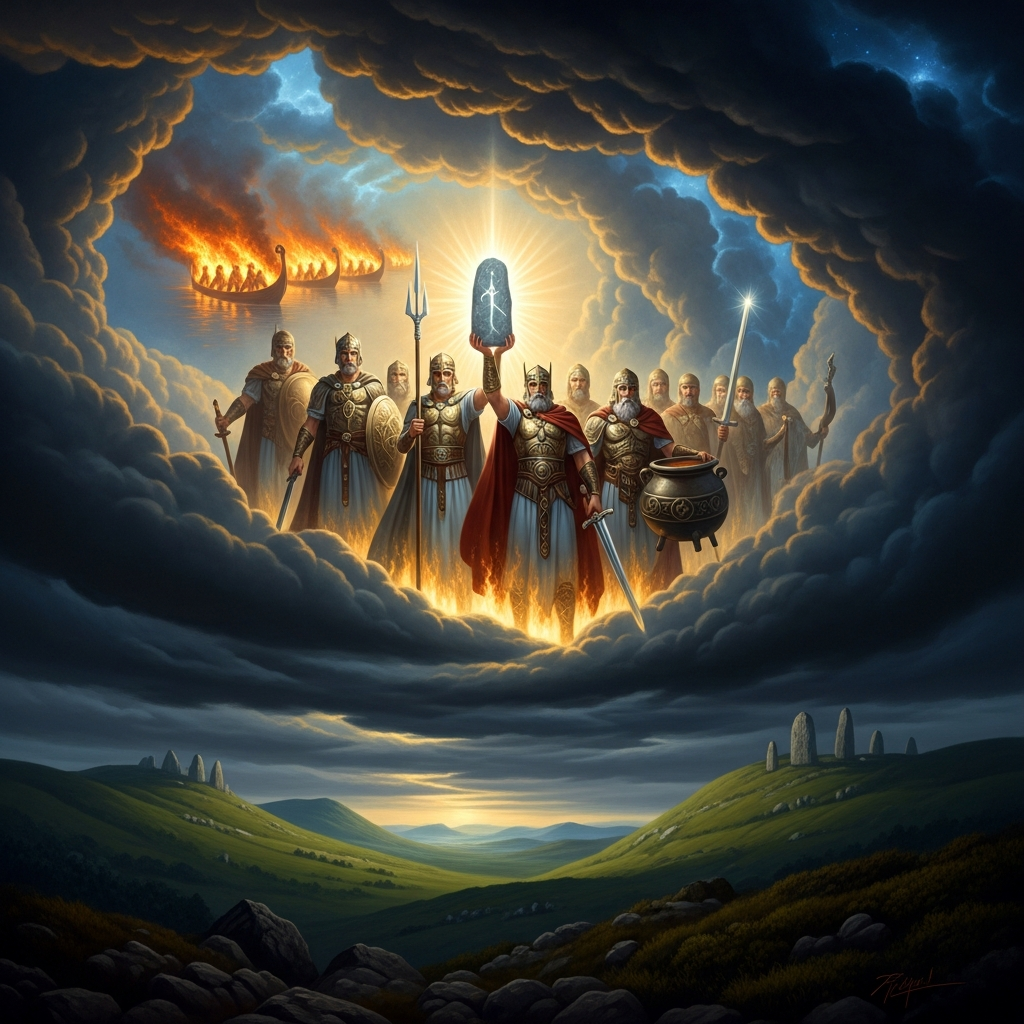
The People of the Goddess Danu came from four cities in the north: Falias, Gorias, Findias, and Murias. They brought four treasures: the Stone of Destiny, Lugh's spear, the Dagda's cauldron, and the sword of Nuada. They came in a cloud, or by burning their boats so there was no retreat — the sources disagree.
- When
- Mythological prehistory; texts compiled c. 11th–12th c. CE; traditional date c. 1700 BCE
- Where
- Ireland, arriving from the four mysterious northern cities
They came in a cloud, the Book of Invasions says.
The Tuatha Dé Danann — the People of the Goddess Danu, the divine race of pre-Christian Ireland, the gods that the Christian scribes of the eleventh century could not bring themselves to call gods and so demoted to a race of magical invaders — arrived in Ireland on the wind. The cloud is described as dark, as great, as covering the sun for three days. They landed on the western coast at the beginning of summer, on the first of May, on the festival the Irish would later call Beltane. They burned their ships behind them — this is the alternative account, told by some redactors as a contradiction and by others as a simultaneous parallel — so that there was no retreat. The smoke of the burning ships, in this version, was the cloud. The arrival was through the smoke of their own departure.
They came from four cities in the north. The four cities are named: Falias, Gorias, Findias, Murias. The locations of these cities are not given. The northern direction is given, but the north of where? The medieval Irish redactors place them somewhere beyond Britain, somewhere beyond the Hebrides, in a region that fades into the geography of the otherworld and the geography of memory. The cities are real in the way the Hyperborean cities of Greek myth are real: real to the people who came from them, and a dream to anyone trying to find them on a map.
They brought four treasures. One from each city.
From Falias they brought the Lia Fáil, the Stone of Destiny.
It was a stone of the kind that the Irish would call later a bullaun, but raised into a standing pillar — a stone that knew the difference between rightful and unrightful kings. When the rightful king of Ireland stood upon it, the stone cried out with a great voice that could be heard throughout the land. When a usurper stood upon it, the stone was silent, or worse, gave a different cry that warned the elders of false rule. The Tuatha set the stone at Tara, the hill of the high kings, and there it remained for centuries. Every legitimate inauguration of a high king of Ireland required the stone’s voice. The kings who could not make the stone speak were not, in the strict religious sense, kings.
The stone is, by some traditions, still at Tara — a small pillar standing on the inauguration mound, shaped like a phallic standing-stone, the original or a replacement, depending on whom you trust. By another tradition, it was sent to Scotland in the early Christian period as a gift, and from Scotland it was carried to Westminster by Edward I in 1296, where it became the Stone of Scone, the stone under the Coronation Chair. Every English and British monarch since Edward II has been crowned sitting above it. In 1996, after seven hundred years in London, the stone was returned to Scotland. It is now in Edinburgh Castle. It is brought back to Westminster only for coronations. Whether it is the Lia Fáil itself or a substitute or a different stone altogether is a question the historians and the Irish nationalists and the Scottish nationalists and the British monarchists answer differently. The treasure has been argued over for a thousand years.
From Gorias they brought the Spear of Lugh.
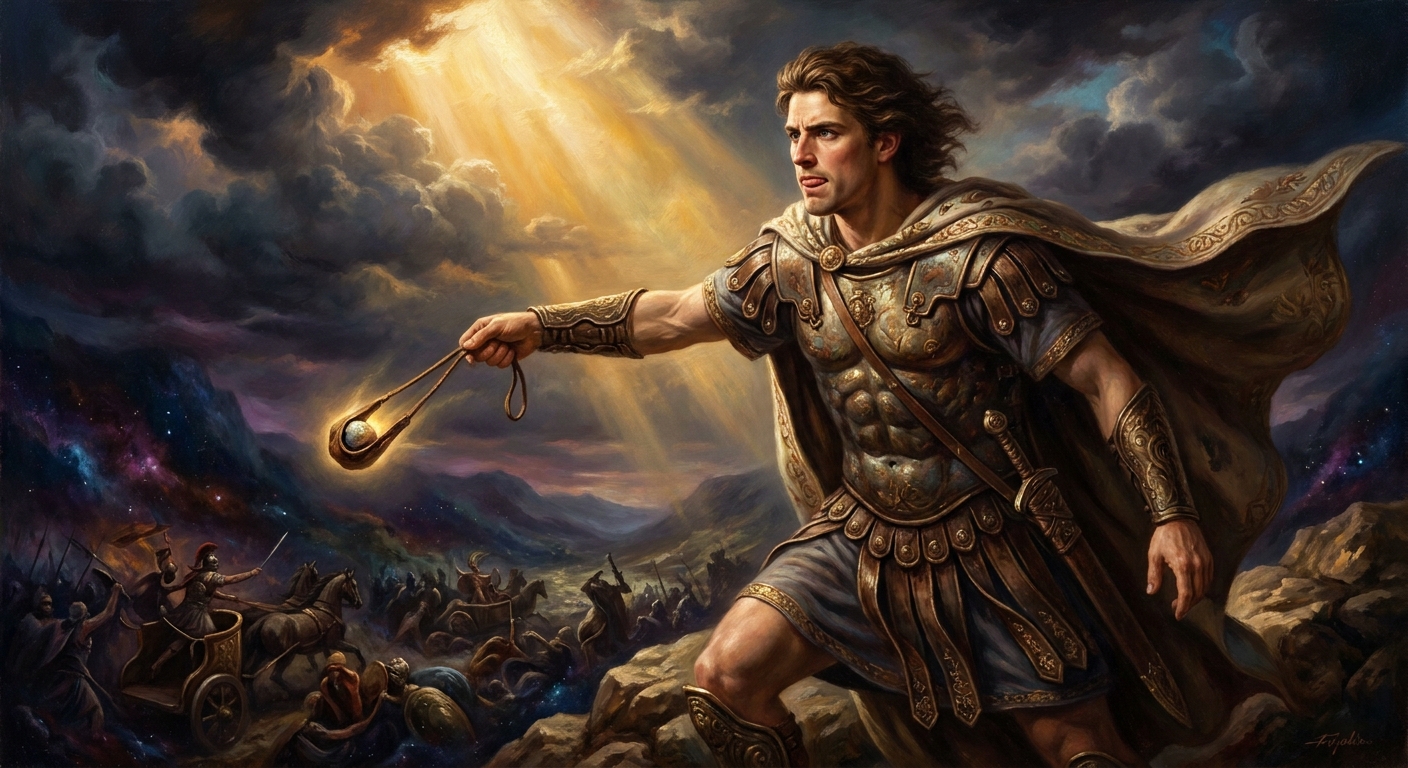
This is the spear that no warrior could face and live. Lugh, the long-armed, the master of every craft, the god of light who is also the god of war when light is what war requires, carried it in the great battle of Mag Tuired against the Fomorians. The spear was alive, in the way the best Celtic weapons were always alive — it sang on the way to the kill, it returned to the hand that threw it, it could not be parried by any shield, and when not in active use it had to be kept in a cauldron of water or in a sheath of poppy heads, because otherwise the spear thirsted and would consume whoever had it.
The medieval reception of this object is the Lance of Longinus, the lance that pierced Christ’s side at the crucifixion. The Christian re-narration kept the active, hungry, semi-conscious quality of the original, kept the protective sheath (now a relic case), kept the association with kingship (the lance became part of the imperial regalia of the Holy Roman Empire), and recast the violence as redemptive. Lugh’s spear in its Christian form is now in the Imperial Treasury in Vienna, or in the Vatican, or in five places at once depending on which medieval relic-shrine you trust.
In its original form, in the Irish tradition, the spear belonged to the bright god, the god of all crafts, the god whose festival is the harvest at the beginning of August (Lughnasadh, still on the Irish calendar). It was given to him because no one else could control it. The Tuatha brought it from Gorias, and after Lugh’s day it was passed down through the divine line, kept in its cauldron, taken out only when the country needed it.
From Findias they brought the Sword of Nuada.
Nuada was the first king of the Tuatha Dé Danann in Ireland. He was tall, fair, the lawgiver, the original presiding figure. He carried a sword that, once unsheathed, no enemy could escape from. The sword had a property that the texts dwell on: anyone who came within its reach was bound to it. The sword would find its target. A warrior facing Nuada with this sword was already wounded — the wound just had not yet happened.
In the first battle of Mag Tuired, against the previous inhabitants of Ireland (the Fir Bolg), Nuada’s sword arm was cut off. By the strict Celtic theology of kingship, a king with a physical blemish could no longer reign. The Tuatha had to depose him. They installed Bres, a half-Fomorian who turned out to be tyrannical, and the Tuatha endured seven years of bad rule before the divine physician Dian Cécht and his son Miach made Nuada a new arm — first of silver (hence his epithet Nuada Airgetlám, Nuada of the Silver Hand) and then of flesh, fully restored. Nuada took the throne back. The sword was returned to him. He led the Tuatha into the second battle of Mag Tuired, against the Fomorians, and won.
The reception of this sword in the medieval Arthurian cycle is Excalibur. The drawing of the sword from the stone, the giving of the sword by the Lady of the Lake, the kingship-validating function of the sword, the eventual return of the sword to the water at Arthur’s death — all of these elements re-encode the Irish original. The Sword of Nuada validated the king. Excalibur validates the king. The sword that comes from elsewhere and goes back to elsewhere is the Indo-European pattern, and the Tuatha brought it from Findias.
From Murias they brought the Cauldron of the Dagda.
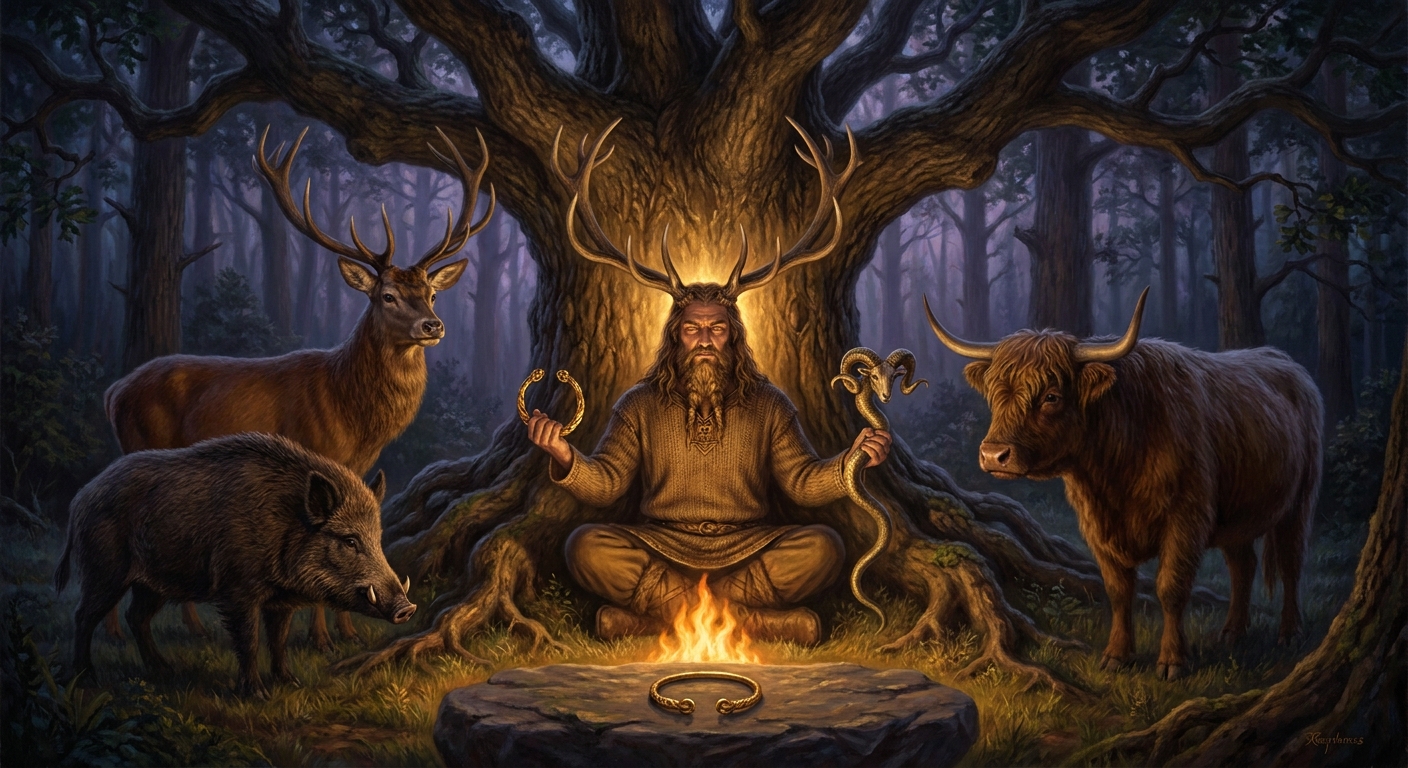
The Dagda is the good god — not morally good, not virtuous, but functionally good, the god who works, the god whose name means the doing one. He was the chief of the Tuatha after Nuada, a vast paunchy figure with an enormous club that could kill with one end and revive with the other, with a harp that played the seasons into existence (the song of summer, the song of winter, the song of sleep), and with a cauldron from which no company ever went away unsatisfied.
The cauldron is the most domestic of the four treasures and also the deepest. Falias gave a stone that selected kings. Gorias gave a spear that killed armies. Findias gave a sword that bound enemies. Murias gave a pot. But the pot is the central object of the four. It feeds. It does not run out. The hospitality of the Dagda is the foundation of Irish kingship — a king who could not feed his guests was not a king, regardless of the Lia Fáil’s verdict — and the cauldron made hospitality structurally possible. It generated food. It generated drink. It also, in some accounts, restored the dead: warriors thrown into the cauldron at night came out at dawn, alive again, but mute, because they had crossed and returned, and what they had seen on the other side was not for speaking.
The reception of this cauldron in the Christian period is the Holy Grail. The Grail tradition takes every essential property of the Dagda’s cauldron — perpetual nourishment, healing, restoration of life, ambiguous provenance from the otherworld, kingship-validating function — and christianizes it. The cauldron becomes a chalice. The chalice becomes the cup of the Last Supper. The cup of the Last Supper becomes the Grail. The Grail is sought by Arthur’s knights. The Grail can only be found by the pure. The Christian reframing is brilliant, and it cannot disguise the older shape underneath: a vessel of plenty from a misty country, sought by warriors, bestowing the things that human power alone cannot bestow.
The Tuatha came ashore. They burned their boats. They marched east. They engaged the Fir Bolg, the inhabitants who had preceded them, in the first battle of Mag Tuired (Mag Tuired in Connacht, on the plain south of the lakes, where the standing stones of the original battlefield are still there to be visited). They won. They settled the country. They held it for several generations of divine rule.
Then the Milesians came — the sons of Míl, the Gaels, the human ancestors of the historical Irish — and the Tuatha had to negotiate. The Milesians were the new wave, and the Tuatha could not push them back. The negotiation reached a famous compromise: the Milesians would have the surface of Ireland, and the Tuatha would have what was below. The Tuatha withdrew into the sídhe, the fairy mounds, the burial mounds and standing stone circles and underground halls of the Irish landscape. They became invisible. They became the Aos Sí, the People of the Mound. They were not gone. They were beneath. The standing stones became their doors. The mounds at Newgrange and Knowth and Dowth became their houses. They are still there. The Irish countryside is full of them.
The four treasures went with them. The Lia Fáil stayed on the surface — a deliberate exception, a single object left visible to validate human kings — but the spear, the sword, and the cauldron retreated into the otherworld, where they remain. They surface periodically in stories. A hero finds the cauldron in a fairy hall and it feeds his army. A warrior is lent the spear for a great deed and must return it before sunrise. A king is shown the sword in a vision but cannot draw it. The treasures move between worlds. The boundary is permeable but only at certain times.
The Tuatha Dé Danann are the great problem of Irish religious history. They are gods, by every property the texts give them — they perform divine functions, they have divine attributes, they are remembered as the source of every important institution and every important object. They are also, as the texts present them, a people. They arrived. They settled. They were displaced. They went underground. The medieval Christian scribes who wrote down the Lebor Gabála faced a choice: they could call the Tuatha gods, in which case they would be writing pagan theology, or they could call them a magical race, in which case they would be writing folk history. They chose the second, and the choice preserved the entire pre-Christian theology of Ireland in a form that Christianity could tolerate.
The four treasures are the most important inheritance of this preservation. The Stone of Destiny, the Spear of Lugh, the Sword of Nuada, the Cauldron of the Dagda — these four objects are the source of the entire later inventory of magical regalia in the Western imagination. The Holy Grail is the cauldron. Excalibur is the sword. The Lance of Longinus is the spear. The Stone under the Coronation Chair is the stone. The Christian re-narration kept the objects and changed their stories, but the objects themselves were already in place, brought by a people from four northern cities whose locations cannot be found.
The Tuatha did not lose Ireland. They went under it. They are still there. The mounds are still there. The treasures are still in the otherworld, surfacing in stories, finding their way into the hands of heroes who need them and back into the dark when the need has passed. This is why the Irish landscape feels full in a way that other landscapes do not. Every standing stone is a door. Every burial mound is a hall. Every river bend is the trace of a fairy road. The country was never fully colonized by the Milesians. The previous tenants are still in the basement.
Echoes Across Traditions
Entities


Sources
- *Lebor Gabála Érenn* (The Book of Invasions), 11th-century Irish compilation of older oral traditions
- *Cath Maige Tuired* (The Battle of Mag Tuired), Old/Middle Irish text
- Marie-Louise Sjoestedt, *Gods and Heroes of the Celts* (1949)
- Proinsias Mac Cana, *Celtic Mythology* (1970)
- John Carey, *A Single Ray of the Sun: Religious Speculation in Early Ireland* (1999)