Contents
A boy of seven, sent to the smith Culann's feast, takes a shortcut through the gate. The great hound has been let loose. The boy kills it with a hurley-stick and a hand-ball driven through its open jaws. The smith mourns. The boy offers to be the hound himself until a pup can be raised.
- When
- c. 100 BCE-100 CE (Iron Age Ulster, mythic time)
- Where
- Ulster, the road to the smith Culann's house at Cuailnge, the threshold gate
The boy’s name was Setanta.
He was the son of Dechtire, sister to King Conchobar of Ulster, by the god Lugh — Lugh of the Long Arm, the warrior-craftsman of the Tuatha Dé Danann, who had come to Dechtire in the form of a small bird and had sent his spirit into a single grain of wheat she swallowed in a glass of wine. The boy was therefore half-divine. The Ulstermen said this and meant it.
He grew up on his father’s earthly farm at Muirthemne, but he heard, from the time he could walk, of the boys’ troop at Emain Macha — Conchobar’s capital, where the king kept a permanent company of one hundred and fifty noble boys in training. The boys hurled together. They wrestled. They learned weapons. Setanta wanted to be among them.
His mother said he was too young.
He went anyway. He was five years old. He took his hurley-stick (a stout ashwood stick, curved at the bottom, used for the game iomáin, the ancestor of modern hurling). He took his hand-ball — a small leather ball stuffed with horsehair. He took his shield and his throwing-spear, both small, both real. He walked the road to Emain Macha alone.
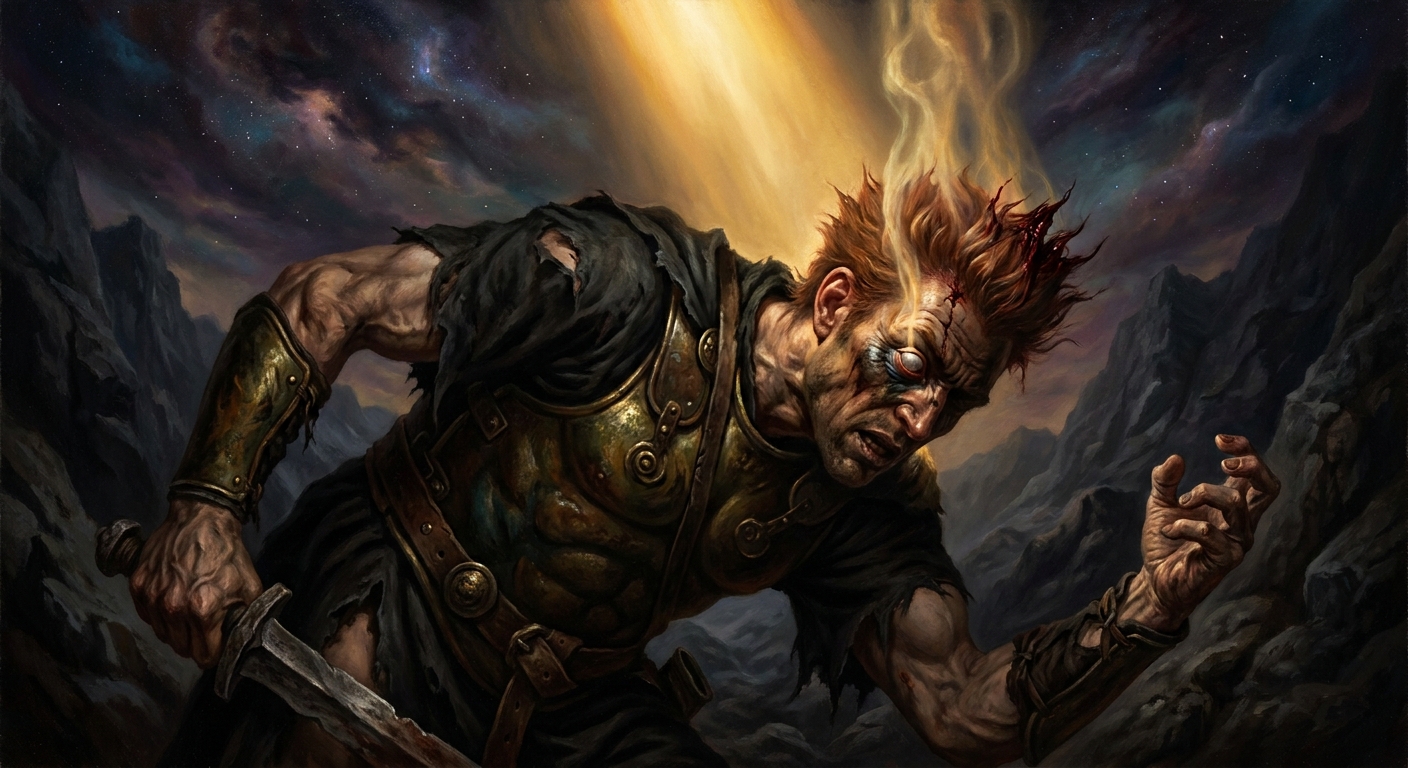
When he arrived at the playing-field, the boys were on it. Setanta walked straight onto the field without making the formal request of safe passage that custom required. The hundred and fifty boys, offended, fell on him at once. They threw their spears at him. He caught them all on his small shield. They drove their hurleys at him. He fielded them. They threw their hand-balls. He caught them. Then he became distorted with rage — the warp-spasm, the Irish call it, the riastrad — for the first time. His body changed. One eye went into his skull and the other came down on his cheek. His muscles writhed under his skin. His hair stood on end with a drop of blood at the tip of each hair.
He went through the boys’ troop like a wolf through sheep. King Conchobar, watching from the ramparts, intervened just before the boys were all dead. He took Setanta under his protection. He had the boy formally inducted into the troop, with the rights of safe passage and full membership. Setanta laid the warp-spasm aside. He became, again, a smiling small boy.
Two years passed.
Setanta was now seven.
The king was invited to a feast at the house of Culann, the great smith of Ulster. Culann was the artisan who made the swords and the cauldrons and the tools of the kingdom. His house was at Cuailnge, on the eastern coast, far from Emain Macha. He had a great hound — a wolf-hound, the kind that could pull down a stag, the kind that no other man’s hound could face — that he kept loose in the grounds of his house at night, as both protection and prestige. The hound knew only Culann; the hound would tear apart anyone else.
Conchobar gathered his retinue and rode out toward Culann’s. As he was leaving Emain Macha, he passed the playing-field. Setanta was on it, hurling. The king watched him for a moment. He had never seen anyone so small handle a hurley so well. He called out: Setanta. Come and join us at the feast.
The boy looked up. I will come, he said. But not yet. I am winning. Let me finish the game and follow you on the road.
The king laughed at the answer and went on his way with the rest of the company.
The feast was at Culann’s house. The king and the warriors arrived in the long northern dusk. They were welcomed in. Culann was a hospitable host. He brought out the best of his cellar. The hall filled with warmth and food and music. The doors were closed. Outside, by ancient custom, Culann let his great hound off the chain. The hound ranged the grounds. The household was now safe.
Inside, well into the feast, Conchobar suddenly remembered.
He froze with the cup at his lips. Setanta is coming after us, he said. He is on the road. He is coming alone, and he does not know about the dog.
It was already too late. The hall fell silent. Outside, in the distance, they heard the deep belling of the hound. They heard a child’s voice. Then they heard the sounds of a fight — a hound’s roar cut short by a single sharp impact, then silence — and then the hound’s voice no more.
The men ran out into the yard with torches.
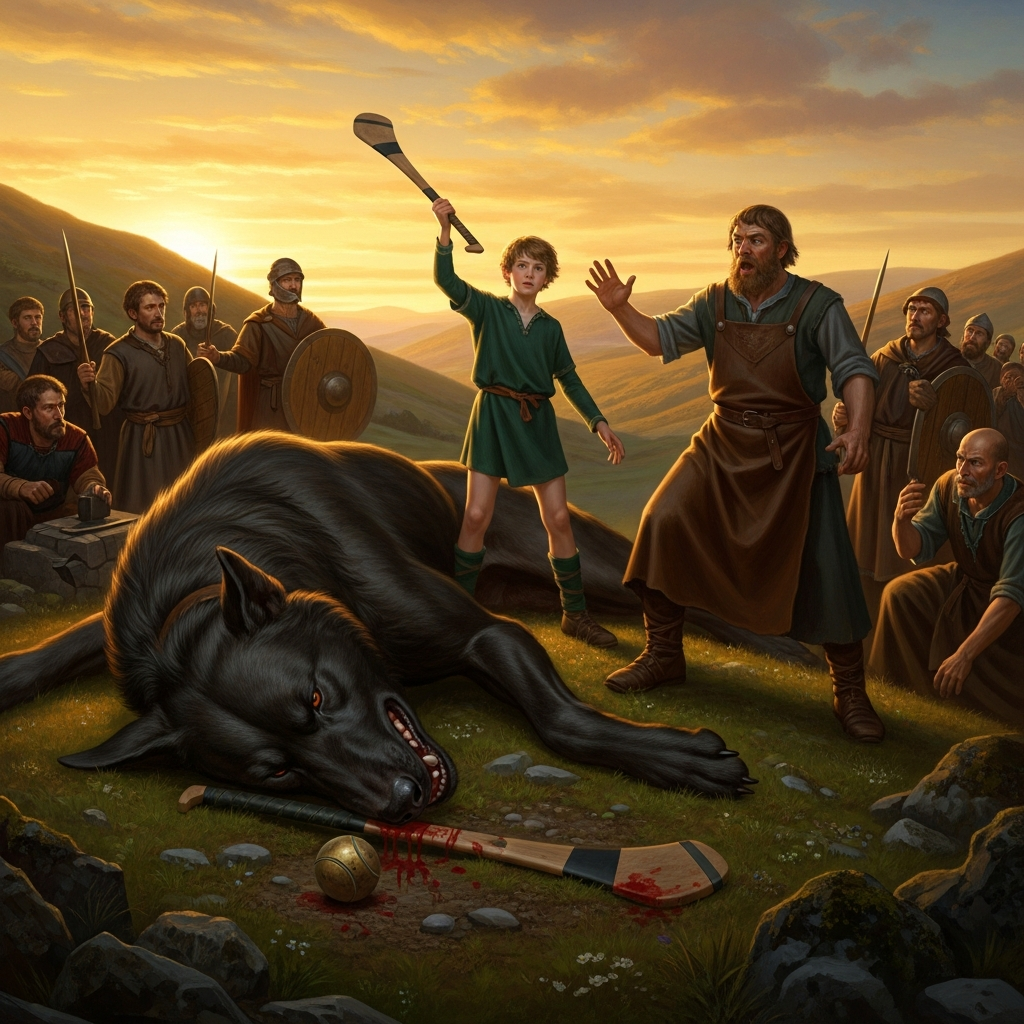
They found, by the gatehouse, the great hound. It was dead. Its enormous body lay still. Its skull was cracked open. Beside it, looking calmly down at it, stood Setanta. He had his hurley in one hand. The other hand was empty.
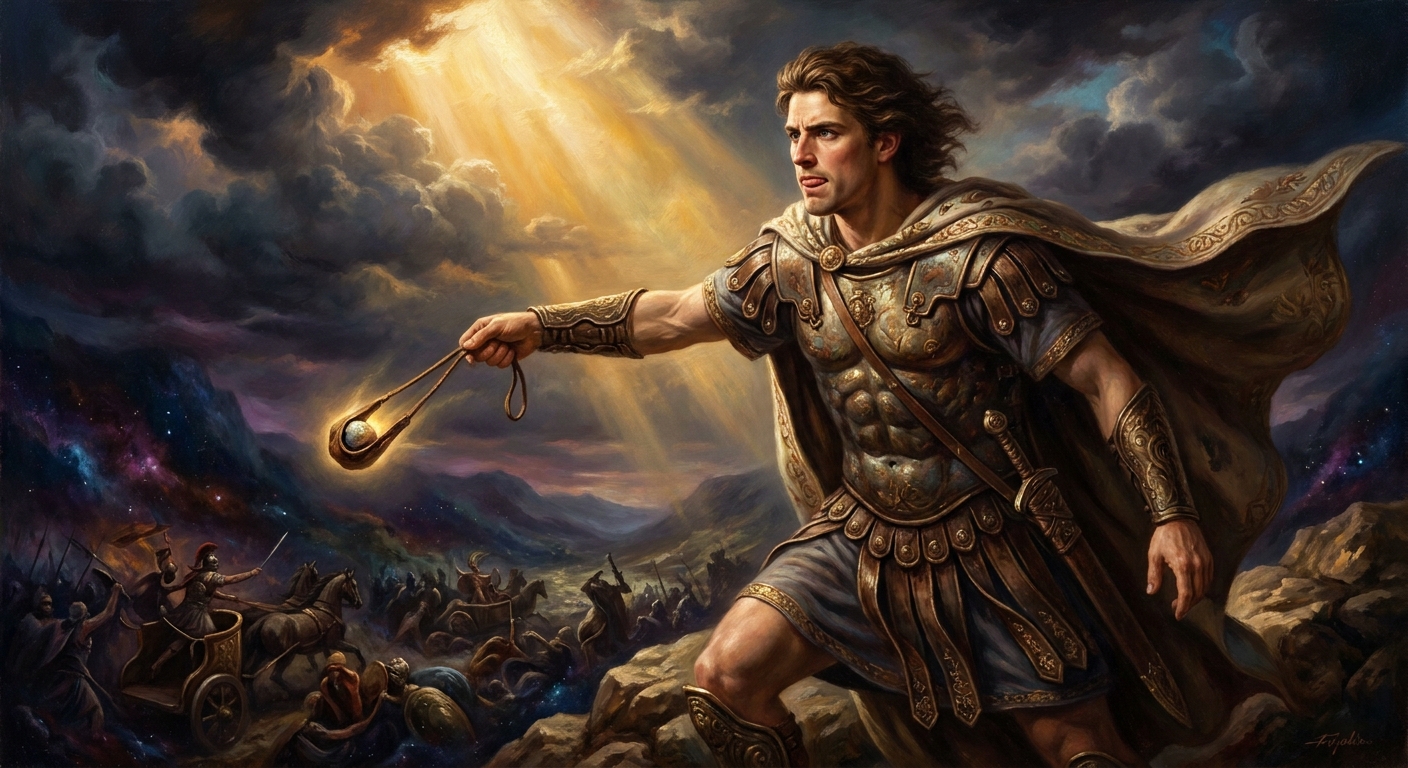
He had heard the hound coming. He had stopped on the road. He had taken his hand-ball and set it on the spike of his hurley. The hound had charged. The hound had leapt into the air with its jaws wide open. The boy had swung the hurley at the open jaws and driven the hand-ball straight down the throat of the hound and out the other side of the spine. The hound had collapsed in mid-leap. The boy, almost as a courtesy to the smith, had then taken the dead body by the hind legs and dashed its head against the gatepost to be sure.
Culann came out into the yard.
He was a craftsman. He was a hard man. He looked at the hound — the hound he had raised from a pup, the hound that had been the soul of his household and the protection of his property — and he wept. He wept like a man who had lost a brother. He could not be consoled.
The warriors of Ulster were embarrassed. The boy was the king’s nephew. The hound was the smith’s child. There was no easy reconciliation.
Setanta walked forward, into the firelight. He was seven. He had blood on his hands. He looked at Culann.
He said: Culann. I am sorry. I did not know your hound. He came at me as an enemy. I had no choice. But I will make this right. Bring me a pup of the same line. I will train it. I will raise it. Until that pup is grown to its full size and has been tested against wolves, I will be your hound. I will guard your house and your cattle and your border. I will sleep in the gateway. I will walk the perimeter. I will be the hound until your hound is ready.
The smith looked at him for a long time.
The smith said: That is just. I accept.
Cathbad the druid had been at the feast. Cathbad was an old man. Cathbad saw what was being done — saw a boy renaming himself in front of a smith and a king — and he stepped forward and pronounced.
Henceforth, Cathbad said, the boy’s name shall not be Setanta. He shall be Cú Chulainn — Culann’s Hound — and that name will be remembered while the Irish tongue is spoken.
The boy accepted the name. The men accepted it. The smith was at least partially comforted. Cú Chulainn slept in the gatehouse for as long as it took the new pup to be raised — the texts vary on the duration, but it is sometimes given as a year — and then resumed his life as the king’s nephew and the foremost member of the boys’ troop.
He grew. By seventeen he was the warrior of Ulster. The Boyhood Deeds end with the warp-spasm coming on him fully, with him taking arms and a chariot from the king, and with the prophecy that he would be the greatest of the Ulstermen and would die young.
He held the ford at the Táin Bó Cúalnge — the Cattle Raid of Cooley — alone for weeks against the army of Connacht, fighting Queen Medb’s champions one by one in single combat while Ulster slept under a curse. He killed his foster-brother Ferdiad in three days of fighting at the ford. He killed his own son Connla, whom he did not recognize, when the boy came as a stranger to test the warriors of Ulster. He died young, as Cathbad had said — bound to a standing stone with his own intestines, refusing to fall, his sword still in his hand, until a raven landed on his shoulder and the watching enemies finally dared to come close enough to take his head.
But all of that is the long story of his life. The short story is this: at seven years old, on a road in the Ulster dusk, he killed a hound and offered to become one. The Irish never forgot the offer. The smith was satisfied. The name stuck. Culann’s Hound.
He had renamed himself, in the act of paying his debt, with the name of the thing he had killed.
Scenes
The boy Setanta on the road in the dusk, hurley-stick in one hand and hand-ball in the other, walking alone through the green Ulster country toward Culann's gate
The hound mid-leap, jaws open wide, against the small figure of the boy at the gate
Inside Culann's hall after the kill
Echoes Across Traditions
Entities
- Setanta (Cú Chulainn)
- Culann the smith
- King Conchobar
- Cathbad the druid
Sources
- Táin Bó Cúalnge (Recension I, c. 1100 CE, from earlier oral tradition)
- The macgnímrada (Boyhood Deeds) section of the Táin
- Lebor na hUidre (The Book of the Dun Cow, c. 1100)
- Standish O'Grady, *History of Ireland: The Heroic Period* (1878)