Contents
The bean sídhe — the woman of the fairy mound — is heard, not seen. When a member of one of the old Irish families is about to die, she wails in the night. She does not cause death. She announces it. She grieves for the death as well as warns of it.
- When
- Folk tradition; first textual references c. 8th c. CE; tradition still alive in some areas
- Where
- Ireland (and the Scottish Highlands, where she is the bean sìth)
She is heard, not seen.
This is the first thing every Irish child is taught about the banshee, and it is the most important thing. She does not appear at the foot of the bed. She does not knock on the door. She does not stand in the kitchen at the witching hour with a candle. She is a voice. The voice comes at night, from outside, from the darkness beyond the cottage, from the laneway or the field or the river that runs past the house. The voice cries. The cry is high and long and wordless. It is the keening sound that Irish women have made over their dead for two thousand years — the caoineadh, the keen, the formal lamentation — but coming from no body that any household member can locate.
If you hear it, the rule is to go inside, close the door, sit down, and listen. You are not in danger from her. She has not come for you specifically. She has come because someone in the house, or in the family connected to the house, is dying or has just died. The cry is the announcement. The death itself may not have happened yet. The death may be happening at this moment, miles away. The death may have happened an hour ago and the news has not arrived. The banshee knows. The banshee always knows first. That is her function.
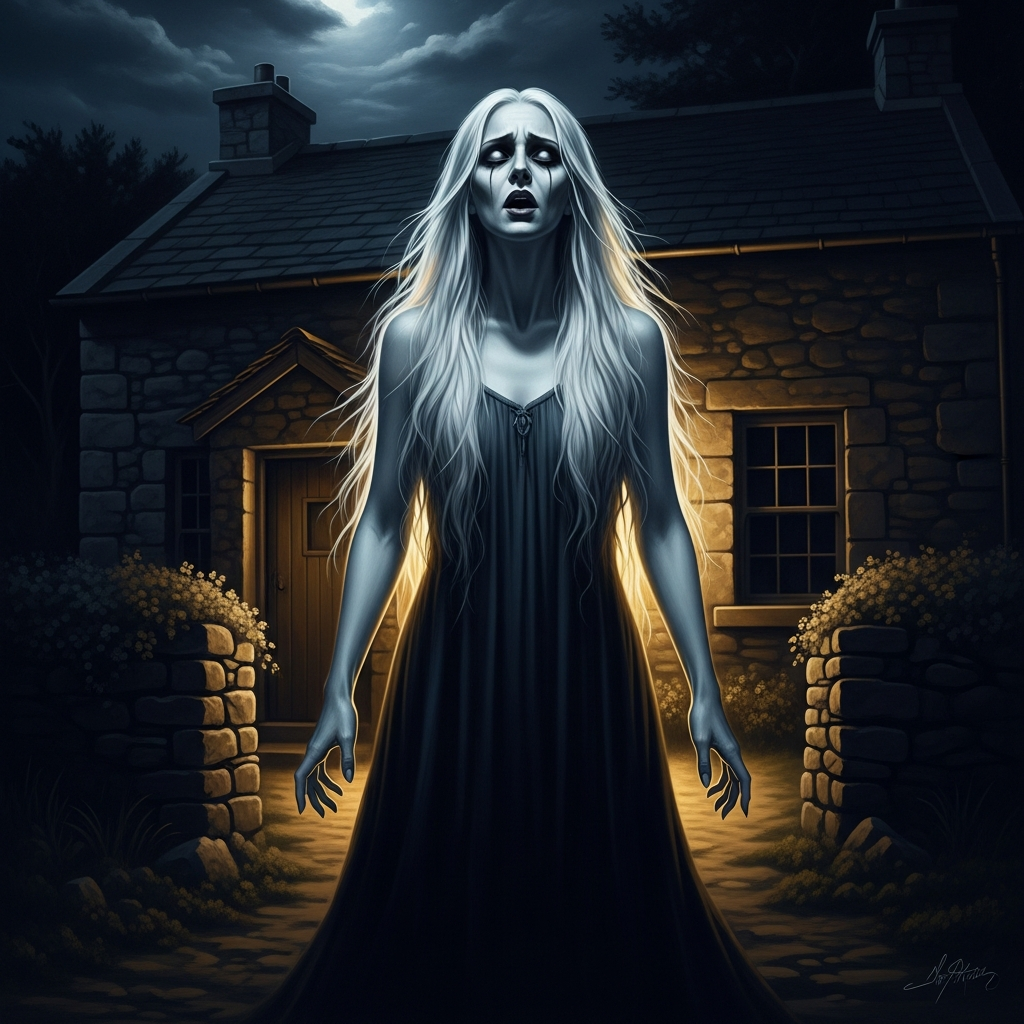
In some accounts, she is glimpsed. A woman walking in moonlight along the laneway, combing her long hair with a comb of bone or silver. A woman in white standing at the gate. A woman bent and shrieking, hair loose, eyes red, clothes ragged. A woman bathing bloody clothes at a ford in the river — this is the older Scottish version, the bean nighe, the washer at the ford, who washes the linen of the soon-to-be-dead. The visions are rare. The voice is the standard form.
She belongs to the old families.
This is the part of the tradition that the modern world finds difficult to receive, because it is openly aristocratic. The banshee does not announce the deaths of just anybody. She follows the old Irish lineages — the families whose names begin with O’ or Mac, the families whose pedigrees can be traced to the medieval kingdoms, the families who have a claim to ancient land and ancient honor. The Ui Néill. The Ó Briains. The Ó Conchobhairs. The Mac Cárthaighs. The Mac Carthys. The Fitzgeralds. The Bourkes. Each great family is supposed to have its own banshee, its own attendant spirit, who has been with the family since before Christianity reached Ireland and will keen for the family until the family ends.
Some banshees are named. The banshee of the O’Briens of Munster is Aibell, who has her own seat at Craig Liath, the gray rock above Killaloe. She has been keening for the O’Briens since the death of Brian Boru at Clontarf in 1014 — she warned him the night before the battle, and he went anyway, and she keened for him at the moment his bodyguard fell. She has keened for every O’Brien chief and most of the O’Brien gentry since. She is still active, by the testimony of family members who have heard her, into the modern period.
The banshee of the MacCarthys of south Cork is Cliodhna, who came from the Otherworld in the form of a beautiful young woman and drowned at Glandore — the wave that drowned her is still called Tonn Chlíodhna, Cliodhna’s wave, the great wave of the Cork coast that breaks at high tide on the cliffs. She keens for the MacCarthys from the wave. The sound of the wave on a stormy night is, in the old tradition, partly her voice.
The banshee of the O’Sullivans is Áine — although Áine is also a sun goddess in her own right, with her own hill at Knockainey in Limerick, and her status as a banshee is a demotion from her earlier divine career. She still keens for the O’Sullivans, in the way an exiled queen might still hold court for a few faithful retainers.
These are the named banshees of the old kings’ lines. There are dozens more, smaller, attached to lesser houses, unnamed in the formal tradition but known to the families themselves. A house that has its banshee is a house with continuity. The banshee is the genealogical evidence — the audible proof that the family is old enough to have one.
The wail itself is described with great consistency across the centuries.
It is high. It is long. It is wordless. It does not vary in melody — it is one sustained cry, falling at the end. It is heard outside the house, never inside. It comes in the small hours of the night, between midnight and dawn, most often around three in the morning. It can be heard from a great distance — across fields, across rivers, sometimes across the country, when a family member has died abroad. The Irish soldier dying in the trenches of the First World War, the Irish emigrant dying in a Boston tenement, the Irish priest dying of fever in a Brazilian mission — all of these have been the occasion of banshee-cries heard at the family seat back home in Ireland, where the relatives who heard them did not yet know what had happened, and would learn only by the slow post days or weeks later.
The cry is sometimes joined by other sounds. A clock that has stopped working starts up. A dog howls at a window facing nothing. A horse in a stable becomes restless. A picture falls off a wall. The arrival of the banshee disturbs the small electrical and mechanical objects of the house — this is the modern version of an older folklore detail, the small objects responding to the presence of the messenger.
She does not stay long. The cry comes for an hour, perhaps two, and stops. By dawn she is gone. The household, having heard her, has the night to prepare. The candles are lit. The priest is sent for. The rosary is begun. The mirrors, in some old traditions, are turned to face the wall. The clock is stopped — deliberately, this time, by the household, in mourning. By morning the news arrives, by telephone or telegram or messenger or the old way of a relative coming up the laneway, and the news is what the banshee has already told them.
What is striking about the banshee tradition is its kindness.
This is not how it sometimes appears to outsiders. The wail is frightening. The figure, when seen, is often described as terrifying. The arrival of a banshee is bad news by definition — someone is going to die. But the function of the banshee is not malicious. She is not a death-bringer. She does not cause the death. The death is going to happen anyway; the banshee is the family member from the otherworld who has come to announce it, to keen for it, to make sure the household has time to gather and pray and say the things that need to be said. She is the first mourner. She begins the keening before the human keeners can know they need to keen.
In this sense, the banshee is an act of compassion from the otherworld. The hard fact of human existence is that death often arrives unannounced — strokes, accidents, sudden hemorrhages, deaths in distant cities — and families are denied the chance to prepare. The banshee tradition denies this denial. In Ireland, in the old families, with the banshee on duty, no death is unannounced. The family has notice. The family has time. The family can light the candles and start the prayers and gather the relatives, sometimes hours, sometimes days before the official news will arrive. The banshee makes the death community’s response possible.
This is why the figure is grieving. She grieves because she knows. She is not warning a victim of an attacker; she is grieving a family member of another family member’s coming death, in advance, on behalf of the family that does not yet know enough to grieve. Her wail is the keen that the family will perform at the wake, performed early, in solo voice, by the family member who has the privilege of knowing first.
The conception is, finally, generous. The otherworld pays attention. The dead are not abandoned. The dying are not abandoned. Someone is keening for them already, before they have died, so that no death goes unmourned even in the moment of its happening.
The tradition is older than Christianity in Ireland. The medieval Christian church absorbed it imperfectly — the banshee survives in folklore but does not appear in any official theology, and priests through the centuries have been variously sympathetic to the tradition (recognizing it as a form of folk care for the dying) and skeptical of it (wishing the families would just call the priest and let the angels do their work). The tradition has outlasted both the medieval church and modern skepticism. The Irish folklore archives at University College Dublin contain hundreds of accounts collected in the twentieth century by trained folklorists from Irish-speaking informants who had heard the banshee themselves — not stories about other people hearing her, but personal accounts, often from people who were respectable, sober, educated, and unwilling to speak about the experience to anyone outside the family.
The accounts are remarkably consistent. The cry is always high and long. The time is always between midnight and dawn. The death always followed within hours or days. The relative who died was always of the old line. The hearer of the cry was always a member of the same family or in the family’s house at the time. The descriptions across collectors and across decades are so uniform that they cannot be entirely cultural transmission; either the families are coordinating their stories (which the folklorists ruled out), or they are reporting something they actually heard. The Irish folklorists have, by and large, taken the position that something is being heard, without committing themselves on what.
In Patricia Lysaght’s classic 1986 study, the most rigorous scholarly treatment of the banshee, the material is allowed to speak for itself. Hundreds of accounts. Geographical distribution across Ireland. Family-by-family lineage of the named banshees. Consistent typology of the cry. Lysaght’s conclusion is methodologically careful: the banshee is a real cultural phenomenon, the experiences are real experiences, the tradition is alive in a recognizable form into the twentieth century. What the experiences are, in metaphysical terms, the study leaves to the experiencer.
The banshee is one of the most exact figures in world folklore. Her function is narrow. Her time is specific. Her domain is one threshold — the moment of impending death — and her job in that moment is to grieve.
She is also the most personal of supernatural figures. Other supernatural beings deal with the world at large. The banshee deals with one family. She knows the family. She has known them for centuries. She has keened for the great-grandfather and the great-grandmother and the grandfather and the grandmother and now the father, and she will keen for the children, and the children’s children, until the family ends. She is the otherworld’s representative at the family’s funerals. Every one of them.
The Irish religious imagination, in producing this figure, has produced a creature whose primary attribute is grief. Other folklore traditions produce creatures whose primary attribute is malice, or hunger, or trickery, or seduction, or wisdom. Ireland produced a creature whose primary attribute is sorrow. The banshee is sad. Her sadness is what she is. She is sad because she knows the family well, she has watched their lives, she sees the death coming, and her response to seeing it is to weep aloud in the laneway in the small hours of the night.
This is, in the end, a generous theology. The dying are not unattended. The household is not surprised. The death is woven into the family’s longer story by a being whose entire purpose is to weep for the family’s losses. The banshee is heard, not seen, because what she does is not for looking at — it is for hearing, for sitting with, for letting the cry pass through the house and prepare the rooms for what is about to happen.
And then, when the dawn comes, she is gone, and the family begins its own keening, in the same key she has set, picking up where she left off.
Echoes Across Traditions
Entities
- Banshee
- Aos Sí
- Aibell
- Cliodhna
- Áine
Sources
- Lady Wilde, *Ancient Legends, Mystic Charms, and Superstitions of Ireland* (1887)
- W.B. Yeats, *Fairy and Folk Tales of the Irish Peasantry* (1888)
- Patricia Lysaght, *The Banshee: The Irish Death Messenger* (1986) — the standard scholarly study
- Irish folklore archives, University College Dublin