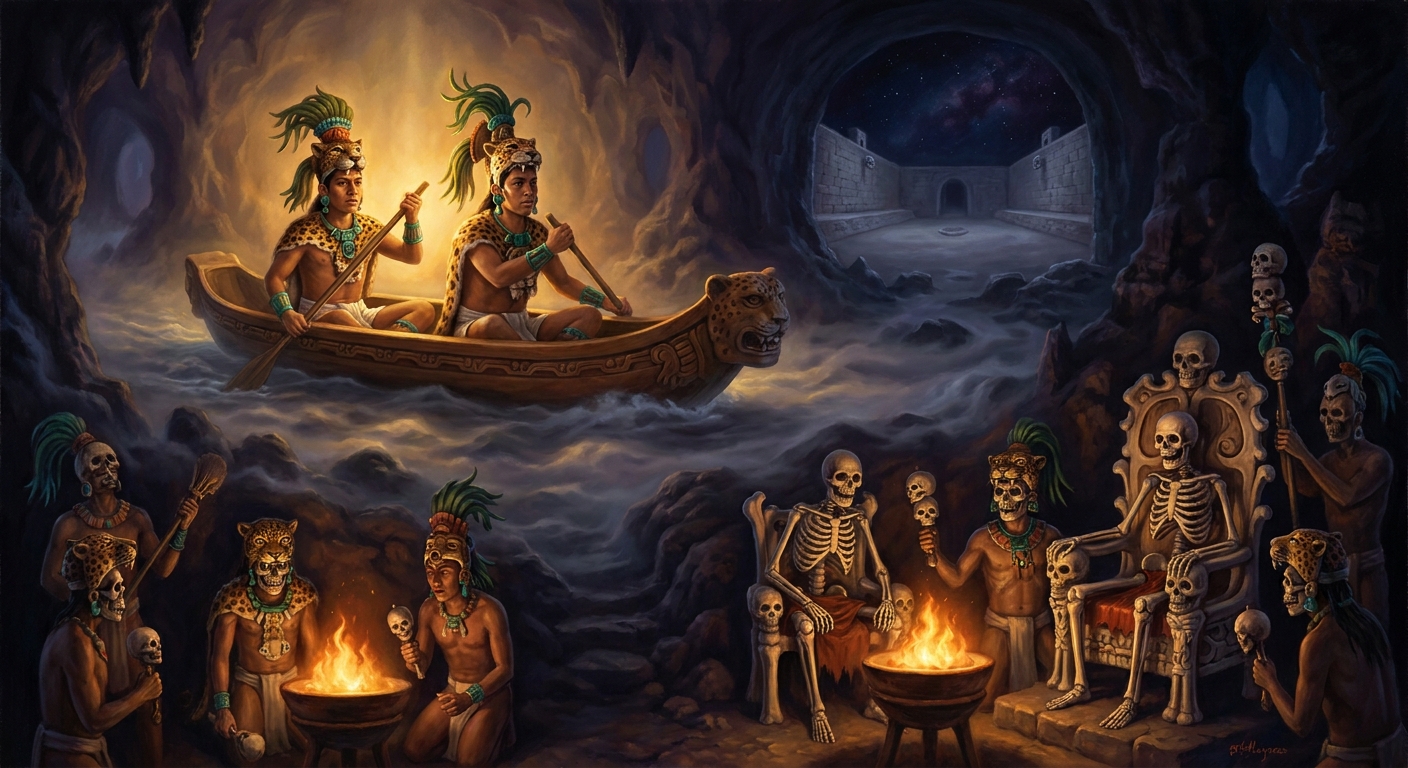
Chaac and the Children Thrown into the Cenote
c. 800-1200 CE — Late Classic to Postclassic Maya; continuing through Colonial contact · Chichén Itzá, Yucatán — the Sacred Cenote (Cenote of Sacrifice); also regional rain shrines across the Yucatán
Contents
In years of drought, the Maya of Chichén Itzá carried jade, gold, copal, and living children to the great Sacred Cenote and threw them in as messengers to Chaac the rain god — asking the water to speak to the sky on their behalf.
- When
- c. 800-1200 CE — Late Classic to Postclassic Maya; continuing through Colonial contact
- Where
- Chichén Itzá, Yucatán — the Sacred Cenote (Cenote of Sacrifice); also regional rain shrines across the Yucatán
In the dry season the sky is a ceramic bowl turned upside down.
No cloud moves across it. The limestone of the Yucatán is a sponge — there are almost no rivers on the surface, no lakes, no streams. The rain that falls goes immediately through the porous rock into underground rivers and caverns, and what is left on the surface dries. In a normal year this is manageable: the rains come in May and the milpa is planted and the corn grows. In a drought year the rains do not come and the corn does not grow and the choice is between starvation and doing something about it.
Doing something about it means Chaac.
Chaac is the rain god, the lightning wielder, the face with the long curved nose and the serpent axe. He is depicted in the Maya codices as a scaly being who stands in rain clouds, pouring water from a jar, slashing his serpent axe to make lightning. He is not one being but four — the chacob, the rain gods of the four directions, one at each corner of the sky, each associated with a color: red for east, white for north, black for west, yellow for south.
When the rains fail, you must speak to Chaac.
The Sacred Cenote at Chichén Itzá is a natural opening in the limestone, sixty meters wide, twenty meters deep from the platform edge to the water below. The water is dark green, opaque, still. You cannot see the bottom. What you throw in disappears immediately, crossing from the visible world to the invisible one.
This is why it is sacred.
A cenote is a portal. The water below connects to the network of underground rivers that are the Maya underworld in its most physical form — the dark water that underlies the entire peninsula, the horizontal equivalent of Xibalbá. When you throw something into a cenote, you are sending it below, delivering it to the water-beings who communicate with the rain that falls from above.
The logic is hydraulic theology: rain falls from sky to earth. Water travels from earth to underground. Underground water communicates with sky through some mechanism that must be maintained. The cenote is the access point for that mechanism.
The priests directed what was thrown.
Jade was the most common offering — jade beads, jade masks, jade pendants, jade figurines. Jade is the color of rain and corn and the green growth of the wet season; it is the most sacred material in the Maya world. Gold was thrown, and copal incense burned on the platform before the throwing. Objects from as far away as Central America and Central Mexico were recovered from the cenote in the twentieth century — it was a node in a trade network of sacred exchange.
And sometimes children.
Diego de Landa, the Spanish bishop who burned the books, also recorded the practice. Young people — the sources say virgins, the sources say specially selected — were thrown into the cenote in the morning. If they were still alive at noon, they were pulled out on ropes and asked to deliver Chaac’s message about the coming rains.
Whether they were typically alive at noon, given the depth of the fall and the cold of the water, is not recorded with reliability.
What the archaeology recovered from the twentieth-century dredging of the cenote includes human skeletal remains — mostly adult males, not the child victims the colonial sources describe, which suggests the colonial sources may have misunderstood or exaggerated the practice, or that the practice changed over time. What is beyond dispute is that the cenote received offerings over centuries, and that those offerings were serious in proportion to the seriousness of the drought.
Chaac is not cruel in the Maya understanding. He is a force that requires participation. The rain does not fall by itself — it must be asked for, continuously, with the right gifts, in the right places. The cenote is the right place. Jade is the right gift. The reason the jade and the children must be the most valuable things you have is that a request made with cheap materials signals that the need is not urgent, and urgent need is the only language that guarantees divine attention.
The dry sky turns blue. The cenote is dark. The rope dangles over the edge.
Someone is always willing to try.
Echoes Across Traditions
Entities
- Chaac
- the rain priests
- the chacob assistants
Sources
- Inga Clendinnen, *Ambivalent Conquests: Maya and Spaniard in Yucatán, 1517-1570* (Cambridge University Press, 1987)
- Clemency Coggins and Orrin Shane, *Cenote of Sacrifice: Maya Treasures from the Sacred Well at Chichén Itzá* (University of Texas Press, 1984)
- Diego de Landa, *Relación de las Cosas de Yucatán* (c. 1566, translated by Alfred Tozzer, 1941)