Contents
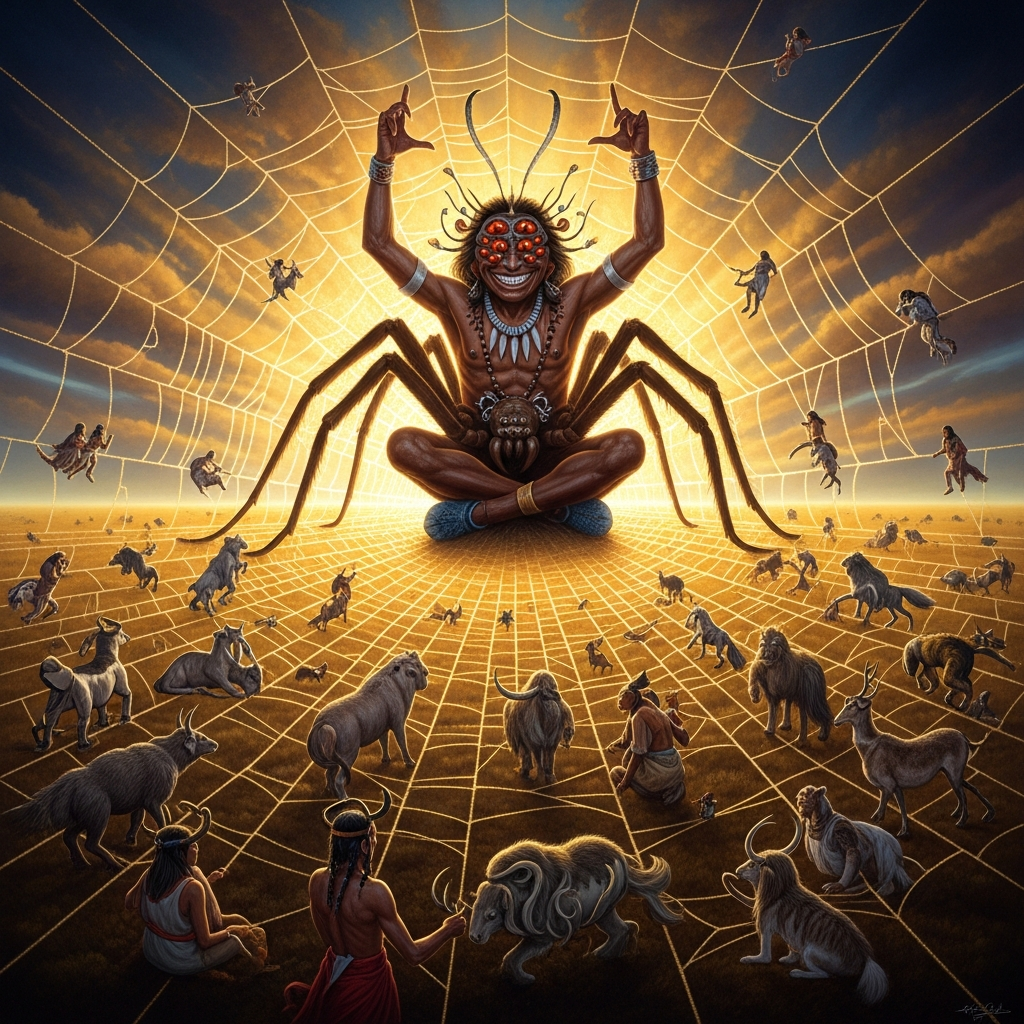
Iktomi the Spider Trickster is always spinning — spinning stories, spinning webs, spinning the elaborate schemes that catch both prey and schemer — and the world he inhabits is a web of consequence in which every action is connected to every other.
- When
- All times — Iktomi is always present, always scheming
- Where
- The Great Plains — wherever the Lakota people live, Iktomi is not far
Iktomi is always making something.
He is always spinning — his spider legs always moving, his clever mind always turning, the web of his plans extending out from him in every direction. He is very smart. He knows he is very smart. This is his central problem and his central gift: a mind that can see angles other minds miss, combined with a complete inability to recognize when his own cleverness has become his trap.
He sees everything except himself.
A typical Iktomi story goes like this: Iktomi is hungry. He sees some ducks. He has an excellent plan. He tells the ducks that he knows a new dance and will teach it to them if they close their eyes — they must keep their eyes closed through the entire dance. The ducks, who are not suspicious enough, close their eyes. Iktomi wrings their necks one by one until he has enough ducks for a feast.
He builds a fire. He buries the ducks to cook under the coals. He decides to sleep while they cook, because he is tired from all the scheming. Before he sleeps he tells his anus to wake him if anyone comes near.
(This is not a dignified plan. This is Iktomi.)
Someone comes near. His anus attempts to alert him — this is the part of the body that sees behind you, that handles what you have tried to leave behind — but it fails in some versions, or succeeds in some versions only to have its warning ignored, and either way the ducks are eaten by someone else before Iktomi wakes.
Iktomi punishes his anus for the failure. His anus, being attached to him, cannot really be punished without punishing himself.
He goes hungry.
The web of stories accumulates.
Every Iktomi story ends with him having gotten exactly what his approach deserved: not what he wanted, and not by chance, but as the direct consequence of his specific failure of self-awareness. He tricks others and is tricked. He schemes and the scheme collapses. He wrings necks and goes hungry. He deceives and is deceived.
The stories are funny. This is important. The Lakota elders who tell Iktomi stories to children are not delivering moral lectures — they are telling funny stories that happen to be accurate descriptions of how certain kinds of behavior play out. The child laughs at Iktomi and in laughing learns to recognize Iktomi in themselves.
The web Iktomi weaves is not his trap alone. It is the web of social consequence: the fact that you cannot act in a community without the community responding, that deception requires maintaining the deception, that every scheme requires energy that could have been spent on something honest, and that the clever person who cannot stop being clever eventually runs out of people willing to be tricked.
The Lakota say: Iktomi taught us everything important by doing everything wrong.
This is the trickster’s paradox: the most instructive figure in the tradition is the one who most reliably fails. His failures are precise and legible. His errors are identifiable. When you see someone doing what Iktomi does, you know how it ends, because you have heard the story.
The web is always visible.
To those who know how to look.
Echoes Across Traditions
Entities
- Iktomi (Spider Trickster)
- Coyote
- the various creatures he tricks and is tricked by

Sources
- Vine Deloria Jr., *Spirit and Reason: The Vine Deloria Jr. Reader* (Fulcrum, 1999)
- James Walker, *Lakota Myth* (University of Nebraska Press, 1983)
- Paul Goble, *Iktomi and the Boulder* (Orchard Books, 1988)