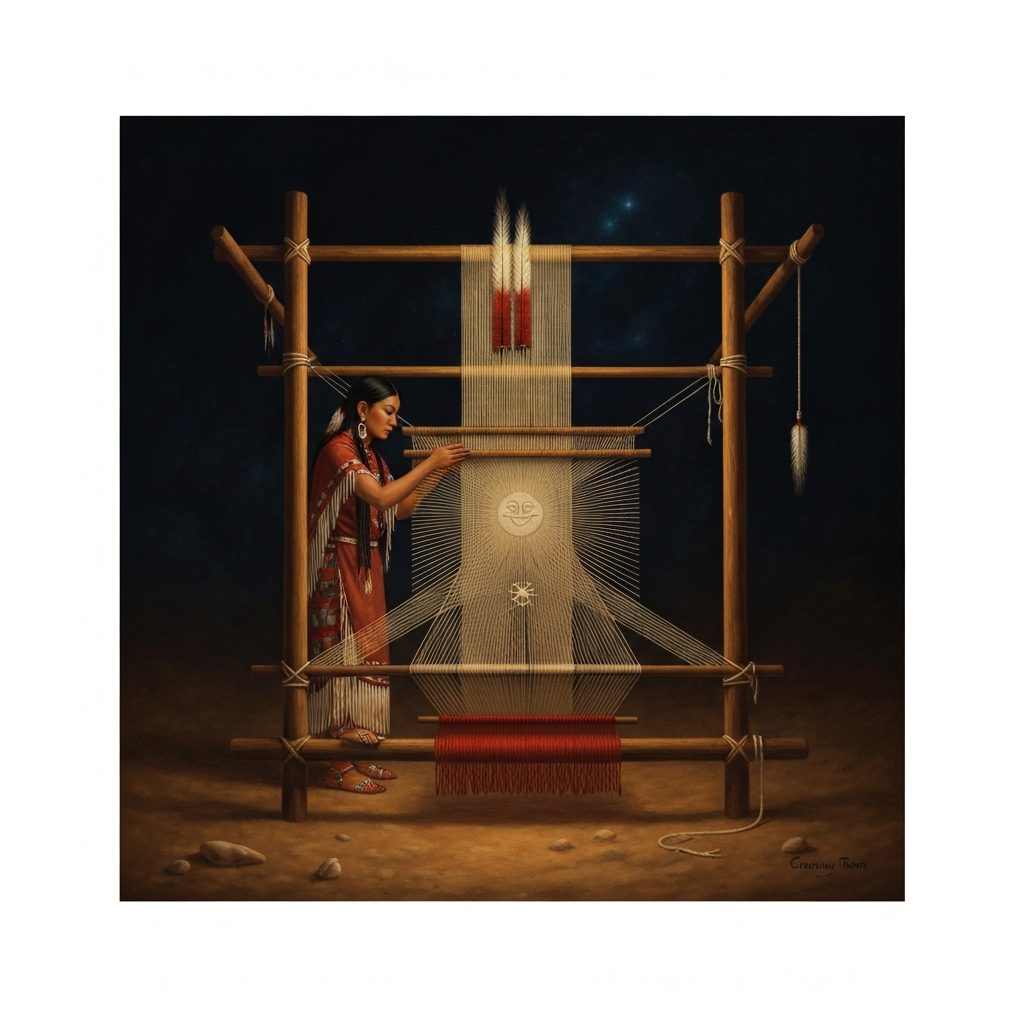
Spider Woman Teaches the Loom
Mythic founding time — early in the Fourth World · Spider Rock, Canyon de Chelly, Arizona — the 800-foot sandstone spire that is her home
Contents
Spider Woman — the ancient being who lives in Spider Rock — teaches the Navajo people how to weave on a loom made from sky and earth and human hair, giving them the art that will sustain them for all generations.
- When
- Mythic founding time — early in the Fourth World
- Where
- Spider Rock, Canyon de Chelly, Arizona — the 800-foot sandstone spire that is her home
Spider Woman lives at the top of Spider Rock.
The spire rises eight hundred feet from the floor of Canyon de Chelly — a single column of red sandstone so tall that its top is often in cloud. She has lived there since before the emergence, since before the people came into this world, since time was being organized. She is very small and very old and she knows everything.
The Hero Twins came to her before their journey to the Sun’s house, and she helped them. She helps anyone who comes to her with a genuine need and the patience to climb.
In the early days of the Fourth World, the Navajo people are cold and have little to cover themselves with. They have animal skins but the skins are heavy and awkward, and the winter comes every year with the same indifference to what the people have.
Spider Woman comes down.
She brings the knowledge of the loom — not the spider’s own web-spinning, which she keeps for herself, but the loom that stands upright and receives the threads in a controlled, geometric way. Spider Man, her husband, explains the structure: the warp sticks are the sky; the weaving sticks are the sun’s rays; the heddles are the rock crystal and the sheet lightning; the batten is the white shell. The comb is made of comb teeth, and the warp threads are rain.
She teaches the women to warp the loom and to throw the shuttle. She teaches them to watch the patterns — not just to follow them but to understand that every pattern is a statement about the structure of the universe, that the geometry of a blanket is the geometry of the sacred mountains and the four directions and the path of the sun.
The women learn.
They learn that each color corresponds to a direction: white for east, blue for south, yellow for west, black for north. They learn that the pattern must close — that an open pattern, a weaving left unfinished at the edge, would trap the weaver’s spirit in the cloth. They learn to leave a small deliberate flaw in every finished piece — the spirit line — so that the weaver’s own consciousness can exit the cloth when the work is done. A weaving with no way out is a weaving that holds the maker.
Spider Woman watches. When a young woman gets frustrated with the complexity of a pattern, Spider Woman is said to send a sign — a spider appearing at the edge of the loom — to say: keep going, this is what patience looks like when it is in your hands.
The rugs and blankets that come from Navajo looms carry these teachings visible to anyone who knows how to read them. The geometric patterns are not decoration; they are prayers made from thread. The sacred mountains are in the corners. The four directions are in the colors. The universe is being woven and rewoven every time a woman sits at a loom and picks up a shuttle.
Spider Woman is still at the top of Spider Rock.
She does not come down unless needed.
The looms are still active, which means she is always needed.
Echoes Across Traditions
Entities
- Spider Woman (Ná'ashjé'ii Asdzáá)
- Spider Man (her husband)
- the first weavers
Sources
- Gladys Reichard, *Spider Woman: A Story of Navajo Weavers and Chanters* (Macmillan, 1934)
- Noel Bennett and Tiana Bighorse, *Navajo Weaving Way* (Interweave Press, 1997)
- Paul Zolbrod, *Diné Bahane'* (University of New Mexico Press, 1984)