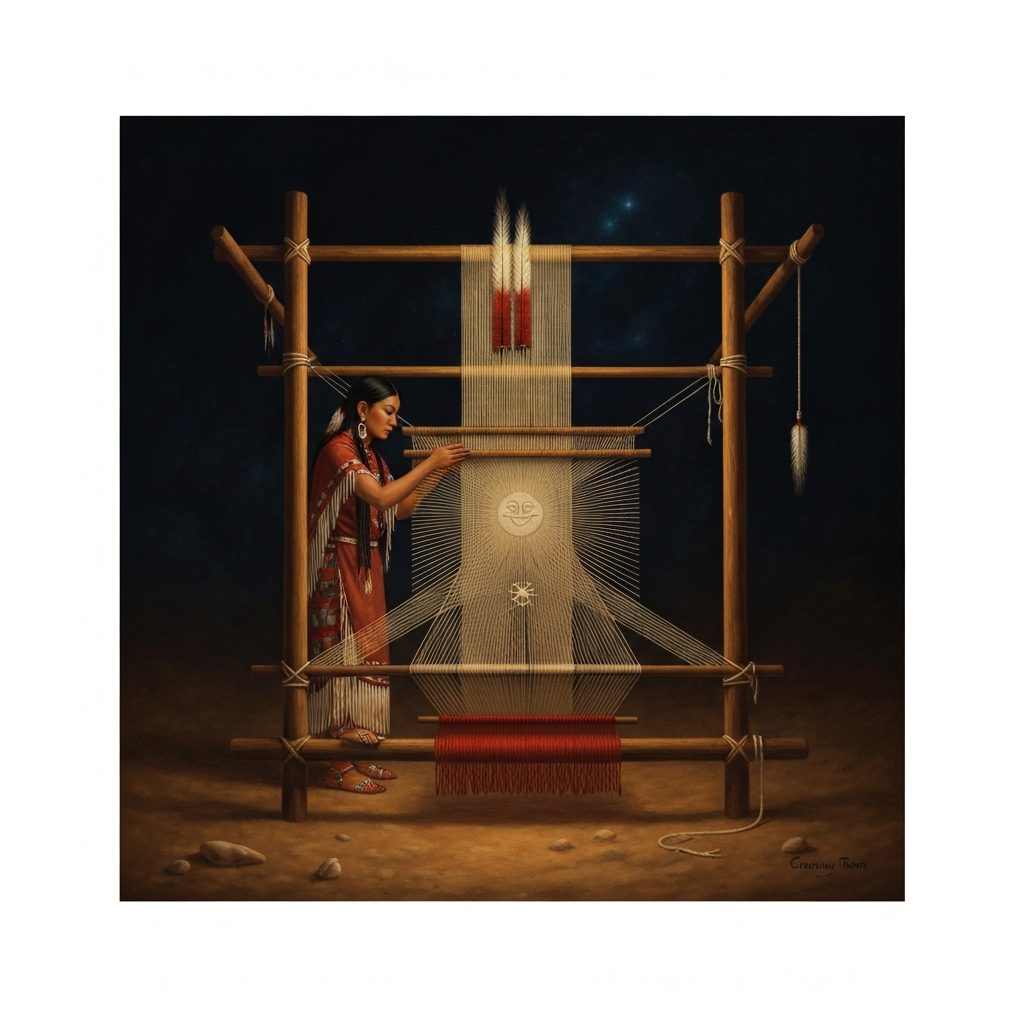
First Man and First Woman in the Fourth World
Mythic time — the first years after the emergence into the Fourth World · The Four Corners region of the Navajo homeland — between the four sacred mountains
Contents
In the Fourth World, First Man and First Woman lay out the sacred mountains with their medicine bundles, argue about who is more necessary, and set in motion the great separation of men and women that nearly destroys the people.
- When
- Mythic time — the first years after the emergence into the Fourth World
- Where
- The Four Corners region of the Navajo homeland — between the four sacred mountains
After the emergence, First Man and First Woman have work to do.
They place the four sacred mountains at the edges of the Navajo homeland: Sisnaajini in the east, white and dawn-colored, decorated with white shell. Tsoodził in the south, blue as turquoise. Dookʼoʼoosliid in the west, yellow as abalone. Dibé Nitsaa in the north, black as jet. They fasten these mountains to the earth with sacred fasteners — lightning, rain, rainbows — so that the world has boundaries that are also doorways.
They make the hogan, the home shaped like the universe, the dome that maps the sky.
Then they argue.
First Woman says: I brought the fire. Everything in this world that is warm comes from me. First Man says: I brought the medicine bundle. Everything in this world that is ordered and named comes from me. First Woman says: without me, there is no life. First Man says: without me, there is no knowledge of how to use life.
This argument is old and does not resolve.
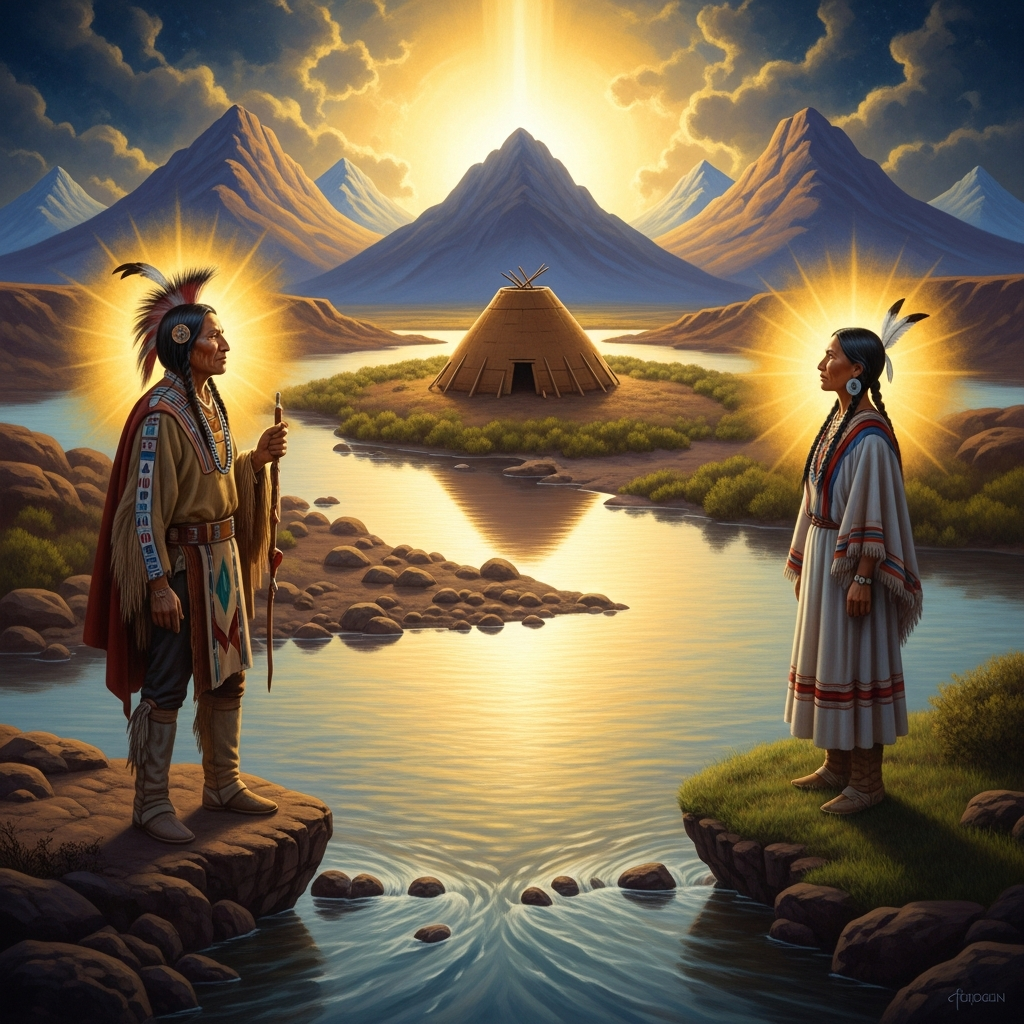
One morning First Woman says something particularly sharp — something about the origin of all power — and First Man takes it as an insult to everything male, to men, to the knowledge he carries. He says: we do not need women. The men will live alone on the other side of the river. We will see who needs whom.
The men cross the river.
The first year is not bad. Both sides have enough food. The men hunt. The women farm. Each side is a little proud, a little lonely, but determined not to admit the loneliness.
The second year is harder. The farms need tending that the women cannot do alone. The hunting requires planning that the men cannot do without counsel.
The third year, things that should not happen begin to happen on both sides of the river. There are children who were not supposed to be born, made in loneliness and desperation. There are ceremonies that fail because they require the presence of both principles to work. The monsters notice that the people are divided and begin moving closer to the river.
The fourth year, First Man and First Woman stand on opposite banks and look at each other across the water.
First Man crosses.
They do not speak for a long time. Then they speak, and what they say is not recorded in the way that a treaty is recorded — what is recorded is that they reached an agreement, a recalibration, an acknowledgment that the world requires both of them and that neither one was as independent as claimed.
The sacred mountains stand at the four directions.
The hogan faces east for First Man, who brought the dawn, and west for First Woman, who brought the fire that lights the dark. Every ceremony that enters through the east doorway honors both of them — the knowledge and the life, the order and the warmth — because the separation taught the Navajo people the one thing that cannot be taught any other way: that the world is made of complementary halves, and that when the halves are separated, the monsters move in.
Hózhó — beauty, balance, harmony — is what you have when First Man and First Woman are on the same side of the river.
Echoes Across Traditions
Entities
- First Man (Áltsé Hastiin)
- First Woman (Áltsé Asdzáá)
- Coyote
- the four sacred mountains

Sources
- Paul Zolbrod, *Diné Bahane'* (University of New Mexico Press, 1984)
- Washington Matthews, *Navaho Legends* (American Folklore Society, 1897)
- Gladys Reichard, *Navaho Religion* (Princeton University Press, 1950)