The Navajo Emergence Through Four Worlds
Before the current world — the mythic time of the underworld journeys · The four underworlds below; the Place of Emergence (Hajíínái) in the Navajo homeland
Contents
The Holy People climb through four underworlds — Black, Blue, Yellow, and White — escaping each world's destruction until they emerge through a reed into the Glittering World, the earth we now inhabit.
- When
- Before the current world — the mythic time of the underworld journeys
- Where
- The four underworlds below; the Place of Emergence (Hajíínái) in the Navajo homeland
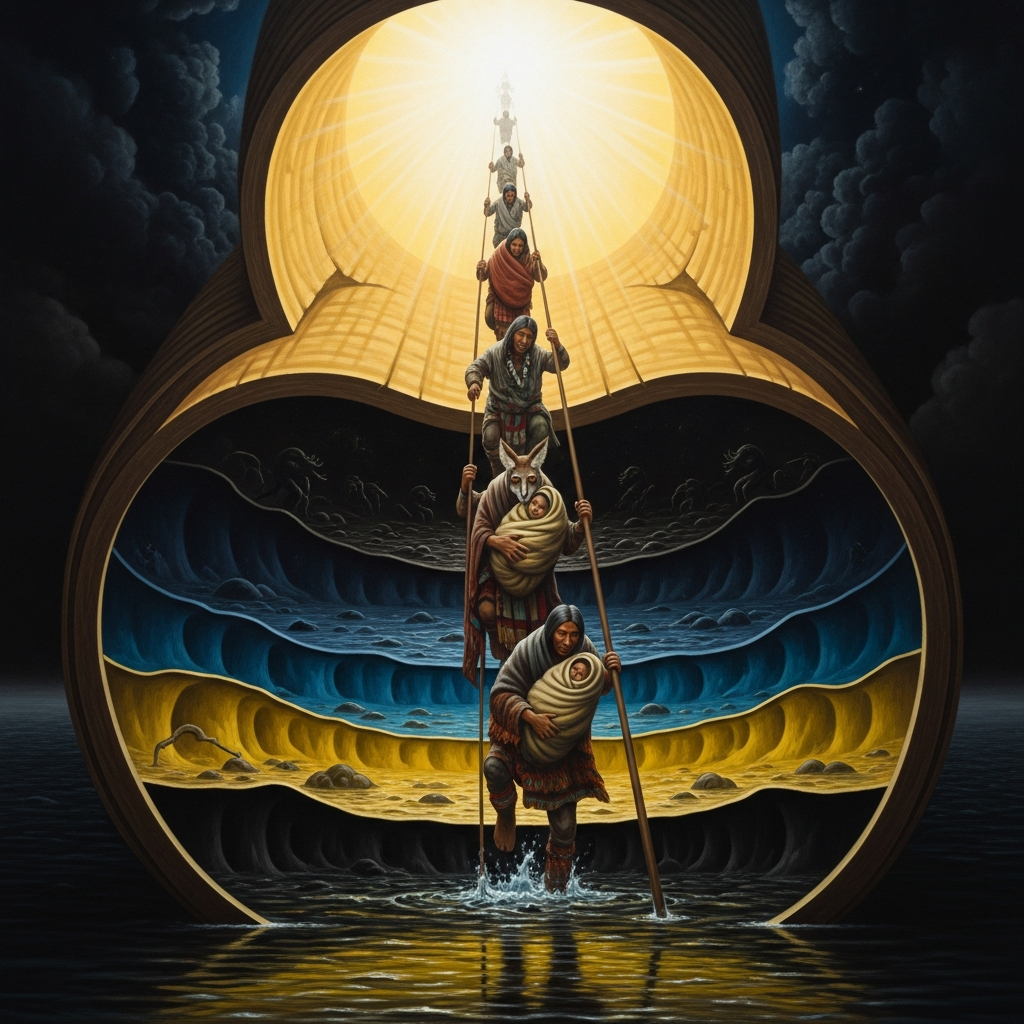
The first world is black.
It is small, like a floating island, and the beings who live in it are not people yet — they are the Holy People, the Diyin Dineʼé, who are not quite human but carry the seeds of all human qualities, including the ones that cause trouble. They live in the First World until fighting begins: the men and the women separate and try to live apart, which is a kind of error that both sides pay for equally. The world becomes untenable. An insect — or some small crawling thing — shows them a way up.
They climb into the Second World, which is blue.
The Blue World is larger and already populated: animals, birds, beings who are not happy to have newcomers. The Holy People break a law here — they behave badly with the wives of the beings who were already there — and must leave quickly. The Second World closes behind them.
The Third World is yellow and larger still. It has rivers and mountains and the beginning of things that will be familiar in the world above. But Coyote is in the Third World, and Coyote’s presence always signals a complication. He steals the baby of Water Monster, a powerful being, and hides it under his blanket. He tells no one. Water Monster, in anger or in grief, releases the sacred waters, and the Third World begins to flood.
The water rises. The Holy People plant a giant reed and climb inside it, climbing up as the water climbs below them. The reed grows with them, extending upward toward the sky of the Third World, pushing toward whatever is above.
They break through into the Fourth World.
They emerge through a hole in the sky — or the earth — and find themselves in the Glittering World, which is the world we live in now. But the water is still rising behind them, flooding up through the hole in the floor. The people stand on the new earth with the water reaching toward their feet.
Someone asks: does anyone know why the flood came? They look at each other. Coyote is standing at the back of the group, his blanket slightly too large, slightly too full. They pull back the blanket and find the baby of Water Monster, who has been crying the whole time in a language only Coyote can hear. They take the child and throw it back through the hole into the water, and the flood begins to recede.
Then they know: the flood came because of Coyote, and the baby had to go back, and the lesson is that stolen things always demand to be returned.
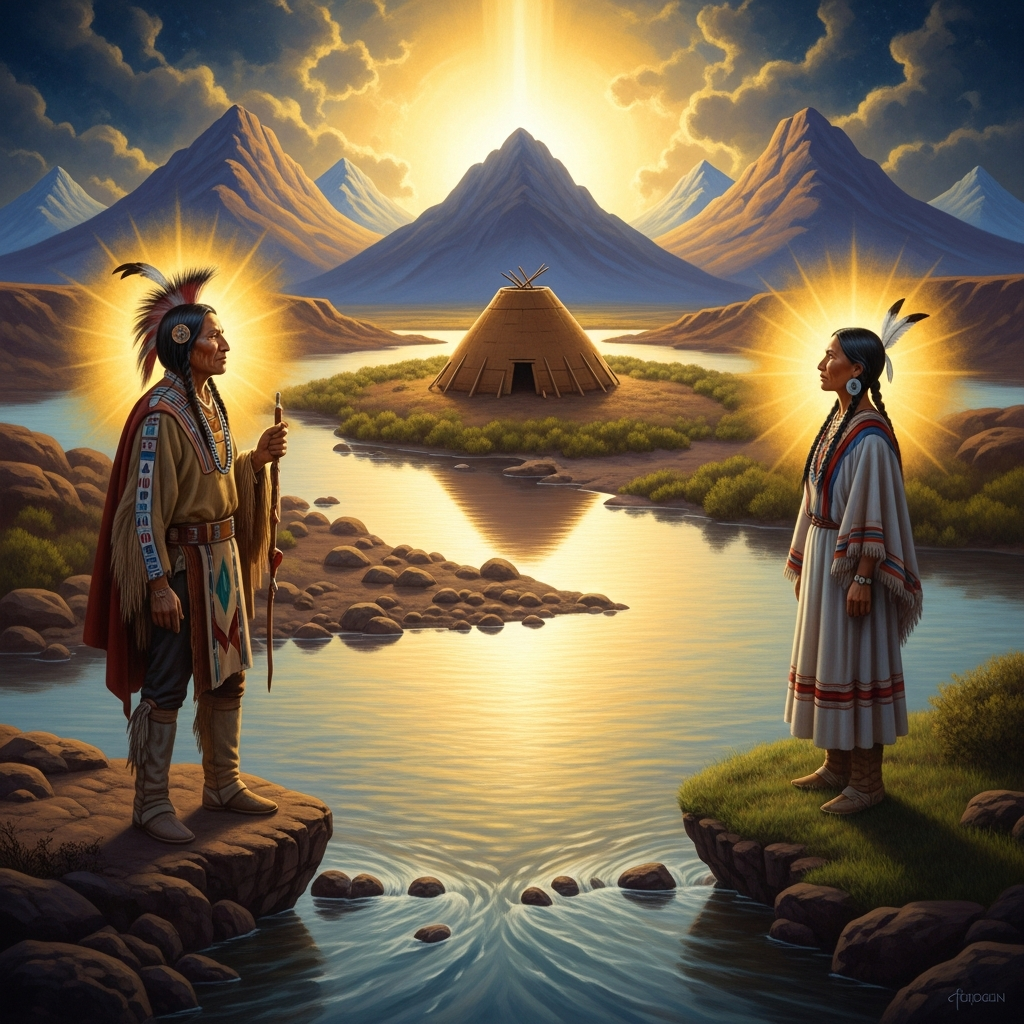
In the Glittering World there is still work to do. First Man and First Woman place the sacred mountains at the four directions. The stars are arranged — carefully, except for the ones Coyote scatters. The sun and moon are created. The Holy People teach the Diné — the People — how to live here, what ceremonies to perform, how to address the powers that are present in everything.
The Place of Emergence is a real location in the Navajo homeland, a sacred site called Hajíínái near the San Juan River. The sipapu, the hole through which the people came, is not visible but is present. The first ceremonies done there are still being done, in the same way, in the same words, because the connection to what happened at emergence is the source of everything that keeps the world in balance now.
Every Navajo ceremony is a return to the emergence.
Every healing is a re-emergence from a world that has become dangerous into a world that is hózhó — harmonious, beautiful, balanced.
Echoes Across Traditions
Entities
- First Man (Áltsé Hastiin)
- First Woman (Áltsé Asdzáá)
- Coyote
- the Holy People (Diyin Dineʼé)
- Water Monster
- the reed

Sources
- Paul Zolbrod, *Diné Bahane': The Navajo Creation Story* (University of New Mexico Press, 1984)
- Washington Matthews, *Navaho Legends* (American Folklore Society, 1897)
- Gladys Reichard, *Navaho Religion* (Princeton University Press, 1950)