Monster Slayer and Born for Water
The founding era — after the emergence, when monsters threatened the Navajo people · The Navajo homeland; the Sun's house in the east
Contents
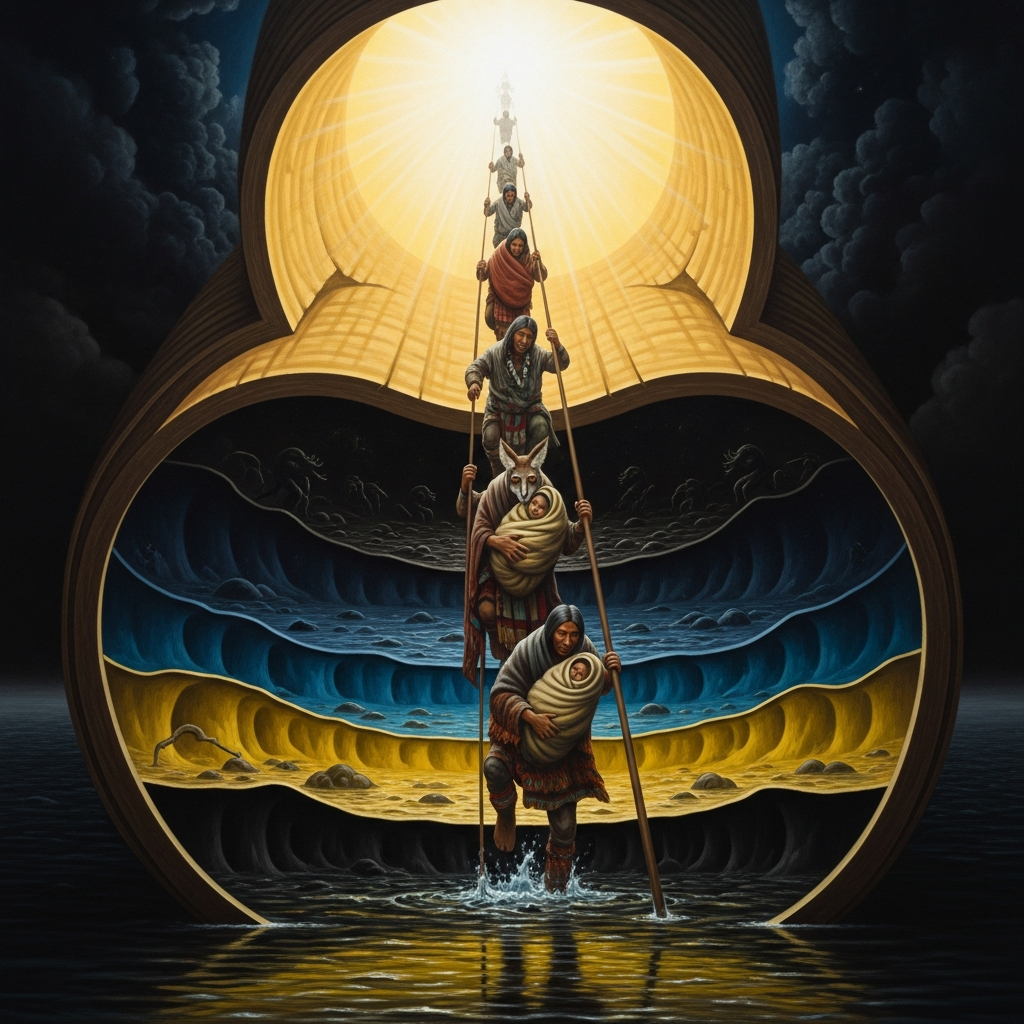
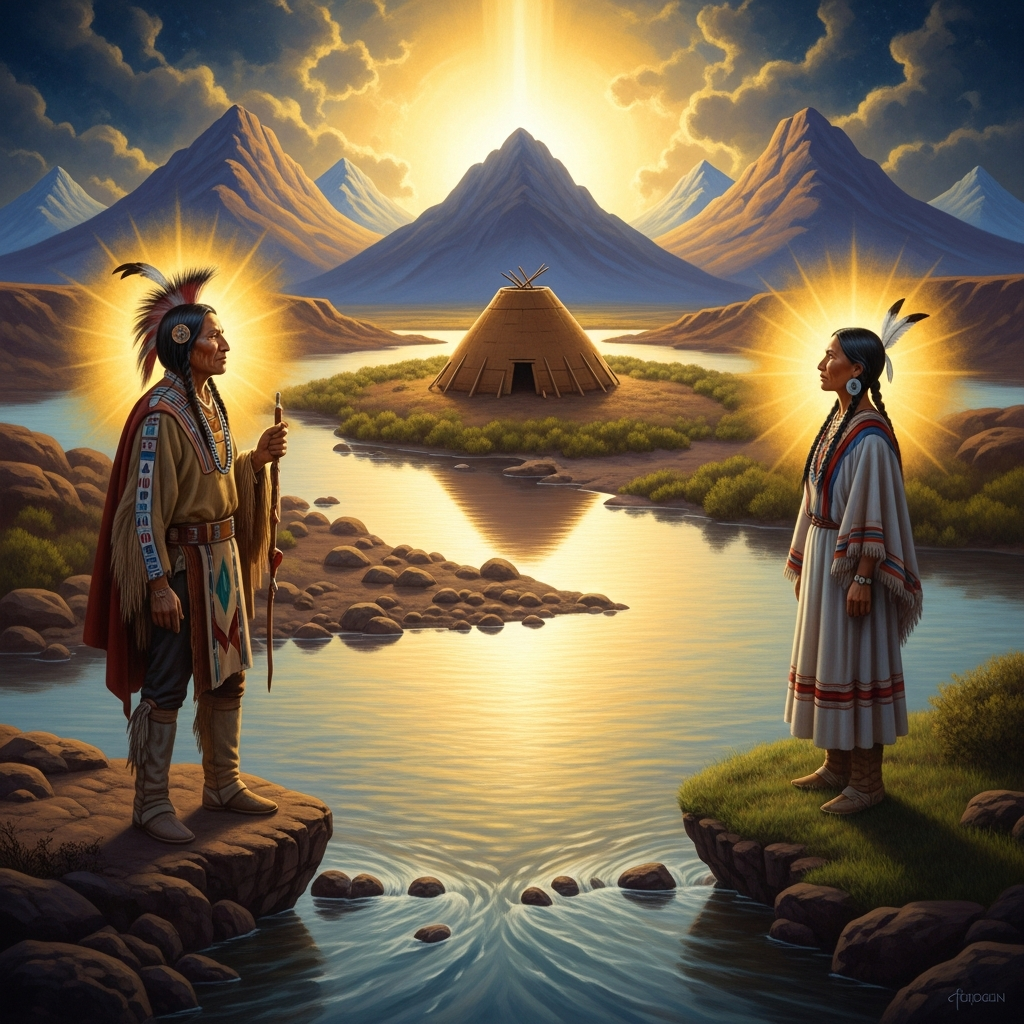
The Hero Twins journey across the dangerous earth to find their father the Sun, survive his lethal tests, receive lightning arrows and thunder armor, and return to destroy the monsters who are killing the Navajo people.
- When
- The founding era — after the emergence, when monsters threatened the Navajo people
- Where
- The Navajo homeland; the Sun's house in the east
The monsters are real.
Yéʼii Tsoh, the Big Giant, walks the earth and eats people. Déélgééd, the Horned Monster, gores them with its great tusks. There are monsters in the water, monsters in the sky, monsters that carry people off in their feathers. The world after the emergence is a world in which the Navajo people are hunted. Changing Woman knows this. She has raised her twin sons in a hidden place, hoping to protect them, but they are old enough now to know what is happening.
Monster Slayer says: we are going to find our father.
Born for Water says: it is very dangerous. Monster Slayer says: yes.
Spider Woman helps them.
She is living in her home in Spider Rock, the great stone spire in Canyon de Chelly, and she has been watching the twins since they were born. She gives them the knowledge they need: the route to the Sun’s house, the dangers they will encounter, the passwords that neutralize the trials. When you reach the place of cutting reeds, she says, call them grandfather. When you reach the place of tearing rocks, call them grandmother. She gives them each a feather and tells them it will protect them if they remember what she has taught.
They walk east across the dangerous earth. The reeds slash at them and they call them grandfather and the reeds are still. The rocks close together like jaws and they call them grandmother and the rocks pause. They cross a desert of blowing sand that scours the skin and they call it grandfather and the sand settles.
At the ocean’s edge they find the house of the Sun.
The Sun does not welcome them.
He tests them. He hangs them on the sharp points of his east wall, his south wall, his west wall, his north wall. He fills a sweat lodge with superheated steam and closes the door on them. He gives them a pipe full of poison tobacco and tells them to smoke all of it. In every test, something intervenes: the feathers Spider Woman gave them, the sacred stones, the wind that brings fresh air through a crack in the sweat lodge wall. In every test they survive what should kill them.
The Sun looks at his sons and says: you are mine.
He gives them their gifts. He gives Monster Slayer the lightning bolts — four arrows made of flint and lightning, the weapons that can kill the unkillable. He gives Born for Water the armor of clouds and rainbow. He teaches them where each monster can be found and which of the monsters must be killed and which must be left alive — because some of the monsters are necessary. Old Age is a monster. Hunger is a monster. Cold is a monster. Poverty is a monster. These cannot be killed because without them the world has no discipline, no urgency, no reason to move.
They come back and kill the monsters.
Monster Slayer strikes Yéʼii Tsoh with the lightning arrow and the giant falls, and when it falls the blood runs across the mesa and turns to stone, and that stone can still be seen in the Navajo homeland. He kills the Horned Monster. He kills the ones in the sky. He kills the ones in the water.
Born for Water stands behind him through all of it, carrying the armor, praying, keeping the balance — because every act of killing, even necessary killing, requires someone to hold the spiritual equilibrium while the other acts.
The world becomes safe enough for the people to live.
But the Enemyway ceremony still exists, because killing still marks the one who does it, even when the killing is necessary. Monster Slayer himself needed to be purified when the last monster fell. That purification is the ceremony that soldiers still receive when they come home from war.
The monsters are gone. The ceremony continues.
Echoes Across Traditions
Entities
- Monster Slayer (Naayéé' Neizghání)
- Born for Water (Tó Bájíshchíní)
- Changing Woman (their mother)
- the Sun (Jóhonaaʼéí, their father)
- Spider Woman (their guide)
- Yéʼii Tsoh (Big Giant)
Sources
- Paul Zolbrod, *Diné Bahane'* (University of New Mexico Press, 1984)
- Aileen O'Bryan, *The Dîné: Origin Myths of the Navaho Indians* (Bureau of American Ethnology, 1956)
- James McNeley, *Holy Wind in Navajo Philosophy* (University of Arizona Press, 1981)