Changing Woman: The Earth's Own Daughter
Mythic time — the founding era after the emergence into the Fourth World · Gobernador Knob (Chʼóolʼįʼí), New Mexico; the western ocean where her turquoise house sits
Contents
She is found as a baby on a mountain, raised by First Man and First Woman, and becomes Asdzáá Nádleehé — Changing Woman — who creates the four Navajo clans from her own skin and walks west to live in a turquoise house in the ocean.
- When
- Mythic time — the founding era after the emergence into the Fourth World
- Where
- Gobernador Knob (Chʼóolʼįʼí), New Mexico; the western ocean where her turquoise house sits
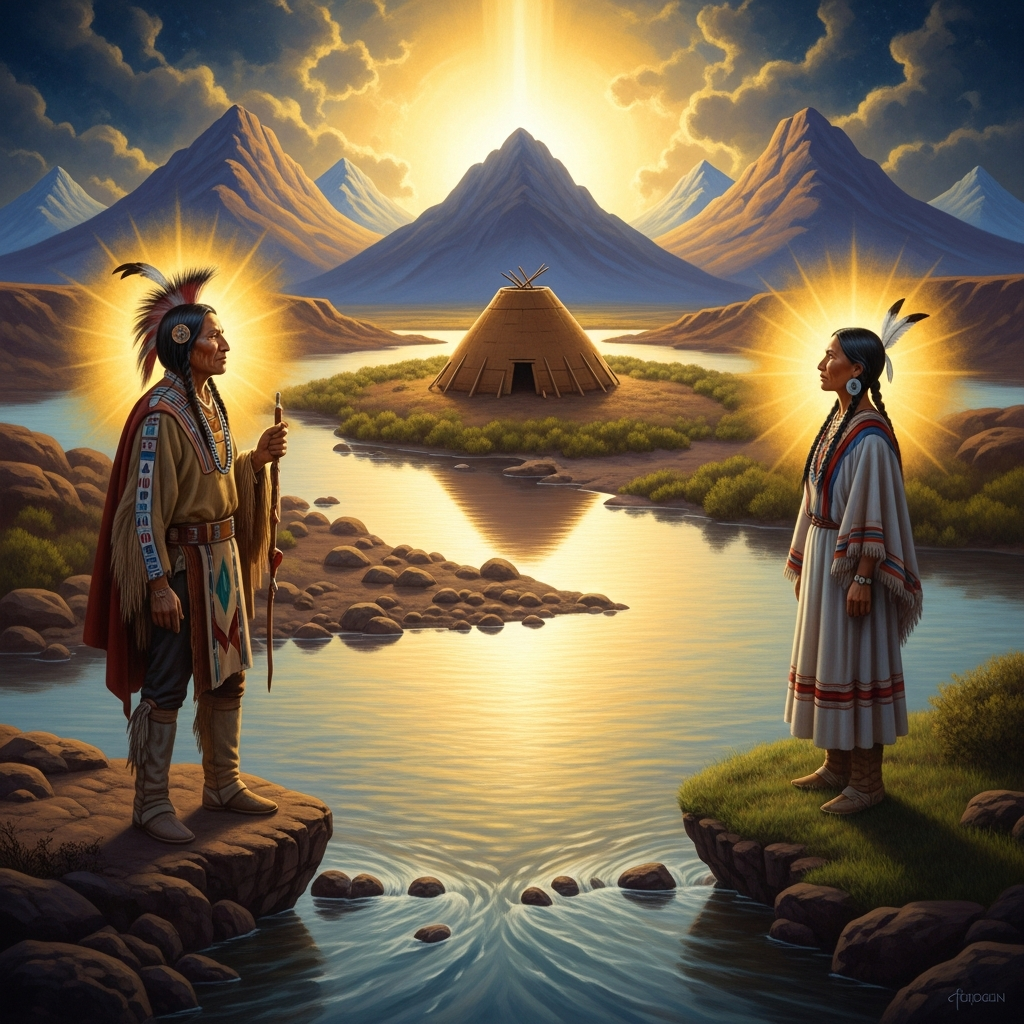
First Man sees the flash of light on Gobernador Knob before he sees her.
It is a particular kind of light — not lightning, not sunrise, but something steady — and he climbs to find it. On the peak, in a cradleboard, he finds a baby girl. She is the color of the turquoise and the white shell and the abalone and the jet that will later be said to be her bones. She is already beautiful. He carries her down the mountain.
First Woman receives her, raises her, names her nothing for the first years because she is not yet what she will be.
In four days — which is four days in the sacred time of myth, which means whatever growing takes — she becomes a young woman. First Man and First Woman perform the first Kinaalda ceremony for her, the ceremony that transforms a girl into a woman in the Navajo way: the running at dawn to greet the sun, the corn cake baked in the earth, the grinding, the prayers. She runs east to meet the light.
The Sun sees her running.
He has been watching her since her birth on the mountain — watching the way he watches everything, which is with total attention and no blinking. He comes to her in the night in the form of a man, as the sun sometimes does. In the morning she finds turquoise pollen on her robe. Nine months later she gives birth to the Hero Twins: Monster Slayer and Born for Water, who will grow up to rid the world of the Naayéé’, the monsters who threaten the people.
This is one story. In another version, she conceives the twins from the drip of water from a waterfall and from the warmth of sunlight — the sky and the earth entering her together.
The clans come from her body.
When the people are formed and the world is being organized, Changing Woman takes the skin that rubs off her body — the dead cells from her forearms, her chest, her legs — and rolls it into small balls and shapes them into the first Navajo people of four clans. She breathes into them and they stand.
This is the Navajo understanding of human kinship: not that people descended from a creator’s external act, but that people literally came from the skin of the earth’s own body. The people are made of her. When they walk on her they walk on a grandmother. When they plant in her they plant in themselves.
She walks west after this.
The Sun builds her a house in the western ocean — a house of turquoise, a house that floats on the water and moves with the seasons — and she lives there. She can be visited. The Hero Twins visit her. The people can reach her through ceremony.
She is never old and never not old. In spring she is a girl running across the greening land. In autumn she is an old woman walking slowly, her hair gray as dried grass. In winter she is absent but not gone. When the first green appears she is young again.
This is why she is called Changing Woman.
Everything that changes is her. Everything that renews is her. The ceremony in which a Navajo girl runs to greet the dawn is not like Changing Woman’s ceremony — it is Changing Woman’s ceremony, again, the same one, the girl becoming the earth becoming the girl, the cycle that does not end.
Echoes Across Traditions
Entities
- Changing Woman (Asdzáá Nádleehé)
- First Man (Áltsé Hastiin)
- First Woman (Áltsé Asdzáá)
- the Sun (Jóhonaaʼéí)
- the Hero Twins (her sons)
Sources
- Paul Zolbrod, *Diné Bahane': The Navajo Creation Story* (University of New Mexico Press, 1984)
- Gladys Reichard, *Navaho Religion: A Study of Symbolism* (Princeton University Press, 1950)
- Charlotte Frisbie, *Kinaalda: A Study of the Navaho Girl's Puberty Ceremony* (Wesleyan University Press, 1967)