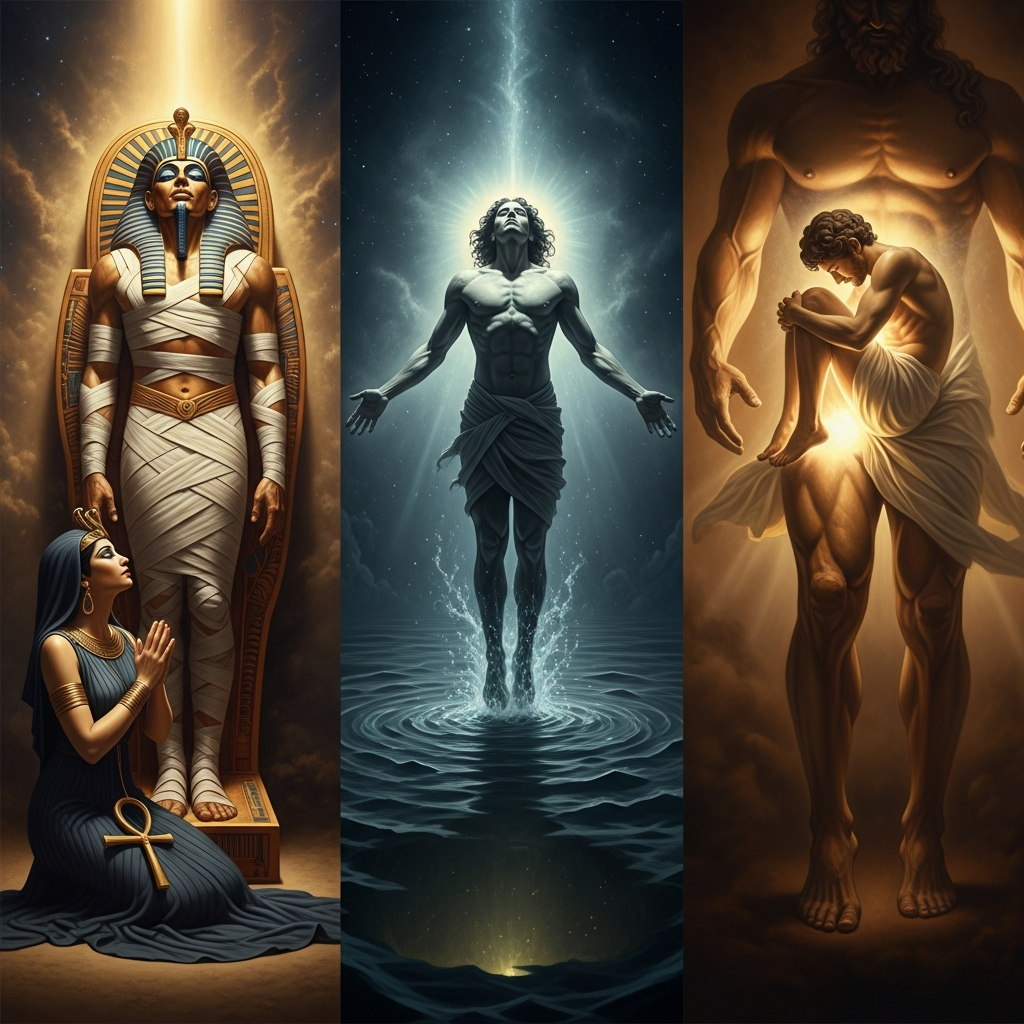
Lords of the Dead: Hades, Osiris, Yama, Ereshkigal, Hel, and Mictlantecuhtli
Ancient, across all periods — Sumerian Bronze Age through Norse and Aztec periods · Elysium and Tartarus, the Duat, Naraka, Irkalla, Niflheim, Mictlan
Contents
The underworld ruler is almost never evil. Across six traditions, the god of the dead is just, melancholy, and bound by rules as rigid as death itself. The bureaucracy of the afterlife reveals what each civilization feared most about dying.
- When
- Ancient, across all periods — Sumerian Bronze Age through Norse and Aztec periods
- Where
- Elysium and Tartarus, the Duat, Naraka, Irkalla, Niflheim, Mictlan
The underworld rulers of world mythology share a quality that surprises most people encountering them for the first time: they are almost never evil.
Hades does not tempt souls to damnation. Osiris does not rig the scales. Yama applies karma; he does not invent it. Ereshkigal enforces the laws of the Great Below; they are older than she is. Hel takes the dead assigned to her and holds them; she does not recruit them. The underworld ruler, in tradition after tradition, is not an adversary but an administrator — the divine official responsible for the realm that every living thing is eventually going to enter.
This convergence is meaningful. It suggests that what ancient peoples needed from their underworld deity was not a tyrant to fear but a judge to trust. The afterlife anxiety that haunted the ancient world was not “what if something evil gets me?” It was “what if I am not treated fairly?” The underworld ruler is the mythology’s answer to that anxiety, and the answer is almost always: the rules are the rules, and they apply to everyone, and they are just.
Hades: The God Who Never Lies
Hades is one of the three sons of Kronos and Rhea, and at the division of the cosmos after the Titanomachy, he received the realm below. This was not punishment — the division was by lot — but it was the worst draw, and Hades’ character in Greek mythology reflects the weight of it.
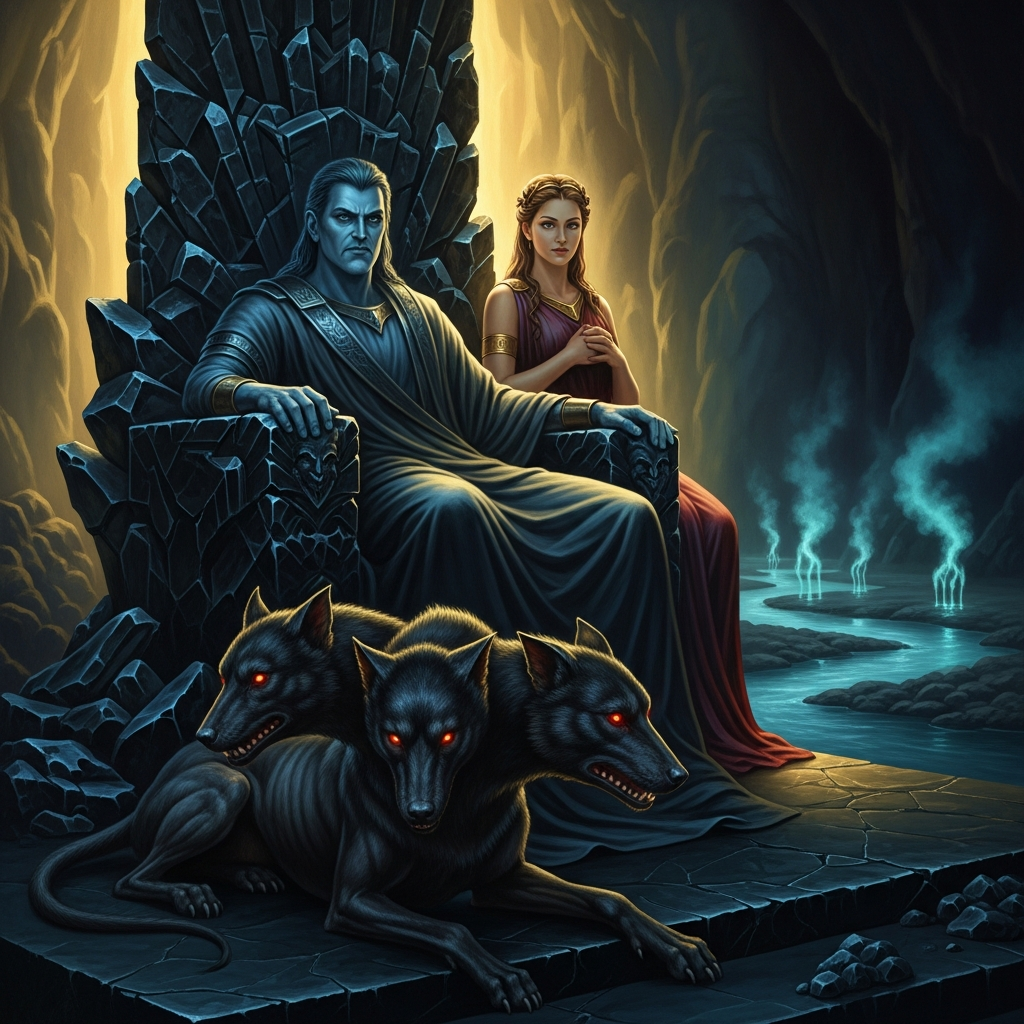
He is among the least present of the Olympians. He has no Homeric Hymn of his own. He rarely appears in the myths of other gods. He sits in his underground palace with his wife Persephone and his dog Cerberus and administers the realm of the dead, and that is essentially what he does. The texts describe him as inflexible, impartial, and completely bound by the laws of his domain. When Orpheus comes to plead for Eurydice, Hades does not refuse out of cruelty but relents because the argument is compelling — and then enforces the condition (don’t look back) without mercy when it is violated.
One of Hades’ standing epithets is “the Unseen,” derived from his helmet of invisibility, but it also functions as a description of his relationship to the living world: he is the force that cannot be looked at directly, the reality that is always there beneath everything, the destination that every road eventually reaches.
He is not Pluto — that is a later, more benign interpretation that emphasizes his role as the god of underground wealth (gems, minerals, fertile soil). In his original character, Hades is simply the dead’s keeper, and his defining quality is that he keeps what he has. The Homeric phrase for death — “the house of Hades” — is not metaphorical. The dead are his guests. They do not leave.
Osiris: The Murdered Judge
Osiris is unique among underworld rulers because he knows what it is to die.
He was a king of the living world before he was king of the dead. His brother Set murdered him, dismembered his body, and scattered the pieces. His wife Isis gathered the pieces, reconstituted the body, and conceived their son Horus through magical means. Osiris was restored — but not to life among the living. He became the first of the dead, and in that capacity the most authoritative possible ruler of the afterlife: he has been through it himself.
His court in the Hall of Two Truths (Maaty) is the most procedurally detailed afterlife judgment in ancient theology. The deceased’s heart is weighed on a scale against the feather of Ma’at, the principle of truth and cosmic order. Forty-two judges observe. The deceased recites the Negative Confession — a litany of sins not committed — addressing each judge by name. Thoth records the verdict. If the heart is heavier than the feather, Ammit — the devourer, part lion, part hippopotamus, part crocodile — consumes it, and the soul ceases to exist entirely, the “second death” that the Egyptians feared more than death itself.
The judgment is not arbitrary. It is a measurement. Ma’at is not Osiris’s personal opinion; it is the cosmic principle to which even Osiris is subject. The king of the dead does not make the rules. He enforces them. This is the Egyptian theology of death at its most honest: there is no appeal to relationship, no exception for the powerful, no clemency based on status. The scales do not care who you were.
Ereshkigal: The Queen Who Did Not Choose Her Throne
Of all the underworld rulers in this survey, Ereshkigal is the most sympathetic and the most psychologically complex.
The Sumerian texts present her as a figure of suffering rather than power. When Inanna descends to the Great Below, Ereshkigal is described as “moaning like a woman in childbirth” — laboring in a grief that has no resolution, trapped in a realm where she is queen but also prisoner, where her domain is defined entirely by death and she must live in it forever.
Her confrontation with Inanna is not simply a conflict between sisters. It is a collision between the divine principle of desire (Inanna, queen of heaven, goddess of love and war) and the divine principle of cessation (Ereshkigal, queen below, goddess of death and the unchanging). When Ereshkigal kills Inanna and hangs her body on a hook, she is not acting from malice but from the laws of her realm: nothing that enters the underworld may leave unchanged. Even a god must surrender what she is.
In the later Akkadian text of Nergal and Ereshkigal, the underworld queen takes the war god Nergal as her husband — an event that is partly a love story and partly a negotiation about the boundary between the living world and the dead. Ereshkigal gets a companion. The underworld gets a warrior. The Great Below becomes slightly less absolutely cold.
Yama: The First Man to Die
The Hindu-Buddhist Yama is one of the most ancient underworld deities in the Indo-European tradition, cognate with the Norse Ymir, the Persian Yima, and possibly the Roman Remus. His authority is not inherited but experiential: he was the first mortal to die, and therefore the one who found and opened the path that every subsequent soul must follow.
In Vedic texts, Yama is not fearsome but stately — a king who governs with the records his scribes Chitragupta keeps for every soul. Karma is the mechanism: the quality of your actions in life determines the quality of your experience after death. Yama does not create these consequences; he oversees their execution. The Hindu texts describe the hell realms — Naraka — with considerable elaboration, and the Buddha’s later cosmology added further layers of post-death experience, both hellish and paradisiacal, through which souls cycle according to their accumulated karma.
Yama appears in the Katha Upanishad as the teacher of the young Nachiketa, who arrives in Yama’s hall and waits three nights without food while Yama is absent. When Yama returns, he offers three boons in apology. Nachiketa’s third boon — the secret of what lies beyond death — produces one of the great theological dialogues in world literature. The lord of the dead is the only one who can answer the question of what death actually is, which is why Nachiketa asks him.
The Bureaucracy of the Afterlife
The pattern that unites these six figures — Hades, Osiris, Yama, Ereshkigal, Hel, Mictlantecuhtli — is that they are administrators, not tyrants. Their realms are governed by rules they did not invent and cannot violate. The scales of Ma’at are beyond Osiris’s discretion. The four years of obstacles in Mictlan are structural, not personal. Hades enforces his own laws on himself; he released Persephone for half the year because the rules required it.
This says something profound about what the ancient world needed from its afterlife theology: not deliverance from judgment but assurance that the judgment was trustworthy. The terror of death is the terror of the unknown — of what happens when you are no longer in control of anything. The underworld ruler who enforces just, fixed laws is the mythology’s answer to that terror. You may not like the verdict. But it will be accurate.
Echoes Across Traditions
Entities


Sources
- Jan Assmann, *Death and Salvation in Ancient Egypt* (2005)
- Walter Burkert, *Greek Religion* (1985)
- Wendy Doniger, *The Hindus: An Alternative History* (2009)
- Diane Wolkstein and Samuel Noah Kramer, *Inanna: Queen of Heaven and Earth* (1983)
- H.R. Ellis Davidson, *Gods and Myths of Northern Europe* (1964)
- David Carrasco, *City of Sacrifice: The Aztec Empire and the Role of Violence* (1999)