The Mind of the Divine: Athena, Thoth, Odin, Saraswati, and Ganesh
Ancient, across all periods — Egyptian Old Kingdom through classical Hindu period · Athens, Hermopolis, Asgard, the Saraswati River, the Hindu heavens
Contents
Wisdom deities are never merely bookish. Across five traditions, the god of wisdom is also a strategist, a scribe, a shaman, or a remover of obstacles. Wisdom in the ancient world was a form of power — and its divine embodiments reflect that.
- When
- Ancient, across all periods — Egyptian Old Kingdom through classical Hindu period
- Where
- Athens, Hermopolis, Asgard, the Saraswati River, the Hindu heavens
Every civilization that has thought carefully about human intelligence has eventually made that intelligence divine.
The wisdom deity is the mythology’s most self-referential invention: a divine being whose domain is the ability to think clearly, to record accurately, to create skillfully, to see strategically. The wisdom god is what divine intelligence looks like when you try to give it a face — and the face it gets is different in every tradition, because every tradition has a different theory of what wisdom actually is.
Is it military strategy? Athena. Is it the written record? Thoth. Is it knowledge purchased through suffering? Odin. Is it the flowing current of speech and song? Saraswati. Is it the capacity to begin and persist? Ganesh. The different profiles are not merely different emphases. They are different answers to the question: what is the most important thing a mind can do?
Athena: Wisdom as the Art of Victory
Athena’s birth is the most famous in Greek mythology: she springs fully armed from Zeus’s head after Hephaestus splits the skull with a bronze axe (or, in some accounts, a hammer). She arrives shouting her war cry, wearing her armor, carrying her spear and shield, ready for battle at the moment of her existence.
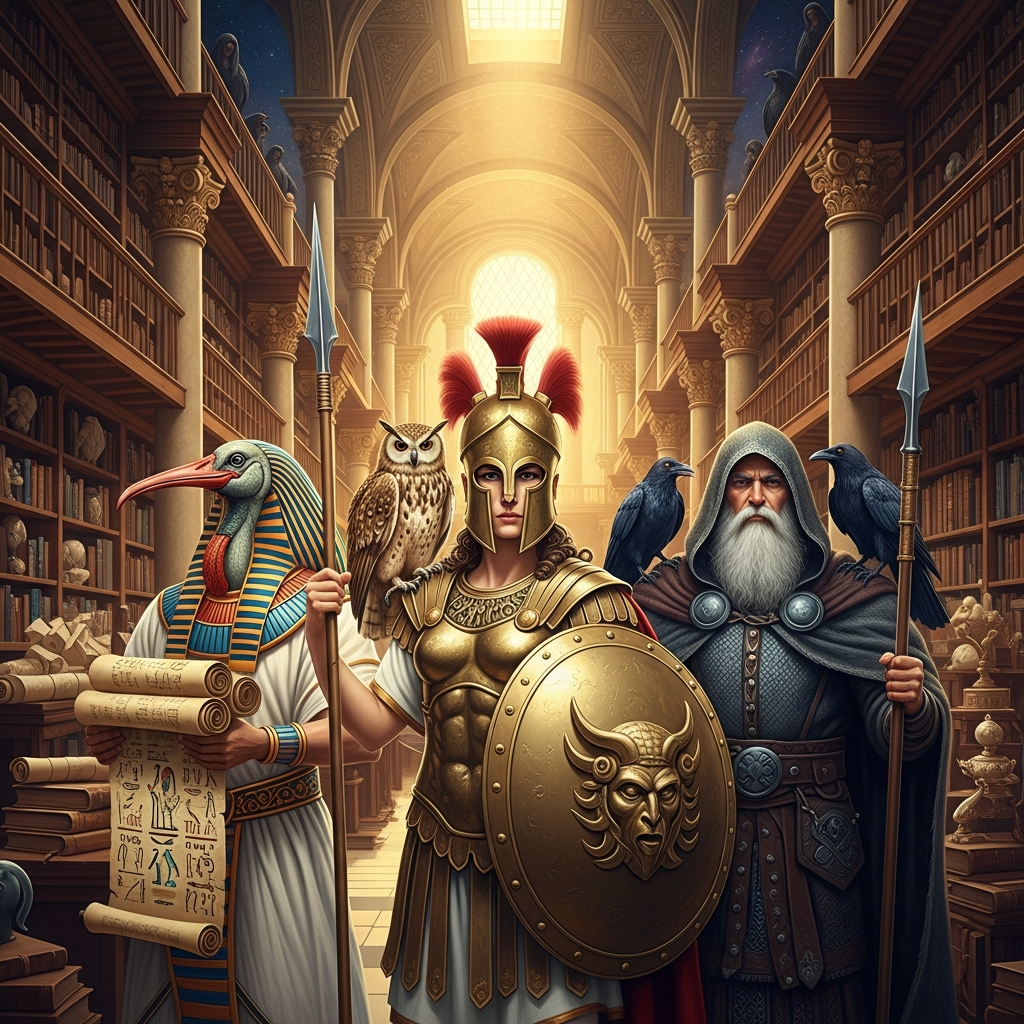
This origin story is a theological statement: wisdom in the Greek world is not contemplative. It is strategic. Athena’s domains are military tactics (not Ares’ bloodlust but the general’s calculation), weaving (the craft that turns raw material into structured form), civic law (the transformation of conflict into procedure), and the making of cities (the application of intelligence to collective life). She is the intelligence that acts, that builds, that wins.
Her patronage of Athens over Poseidon’s was won by demonstrating that the olive tree was more valuable to civilization than salt water — not more dramatic, not more immediately powerful, but more lastingly useful. This is Athena’s calculus: practical intelligence, long-term value, sustainable production. She does not promise spectacle. She produces outcomes.
The contrast with Ares is the defining axis of Greek theology about violence. Ares is strong; Athena is effective. Ares loves the fight; Athena wants to win. The gods, in general, tolerate Ares and revere Athena — which is the Greek evaluation of brute force versus applied intelligence in the same judgment.
Thoth: The God Who Records Everything
Egyptian civilization was, in significant measure, built on writing. The administrative apparatus of the pharaonic state — taxation, accounting, law, religion, history — depended on the written record. In a culture where writing was this foundational, making the patron of writing a divine figure was not decorative but constitutional.
Thoth — ibis-headed scribe, measurer of time, keeper of the divine records — was not one of the great cosmic deities of the Egyptian pantheon. He was not the sun or the creator or the king of the gods. But he was present everywhere the gods needed something recorded, calculated, or adjudicated. When the gods gathered for a council and the decision needed to be preserved, Thoth was there with his palette and reed. When the deceased arrived at the Hall of Two Truths for judgment, Thoth recorded the verdict. When Nut needed additional days to give birth, Thoth gambled with the moon for them.
The Egyptian concept of wisdom is not primarily about personal intelligence but about accuracy — the correct recording of what is. Thoth’s most important attribute is not brilliance but precision. He writes what actually happened, not what was supposed to happen, not what anyone would prefer had happened. The divine record is true. This is his entire theological purpose.
In the later Hermetic tradition, Thoth was identified with Hermes and became Hermes Trismegistus — the “thrice-great Hermes” — credited with authoring the foundational texts of Western alchemy and astrology. The Egyptian scribe god, merged with the Greek messenger god, became the patron of the most esoteric knowledge in the Western tradition.
Odin: Wisdom as Ordeal
Odin does not receive his wisdom. He acquires it through a series of self-inflicted acts of suffering so extreme that they constitute a theology of knowledge in themselves.
The runes — the Norse sacred writing system, understood to be far more than an alphabet — were not invented. They existed in the cosmos, hidden. Odin discovered them by hanging himself on Yggdrasil, the world tree, for nine days and nights, pierced by his own spear, without food, without water, looking down into the darkness. On the ninth day, the runes appeared to him. He screamed, took them up, and fell back.
He also sacrificed one eye to drink from Mimir’s well, which lies at the root of Yggdrasil. The well contains cosmic knowledge — the underlying truth of events. Mimir, the wise head who guards it, charged one eye for a single drink. Odin paid without hesitation. The missing eye is visible in every representation of him: wisdom that cost something specific, permanently marked on the body.
This is the most unusual wisdom theology in the survey. Athena is given wisdom as a birthright, as an inherent divine quality. Thoth’s wisdom is functional — he is wise because wisdom is his role. Odin’s wisdom is acquired through a process that would kill anyone else, and the acquisition is always marked, always at a cost. The Norse theology of knowledge insists that the most important things cannot be simply known. They must be paid for. And the cost is always personal.
Saraswati: Wisdom as the Current of Language
If Athena is strategic wisdom and Thoth is archival wisdom and Odin is earned wisdom, Saraswati is flowing wisdom — the current of intelligence and creativity that moves through speech, music, and learning.
She is associated with the Saraswati River, one of the sacred rivers of the Rig Veda, which has since dried up (its course is archaeologically attested in the Thar Desert). The identification of a goddess of knowledge with a river is not incidental: the river flows, carries, nourishes, and makes fertile. Knowledge in Saraswati’s theology is a current that irrigates the mind, not a fixed store to be accumulated.
She is the patroness of students, teachers, musicians, poets, and scholars, and her image — white robes, lotus seat, vina in hand, book and water pot present — emphasizes purity and flow. Her annual festival, Saraswati Puja (or Vasant Panchami), is observed at the beginning of spring. Students place their books and instruments before her image overnight. The act of study is made sacred by its dedication to the goddess of the current of learning.
Ganesh: Wisdom as the Capacity to Begin
Ganesh is the most pragmatic wisdom deity in this survey, because his domain is not knowledge per se but the application of intelligence to the act of undertaking.
He is Vighnaharta — the remover of obstacles — and Vighnakarta — the creator of obstacles (for those who deserve them). He is propitiated at the beginning of every Hindu undertaking: a new business, a marriage, a journey, an exam, a new home. The prayer is not for success exactly but for the clearing of whatever blocks the path to the work.
His mythology includes the moment when he served as scribe for the Mahabharata, the greatest epic in Sanskrit literature. The sage Vyasa was dictating it without pause; a stylus broke; Ganesh snapped off one of his own tusks and used it as a pen rather than interrupt the flow of composition. The image of the wisdom deity as problem-solver — one who finds a tool where none is available, who keeps the work moving by any means necessary — is Ganesh’s defining characteristic.
He is also the god of writing itself, which connects him to Thoth across the Indian Ocean. Both deities are associated with the record, the text, the written form of thought. But where Thoth’s writing is primarily about accuracy and preservation, Ganesh’s is about the act of composition itself — the creative, continuous, obstacle-removing work of putting thought into permanent form.
What Wisdom Deities Agree On
Five different profiles, five different emphases — but one thing the wisdom deities agree on across all traditions: wisdom is not a luxury. It is a necessity.
Athena is needed because military victories require intelligence as much as strength, and civilization requires governance as much as force. Thoth is needed because a complex civilization depends on written records, and someone divine must be responsible for their accuracy. Odin is needed because the most important knowledge cannot be received passively — it must be pursued to the ends of the self. Saraswati is needed because the life of the mind and the arts is not secondary to practical action but the current that makes action meaningful. Ganesh is needed because even the wisest plan fails when something blocks the way.
The wisdom deity is the mythology’s recognition that intelligence — the capacity to know, record, create, strategize, and persist — is not merely human. It is cosmic.
Echoes Across Traditions
Entities


Sources
- Walter Burkert, *Greek Religion* (1985)
- Richard Wilkinson, *The Complete Gods and Goddesses of Ancient Egypt* (2003)
- H.R. Ellis Davidson, *Gods and Myths of Northern Europe* (1964)
- Wendy Doniger, *The Hindus: An Alternative History* (2009)
- David Leeming, *The Oxford Companion to World Mythology* (2005)