Haoma: The Plant That Touches the Divine
The primordial era and throughout the sacred ritual year · The sacred mountain where Haoma grows — the high slopes where the plant that touches the divine is gathered
Contents
The sacred plant Haoma grows on the mountain of creation and is pressed to yield a drink that strengthens warriors, heals the sick, and lifts the priest's prayers to the divine — a plant whose identity has been debated and sought for three thousand years.
- When
- The primordial era and throughout the sacred ritual year
- Where
- The sacred mountain where Haoma grows — the high slopes where the plant that touches the divine is gathered
He comes to Zarathustra at the mortar.
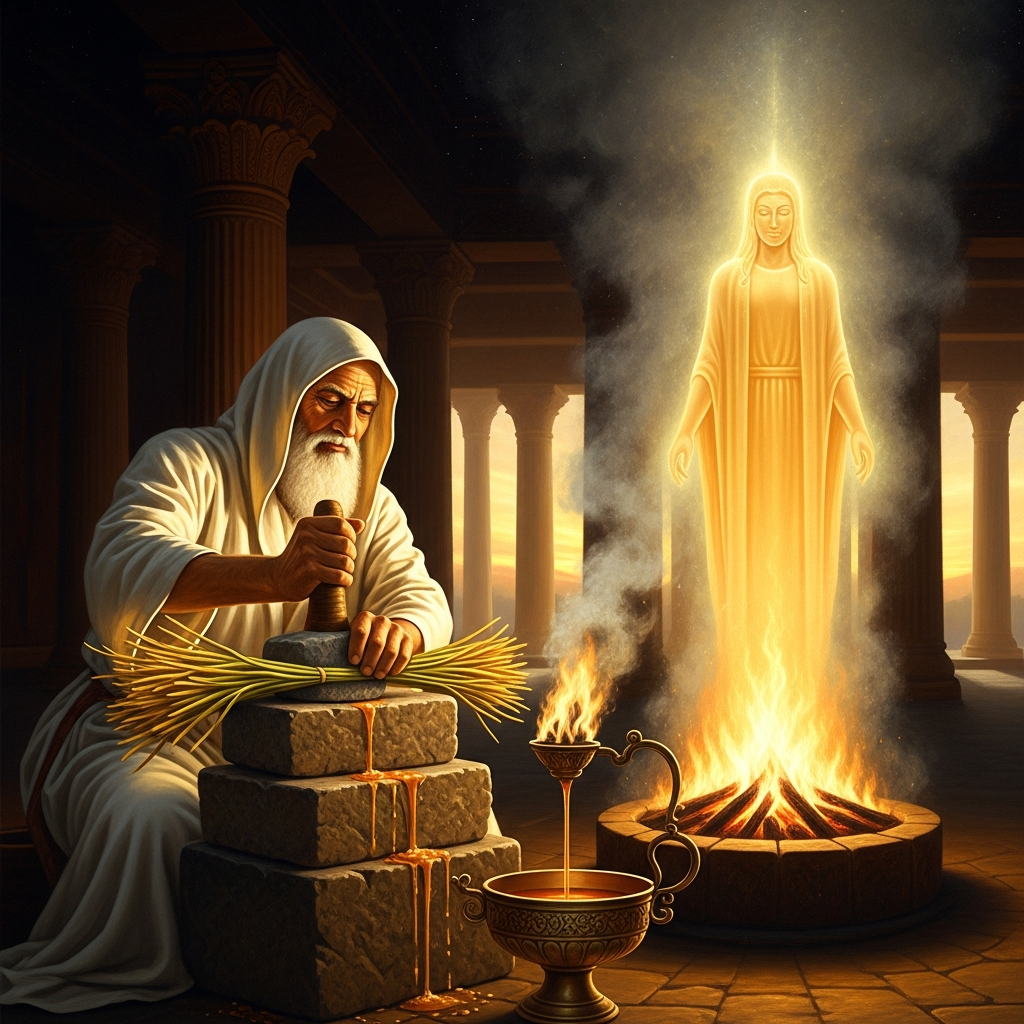
The Yasna records the encounter: Zarathustra is pressing Haoma — the golden-green plant that has been gathered from the mountain slopes and brought to the ritual space to be crushed between the two pressing stones, the mōrtar and pestle of divine ceremony — when Haoma himself appears, in human form, asking to be honored.
This is the paradox at the center of the Haoma ceremony: the plant is both the substance being pressed and the divine being present in the pressing. You are not using Haoma; you are worshipping Haoma while Haoma worships with you.
Zarathustra asks who he is.
I am Haoma, the figure answers. The uncorrupted one. The tall one. The golden one. Press me for the drink of the righteous. Press me for the exhilaration that strengthens.
The exchange is strange in the context of Zarathustra’s reform, because Zarathustra is elsewhere notably hostile to the daeva-cults and their intoxicating rituals. His Gathas have passages that seem to condemn the excessive drinking of what he calls urine of drunkards — the ritual beverages of the religious traditions he was reforming. And yet in the Yasna, the central ritual text of the religion he founded, the pressing and drinking of Haoma occupies the most sacred liturgical position.
The resolution most scholars now accept: Zarathustra condemned the daeva-rituals in which intoxication was the point, where the drunken priest was considered divinely possessed and the chaos of inebriation mistaken for divine presence. He retained the Haoma ritual because in its proper form it was not about intoxication but about the aligning of the worshipper with the divine order through precise, attentive ritual action.
Haoma is said to give four gifts, depending on who presses him.
The first presser of Haoma was Vivanghat, and his gift was a son — Jamshid himself, the golden king of the four-hundred-year summer. The second presser was Āthwya, and his gift was Thraetaona, who would defeat the serpent-king Azi Dahāka. The third presser was Thrita, the healer, who received the gift of healing from Haoma — the first physician who could cure disease and delay death. The fourth presser was Pourushaspa, Zarathustra’s own father, whose pressing gave him the prophet.
In each case the gift is not the drink itself but the son, the consequence, the future that the ritual makes possible. Haoma does not give his gifts directly — he gives them through lineage, through the generations that follow from an act of correct ritual performed with attention and devotion.
The botanical identity of the original plant has been debated for two centuries.
The most serious candidates include: Ephedra species, whose alkaloids produce alertness and mild euphoria and which grow on exactly the mountain slopes where Haoma would have been gathered; Amanita muscaria, the fly agaric mushroom; cannabis; and several other psychoactive plants of the Central Asian steppes. The debate remains unresolved. The ancient practitioners, who had the original plant in their hands every time they pressed it, left us the liturgy but not the botany.
What they left is the image that survives: the priest at the stone, pressing the golden-green stalks, the juice running amber into the vessel, the smoke of the fire carrying the prayers upward, and Haoma himself present in the pressing — a divine being who submits to being ground between stones so that something in him can be extracted and given to the human who is trying to reach the divine.
The structural parallel with the Eucharist is not coincidence.
Both sacraments involve a divine being who submits to being consumed for the worshipper’s benefit. Both involve a drink that is simultaneously substance and presence. Both transform the one who receives them — the Haoma presser is strengthened, healed, made eloquent, granted divine favor; the Eucharistic communicant receives the divine life. The shared Indo-European root of the ritual is visible in the structural parallels even across the three-thousand-year distance between them.
The golden plant grows on the mountain.
The mountain is wherever the righteous seek it.
Echoes Across Traditions
Entities
- Haoma
- Ahura Mazda
- Zarathustra
- Vivanghat
- Thrita

Sources
- Avesta, *Hom Yasht* (*Yasna* 9–11), translated by James Darmesteter
- Mary Boyce, *A History of Zoroastrianism*, Vol. I (Brill, 1975)
- R. Gordon Wasson, *Soma: Divine Mushroom of Immortality* (Harcourt, 1968)
- P.O. Skjærvø, 'Haoma,' *Encyclopædia Iranica* (2002)