Combat Profile
Sacrificial Conveyance
Carries any offering, prayer, or oath directly to the addressed deity, ensuring divine acknowledgment; ignores spatial and dimensional boundaries
Twice-Born Flame
Agni is reborn each dawn and at every kindling; he cannot be permanently extinguished while one ember remains anywhere in the cosmos
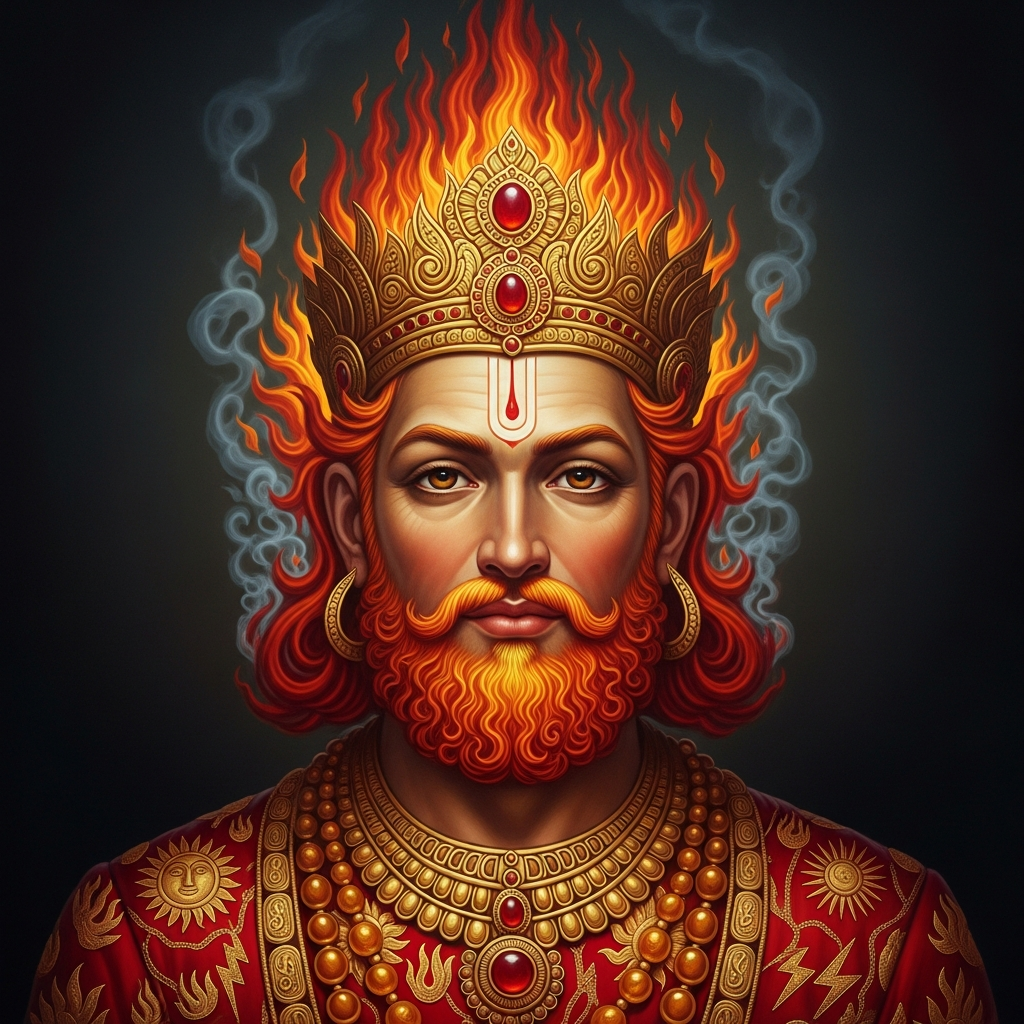
Agni is fire — and fire, in Vedic religion, is the central religious fact. He is the priest among the gods and the god among the priests, the messenger who carries every offering from the sacrificial altar to the heavens. He is born three times: in the heavenly sun, in the lightning of the storm clouds, and in the friction-fire kindled at every ritual hearth. Each morning he is reborn fresh; each evening the household banks his coals. Without Agni, the gods would starve; without Agni, the dead could not be cremated and released; without Agni, the sacrifice — and therefore the cosmos — would collapse.
The Rigveda opens with a hymn to Agni, not to Indra: Agni I praise, the household priest, the god of the sacrifice (RV 1.1.1). He has seven tongues to lick up offerings, two faces (one for the gods, one for the priests), and a body of pure flame. He is the witness to every wedding (the seven steps around the fire), the conveyor of every soul to the ancestors, and the guarantor of every oath sworn in his presence. He is, in a literal Vedic sense, the link between worlds.
Biblical Parallels: The Vedic yajna and the Hebrew olah (whole burnt-offering, Leviticus 1) are functionally identical: smoke as the medium of divine reception, the priest as the one who feeds the offering to the fire. Agni’s role as messenger between earth and heaven parallels the angelic function in Genesis 28:12 (the ladder) and the smoke of the altar that “rose up to God” (Judges 13:20). The pillar of fire that led Israel by night (Exodus 13:21) is the closest Hebrew counterpart to Agni-as-divine-presence.
Cross-Tradition: Direct cognate with Roman Vesta (the household hearth-fire, never to be extinguished) and with the Iranian Atar (sacred fire of Zoroastrianism, still tended in the fire-temples of Parsi communities). Echoes Hephaestus and Vulcan in the smith aspect, but Agni’s primary role is sacrificial rather than artisanal.
1 min read