The Gift That Costs Everything: Blood Sacrifice Across World Religion
Vedic sacrifice described from c. 1500 BCE; Greek temple sacrifice from Mycenaean period (c. 1600-1100 BCE); Hebrew Temple sacrifice from c. 10th century BCE to 70 CE; Aztec sacrifice at its height c. 1325-1521 CE; Norse blót from c. 200-1000 CE · The fire altar on the Ganges plain; the Temple Mount in Jerusalem; the Templo Mayor in Tenochtitlan; the sacred grove at Uppsala; the open-air altar on every Greek hilltop
Contents
From Aztec hearts to Vedic fire altars, blood sacrifice appears in virtually every ancient religion. It is the universal transaction: life given to sustain life.
- When
- Vedic sacrifice described from c. 1500 BCE; Greek temple sacrifice from Mycenaean period (c. 1600-1100 BCE); Hebrew Temple sacrifice from c. 10th century BCE to 70 CE; Aztec sacrifice at its height c. 1325-1521 CE; Norse blót from c. 200-1000 CE
- Where
- The fire altar on the Ganges plain; the Temple Mount in Jerusalem; the Templo Mayor in Tenochtitlan; the sacred grove at Uppsala; the open-air altar on every Greek hilltop
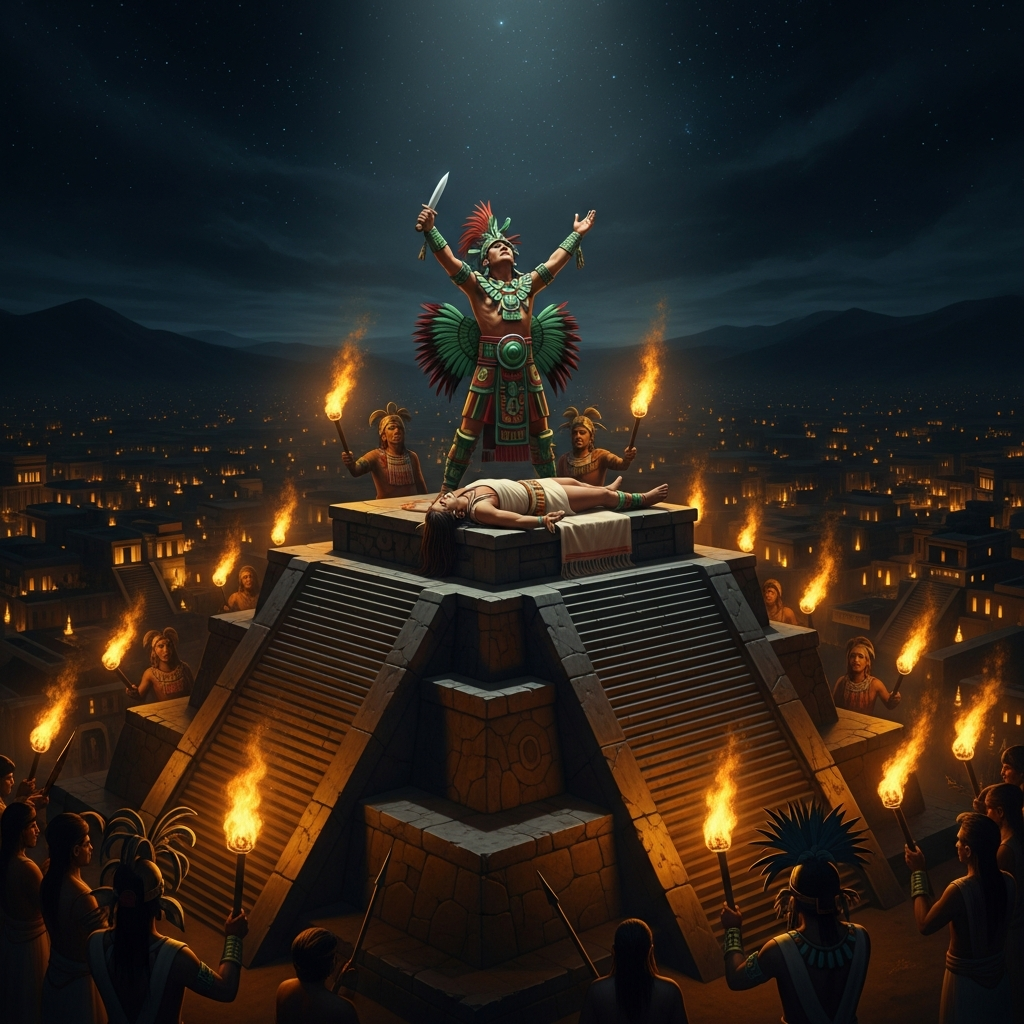
On the morning of the Aztec ceremony called Toxcatl, a young man who had spent the previous year living as a god walked up the steps of the Templo Mayor. For twelve months he had been dressed in the regalia of Tezcatlipoca — turquoise jewels, flowers, a smoking mirror — and had been treated as the god himself. He had been given four wives, named for the most important goddesses. He had eaten the finest food in Tenochtitlan, been carried through the streets, been worshipped.
At the top of the stairs he broke the clay flutes he had played during the year. Then the priests cut out his heart.
His replacement was already being chosen.
This is what we mean when we say that Aztec sacrifice was not cruelty. It was the most serious transaction the civilization could perform. The man who walked up those steps had lived as a god. His death was not a murder. It was a return.
The Universal Logic: Feeding the Powers
Before asking why sacrifice appears in so many traditions independently, it is necessary to understand the internal logic that makes it coherent in each case. Sacrifice is not a primitive confusion — it is a rational response to a specific theory of how the cosmos works.
In each tradition that practices it, the fundamental premise is that the divine powers require something from humans, and that the relationship between the divine and the human is transactional. The gods give rain, fertility, victory, health, continued existence of the sun. Humans give back a portion of what they have received. The sacrifice is not a bribe. It is payment of a debt that was incurred simply by being alive in a world maintained by divine effort.
Walter Burkert, in his landmark study of Greek sacrifice, argued that the origin of the ritual lies deeper than theology — in the hunting practices of Paleolithic humans who needed to negotiate a psychological relationship with the animals they killed to survive. The apology to the animal, the ritual acknowledgment of its death, the communal eating of its flesh — these practices, he argued, became the template for all later sacrifice. The gods are the original animals, scaled up.
René Girard’s rival theory locates sacrifice in social psychology rather than hunting psychology: sacrifice is the managed, ritualized channeling of violence that would otherwise tear the community apart. The scapegoat mechanism — loading the community’s sins and tensions onto a sacrificial victim and expelling them — is the original social technology for maintaining peace. The sacrifice is not primarily a gift to the gods; it is a gift to social cohesion.
Both theories explain part of the evidence. Neither explains all of it.
The Vedic Science of Giving
The Vedic sacrifice is unique in its transformation into an exact science. The Shatapatha Brahmana — a prose commentary text of enormous length and obsessive detail — treats sacrifice as a form of applied cosmology. The fire altar (agnicayana) is built in the shape of a bird, with 10,800 bricks corresponding to the number of muhurtas (time-units) in a year. Every measurement, every brick, every chant is part of a system in which getting the details wrong is cosmologically dangerous.
The Vedic theory is mutual sustenance: humans feed the gods (through fire, which carries the offering upward), and the gods feed humans (through rain, which carries nourishment downward). The cosmic cycle is maintained by this exchange. If sacrifice stops, the rain stops. The world machinery runs on sacrifice.
The transition from Vedic sacrifice to classical Hinduism involves a dramatic internalization of this logic. The Upanishads (beginning c. 800 BCE) begin to argue that the external fire sacrifice can be replaced by the internal fire of breath and meditation — the sacrifice of the self within the self. Sacrifice does not disappear; it moves inward. By the time of the Bhagavad Gita, “sacrifice” (yajna) has been redefined to include any disciplined action performed without attachment to results — the spiritual life itself as perpetual sacrifice.
Prometheus’s Gift: The Invention of Irreverence
The Greek myth of how sacrifice came to be assigned its specific form is one of the most irreverent divine-origin stories in mythology. Prometheus at Mekone — the primordial sacrifice that set the precedent for all subsequent sacrifices — cheated Zeus. He divided the ox into two portions: the good meat hidden inside the stomach lining, and the bones wrapped in gleaming fat to look attractive. Zeus, knowing he was being tricked but unable to resist the test, chose the fat and the bones. He got the smell of burning fat at every sacrifice forever after. Humans got the meat.
Hesiod tells this story completely straight: Zeus was outsmarted. He punished Prometheus for it (fire, Prometheus’s counter-gift to humanity, is the punishment’s occasion), but he remained bound by the precedent. Every Greek sacrifice thereafter divided the animal on these terms — the fat and bones for the gods, the meat for the humans — because at the original sacrifice, Zeus accepted that deal.
The myth preserves something important: sacrifice in Greek religion is not unconditional submission to divine power. It is a negotiated relationship. Prometheus negotiated the terms, and they stuck.
When Sacrifice Ends
The most theologically significant moment in the history of sacrifice is not when it is practiced but when it stops. Each tradition’s reasons for ending (or transforming) sacrifice reveal what sacrifice was really for.
In Judaism, the destruction of the Temple in 70 CE made sacrifice physically impossible — the altar no longer existed. But the rabbinic response was not paralysis. The Talmud records discussions that effectively argued: prayer is better than sacrifice, and study is better than prayer. The loss of the Temple was reframed as a purification. God had always preferred justice and mercy to burnt offerings (the prophets Amos, Hosea, and Isaiah had been saying so for centuries). The rabbis made the abolition of sacrifice into the completion of a prophetic argument.
In Christianity, the sacrifice ends with Jesus. The Letter to the Hebrews argues explicitly that the Levitical sacrificial system was a prefiguration of the one perfect sacrifice — Christ’s death on the cross — which, being perfect, needs no repetition. The Eucharist is the memorial of this unrepeatable event, not a new sacrifice. Christianity absorbed and resolved the entire sacrificial system by directing it at a single point.
In Aztec civilization, sacrifice did not end through theological transformation. It ended when the Spanish destroyed the Templo Mayor. What this means about the internal logic of the sacrificial system — whether it could have evolved, whether the theological pressure was building toward a different understanding — is a question the historical record cannot answer.
The Norse blót ended with Christianization and the political power that enforced it. The last great sacrifice at Uppsala was ended by Christian kings. The theological infrastructure was destroyed from outside before it had the opportunity to transform from within.
The Thing Beneath the Transaction
Every theory of sacrifice — economic, psychological, cosmological — eventually confronts a residue it cannot explain: the sense that the most meaningful gifts are the ones that cost the most. Not because the cost itself has value, but because the willingness to sustain a real loss is the only proof of the transaction’s seriousness.
The Aztec human sacrifice was the logical terminus of this principle. The gods had given everything — had literally died to make the world. What adequate return could be made except by giving back the most precious thing the humans had?
The Akedah — God’s command to Abraham to sacrifice his son Isaac, interrupted at the last moment by an angel — is the moment in Abrahamic tradition when this logic is both affirmed and transcended. God had the right to demand the most precious thing. Abraham proved he would give it. And then God said: not this. Never again this.
That moment — the near-sacrifice, the substitution, the prohibition — is arguably the most important single theological moment in the history of religion. It is the moment when the logic of sacrifice reached its extreme and was redirected.
What comes after the substitution — prayer, justice, charity, the inner fire — is religion as we mostly recognize it today.
Echoes Across Traditions
Entities
- Huitzilopochtli
- Tlaloc
- Agni
- Indra
- Zeus
- Yahweh
- Odin


Sources
- Rigveda (c. 1500-1200 BCE), sacrifice hymns
- *Shatapatha Brahmana* (c. 800-600 BCE), on Ashvamedha
- Leviticus 1-7, Hebrew Bible (sacrificial system)
- Hesiod, *Theogony* 535-560 (Prometheus and sacrifice)
- Ibn Fadlan, *Risala* (922 CE) — account of Rus blót
- Adam of Bremen, *Gesta Hammaburgensis* IV.26-27 (c. 1075 CE) — Uppsala temple
- Diego Durán, *Book of the Gods and Rites* (c. 1576 CE) — Aztec sacrifice
- Walter Burkert, *Homo Necans: The Anthropology of Ancient Greek Sacrificial Ritual* (1972)
- René Girard, *Violence and the Sacred* (1972)
- Inga Clendinnen, *Aztecs: An Interpretation* (1991)