The Birth of Athena: Wisdom from the Mind of God
Hesiod's account c. 700 BCE; the cult of Athena in Athens reaches back to Mycenaean period, c. 1400-1200 BCE · Olympus; the forge of Hephaestus (variously located at Lemnos or under Mount Etna); the banks of the Triton river in Libya (alternate birth tradition)
Contents
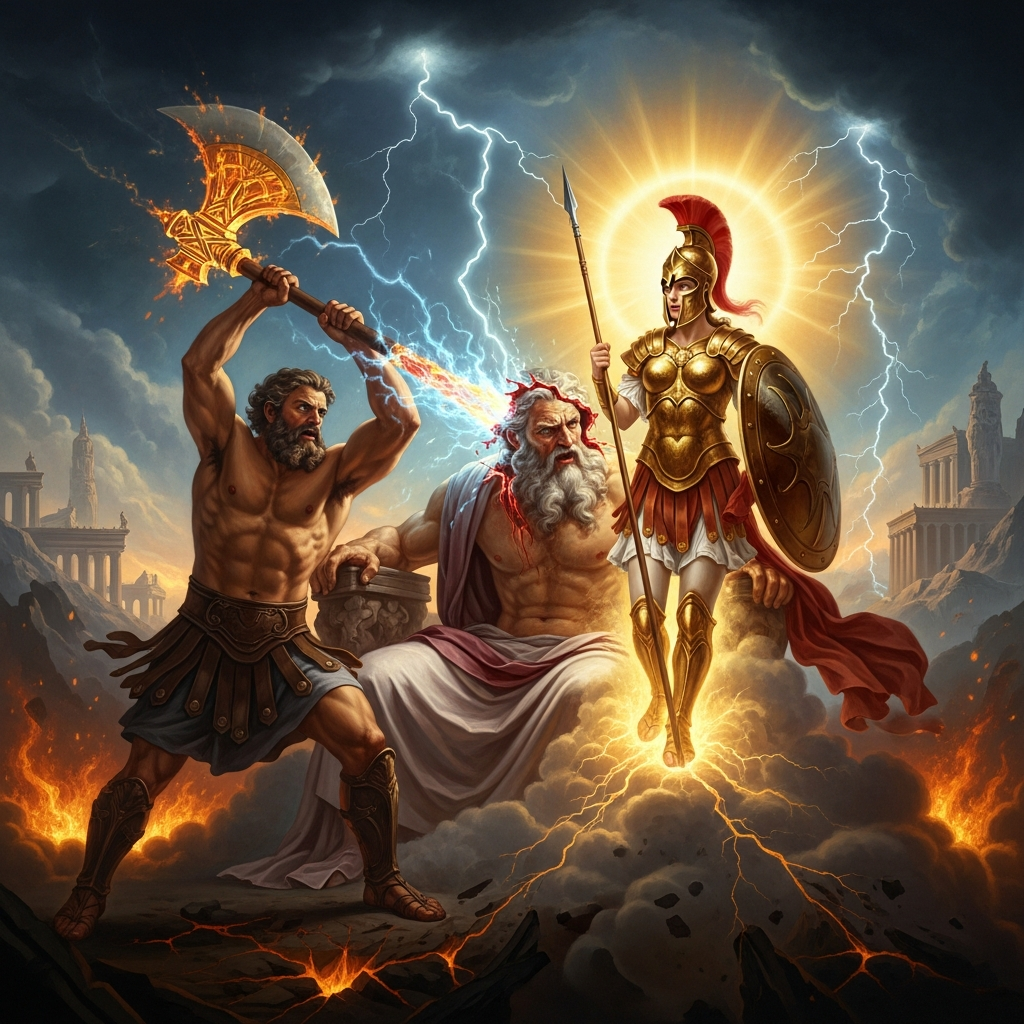
Zeus swallows the Titaness Metis to prevent a prophecy. Months later, blinding headaches drive him to Hephaestus's forge. An axe splits his skull. Athena leaps out fully armed, crying her war cry.
- When
- Hesiod's account c. 700 BCE; the cult of Athena in Athens reaches back to Mycenaean period, c. 1400-1200 BCE
- Where
- Olympus; the forge of Hephaestus (variously located at Lemnos or under Mount Etna); the banks of the Triton river in Libya (alternate birth tradition)
Begin with the prophecy, because the birth does not make sense without it.
Zeus has a problem that Cronus had before him and Ouranos before Cronus: a son is coming who will overthrow him. Cronus knew this and swallowed his children. Zeus knows it too — the knowledge comes from the Titaness Metis, goddess of wise counsel, who is pregnant by Zeus with what the oracles have declared will be a daughter first and then a son, and the son will surpass his father in power.
Zeus’s response is to swallow Metis.
Hesiod is matter-of-fact about this. Zeus “suddenly put her in his belly,” and Metis, absorbed into the king of the gods, became the internal source of the divine wisdom Zeus thenceforth possessed. The daughter is already forming in her womb. The womb is now inside Zeus.
The headaches begin months later.
The pain is described in later sources as splitting — an agony that makes the mountains tremble when Zeus presses his hands to his temples. He roars. The Olympians scatter. The earth shakes. Nothing works. Hermes diagnoses it; Prometheus, in some accounts, is the one who tells Zeus what is needed; in most accounts it is Hephaestus who is called to act.
Hephaestus is the smith god, the craftsman, the fire-worker who makes the weapons and ornaments of the gods. He is the god whose body has been broken (thrown from Olympus by Zeus, or by Hera — the sources conflict, the result is the same: a lame forge-god with spectacular hands). He arrives at his father’s head with his axe.
He strikes.
The skull splits.
Athena leaps out.
She is wearing full armor. The helmet is on her head. The aegis — the divine breastplate or cloak, fringed with serpents, bearing the Gorgon’s face at its center — is on her chest. She is holding her spear. She is carrying her owl.
The Homeric Hymn to Athena describes the moment: “She sprang quickly from the immortal head and stood before Zeus who holds the aegis, shaking her sharp spear: great Olympus began to reel horribly at the might of the grey-eyed goddess, and earth round about cried fearfully, and the sea was moved and tossed with dark waves.”
The gods go silent. Then they resume their seats. Athena removes her armor. The crisis is over.
She is fully grown. She has always been fully grown. There is no childhood, no adolescence, no mother to remember. There is the god of craft’s axe, and then there is Athena — the grey-eyed one, the daughter of Zeus’s forehead, already knowing everything she will ever know.
The portfolio she carries explains the myth’s logic.
Athena is the goddess of wisdom and of war. Not war in the Ares sense — not blood-frenzy and slaughter for its own sake — but strategic war, planned war, the kind of fighting that wins by knowing more than the enemy knows. She is also the goddess of craft: weaving, pottery, metalwork, ship-building, the techniques by which civilization turns raw material into function. She is the goddess of the city, of law, of the kind of justice that stops blood-feuds.
The combination that seems paradoxical (wisdom and warfare, craft and law) coheres if you understand the Athena principle: applied intelligence. The weaver calculating the pattern. The general calculating the campaign. The lawyer calculating the argument. These are all the same activity. Athena presides over the human mind at work in the material world.
Born from a head, she is the externalization of mental work.
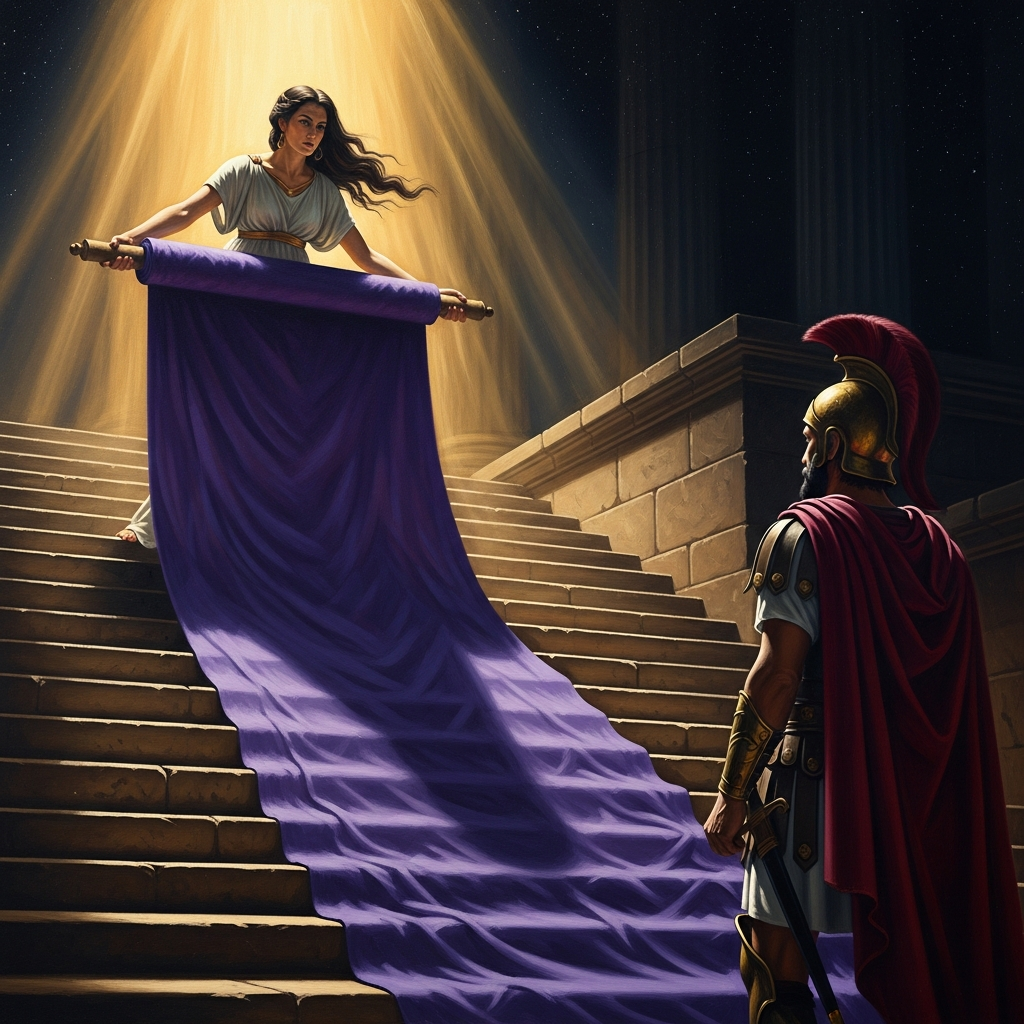
There is a weaving contest.
Arachne, a mortal weaver from Lydia, claims she can weave better than Athena. This is the kind of claim that ends badly in Greek mythology. Athena appears disguised as an old woman and offers advice. Arachne dismisses her. They compete.
Arachne’s tapestry is technically flawless — the myths concede this. She weaves scenes of the gods’ sexual transgressions: Zeus and Leda, Zeus and Europa, Zeus and everyone. The scenes are beautiful and damning.
Athena’s tapestry shows the gods in their glory and, in the four corners, what happens to mortals who challenge the divine. She looks at Arachne’s work. She destroys it. She strikes Arachne with her shuttle.
Arachne hangs herself in shame. Athena, perhaps taking pity, transforms her into a spider — allowing her to weave forever. This is Ovid’s version. It is one of the few myths in which the goddess’s action is ambiguous: punishment or mercy or both.
Hephaestus’s role in the birth has a coda.
In some sources, when Athena emerged fully armed from Zeus’s skull, Hephaestus was not only present as the midwife — he was in love with her. He had been promised her by Poseidon as a bride; or he had long desired her; the sources differ. He attempts to assault her.
She escapes. His seed falls on the earth. Gaia, the earth, bears the result: Erichthonius, the half-serpent child who becomes one of the early kings of Athens.
Athena raises Erichthonius as her own. She puts him in a chest, gives the chest to the daughters of Cecrops (the king of Athens) to guard, and tells them not to open it. They open it. Inside is the serpent-child. They go mad.
This is Athens’ own origin story — the city’s first king is the child of the smith-god’s failed desire for the wisdom-goddess, raised by her despite everything, founding the city she protects. Athens is the city that was born from the combination of craft and wisdom and the rejection of force.
The myth is the city’s self-portrait.
Pindar gives the birth its most vivid image: Hephaistos with his axe of bronze cleft asunder the head of Zeus, and Athena leapt from the top of her father’s head with a great shout, and Ouranos shuddered and the whole earth trembled.
The shout is the detail that stays. Athena does not emerge silent and composed. She shouts — her war cry, the first sound she makes in the world. She comes out fighting. She has come from the interior of the god who defeated the Titans and made the cosmos what it is, and she arrives already knowing the terrain.
She carries in herself everything Zeus absorbed when he swallowed Metis: all the counsel, all the foreknowledge, all the strategic wisdom of the Titaness who was the goddess of wisdom before wisdom had a name.
She is the daughter of her father’s intelligence.
She is also the daughter of her mother’s suppression.
Both facts live in her grey eyes.
Both facts live in the city that took her name.
Echoes Across Traditions
Entities
- Athena
- Zeus
- Metis
- Hephaestus
- Prometheus
- Eileithyia
Sources
- Hesiod, *Theogony* 886-900 (c. 700 BCE)
- Pindar, *Olympian Odes* 7.34-38 (c. 476 BCE)
- Homeric Hymn to Athena (c. 7th-6th century BCE)
- Apollodorus, *Library* I.3.6 (c. 2nd century CE)
- Walter Burkert, *Greek Religion* (1985)
- Eva Keuls, *The Reign of the Phallus* (1985)
- Froma Zeitlin, 'The Dynamics of Misogyny: Myth and Mythmaking in the Oresteia' (1978)