Contents
A princess raised by hunters refuses to marry. She agrees only on one condition: any suitor who races her and loses dies; any suitor who wins gets her. Many die. Then a young man prays to Aphrodite, who gives him three golden apples and tells him exactly when to drop them.
- When
- c. 800 BCE (mythic time)
- Where
- Boeotia, the public running-track outside the city, the temple of Cybele in the deep forest
She had been left on a mountain at birth.
Her father, the king Iasus of Boeotia, had wanted a son. Atalanta arrived, and he carried her up the slopes of Mount Parthenion and left her on the ground for whatever animal found her first. A she-bear found her. The bear nursed her. Hunters of the goddess Artemis, coming through the woods, found the girl in the bear’s lair and raised her.
She grew up in the wilderness. She ran faster than any human in Greece — fast enough that she could catch deer on foot. She killed the Calydonian boar that no man could kill — drew first blood with an arrow, before Meleager finished the kill. She wrestled Peleus, Achilles’s father, at funeral games, and threw him. She joined the Argonauts.
When at last her father acknowledged her — having lost his sons, having no other heir, having heard that a famous huntress was in fact his abandoned daughter — he took her back into the palace. And he said the thing fathers always said. It is time you were married.
She refused. She had been raised among the followers of Artemis, who did not marry. She had taken the goddess’s vow.
Her father pressed.
She offered a compromise that she expected would settle the matter. I will marry the man who can beat me in a race. Anyone who tries and loses, I will kill. Anyone who beats me, I will marry.
Her father agreed, hoping that a foot-race would interest at least some men.
Many came. They came from across Greece — princes, athletes, ambitious provincials — confident that they could outrun a woman. Atalanta, on the day of the race, allowed each suitor a head start. She gave them as much as half the course before she even began. Then she ran.
She ran, Ovid says, the way arrows fly — like a Scythian arrow — and she caught each man before the finish, and killed him on the track with a spear she carried. The heads went onto stakes outside the city, as a discouragement to fresh suitors.
The discouragement did not work. The men kept coming. The stakes kept filling.
A young man named Hippomenes was in the crowd one day, watching the race. He had come only to laugh — what fool would risk his neck for a woman? — and he was laughing as the racers were called to the line. Then he saw Atalanta strip off her cloak for the running. He stopped laughing. The hardness ran out of his face. He stood very still for the entire race. When she had killed the latest suitor and the spear was being cleaned, he stepped forward and said: I will race her tomorrow.
He was a great-grandson of Poseidon. He had nothing else to offer.
Atalanta, looking at him, hesitated for the first time. He was very young. He was unarmed. Boy, she said quietly, go home. There are princesses you can have without being killed for them. I do not want your head on a stake. Find another wife.
He thanked her for the warning. He repeated his intention.
She turned away. The course was prepared.
That night Hippomenes went to a grove sacred to Aphrodite and prayed. He did not pray for speed; he was not fool enough to think he could outrun her. He prayed for help. He prayed to the goddess of love who, as he pointed out, had a personal interest in seeing brides led to marriage rather than losing them to forest goddesses.
Aphrodite heard. She came down to him in the grove. From a tree she had cultivated in her garden in Cyprus — a tree of golden apples, gold-fruited, gold-leafed — she had picked three apples. She put them in his hand. Drop them, she said, one at a time, when you need to slow her. Throw them off the line of the track, so she has to leave her stride to retrieve them. She is greedy for beauty. The apples will catch her. Use them when you need them most. Do not waste them.
The morning came. The crowd assembled. Hippomenes and Atalanta took their places. The trumpet sounded. They ran.
She caught up to him within thirty strides. He could feel the air she pushed past him. She drew level with him, glanced at him almost regretfully, and began to pull ahead.
He took the first apple from his belt and threw it sideways across her path.
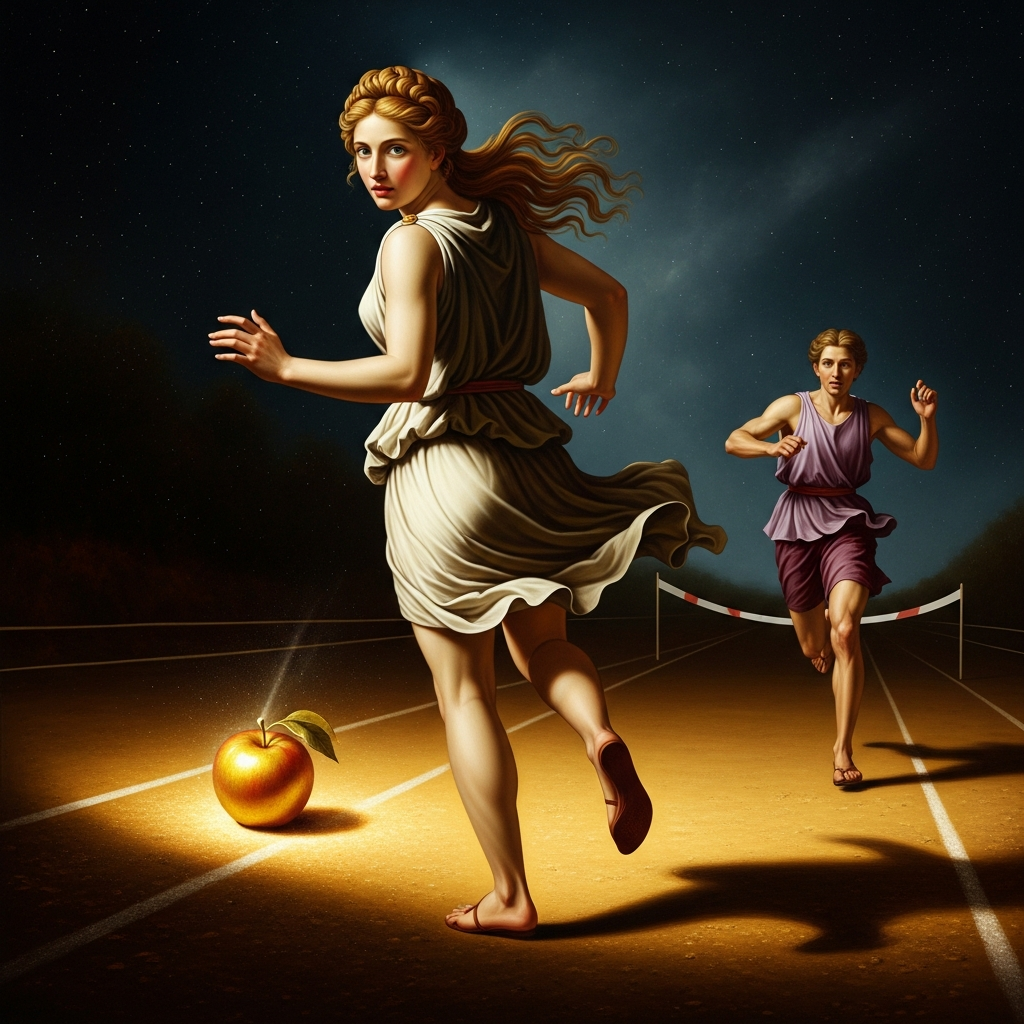
It rolled, glinting, across the track and into the soft dust at the side. Atalanta, in mid-stride, saw the gold flash. Her head turned. She had never seen gold like this. She broke from her line, scooped the apple up, and resumed running. The detour had cost her three strides.
He was ahead now, briefly. She caught him within thirty more strides.
He threw the second apple. He threw it further to the side this time, into the long grass. She had to hunt for it for a moment before she found it. She found it. She came back onto the track. He was further ahead now. The finish line was coming.
She caught him.
The third apple was the last. He had no plan after the third. He took it from his belt — he was already gasping for breath, his legs were burning, he was running on fear and on grace and on the goddess’s loan — and he threw it as hard as he could, sideways, far off the track into the heaviest part of the field.
Atalanta hesitated for the first time. She could see the line. She could see the apple. The crowd could see her hesitate.
She broke for the apple. She got it, and she sprinted back.
It was too far. She came back onto the track and he was over the line.
She had lost.
The crowd roared. Atalanta walked off the track holding three golden apples. By the rules she had set herself, she was now Hippomenes’s wife.
He took her home. He had won her by trick rather than by speed; he loved her, in his way, and she — having been beaten only because the goddess of love had loaded the dice — found that her own feelings had begun to shift. They were married.
Aphrodite, watching all this, was waiting for her thank-you sacrifice.
It did not come. Hippomenes, drunk on his prize, simply forgot. He had got the girl. He had lost interest in the goddess who had given him the means.
Aphrodite was offended. She is a goddess who notes such things.
One day, traveling, the couple passed a cave that was sacred to Cybele — the great mother goddess, whose wrath was older than any of the Olympians’. The cave was a holy place; no human was permitted to enter for any purpose, certainly not for love-making. Aphrodite, walking invisibly beside them, planted in both of them at the same instant a sudden and irresistible desire.
They went into the cave together. Cybele saw them.
She did not strike them dead. Death would have been a kindness. Instead, she changed them. She gave Hippomenes a tawny mane and four heavy paws and a tail and the long teeth of a hunting cat; she did the same to Atalanta. They became lions. She harnessed them to the chariot she rode through the sky, and the two of them — punished into beasts who, in Greek belief, did not even mate with each other but only with leopards — drew her chariot for the rest of time.
The girl who had refused to be a wife had, in the end, been forced into a wife’s role and then frozen in animal form drawing a goddess’s car.
The story keeps something difficult open. Atalanta is sympathetic. Her terms are not unreasonable. The men who race her are warned and choose their fate. And yet the structure of her world — father, oracle, goddess, market — does not let her keep her vow. The apples are pretty. The pause is small. The cumulative cost is the rest of her life on four legs.
The Greeks knew. The crowd, watching her bend a third time for the gold, was already mourning.
Scenes
The starting line of a public race
Halfway down the course, a golden apple bounces and rolls into the dust
In a forest temple of Cybele, Atalanta and Hippomenes — punished for desecration — are caught in mid-transformation, claws lengthening, manes thickening, two lions yoked forever to the goddess's chariot
Echoes Across Traditions
Entities
- Atalanta
- Hippomenes
- Aphrodite
- King Iasus
- Cybele
Sources
- Ovid, Metamorphoses X.560-707
- Apollodorus, Library 3.9.2
- Hyginus, Fabulae 185
- Theognis, Elegies 1287-1294