Arachne and the Tapestry of the Gods' Crimes
c. 700 BCE (mythic time) · Lydia in Asia Minor, the workshop of Arachne, the eventual web in the corner of the rafters
Contents
A peasant girl claims she weaves better than Athena. The goddess accepts the challenge. Arachne's tapestry is, in fact, perfect — and depicts Zeus, Apollo, and Poseidon raping mortal women in the form of bulls, swans, and serpents. Athena, defeated, strikes her. The girl hangs herself; the goddess turns the rope into a thread.
- When
- c. 700 BCE (mythic time)
- Where
- Lydia in Asia Minor, the workshop of Arachne, the eventual web in the corner of the rafters
She lived in a town in Lydia, far from any palace.
Her father, Idmon of Colophon, was a dyer of wool — the kind of dyer whose vats stained his hands purple permanently, who knew every secret of murex and madder and woad, and who passed those secrets to his daughter. Her mother had died young.
The girl was Arachne, and she was a weaver.
By her teens she was the best weaver in the district. By twenty she was the best in Lydia. By twenty-two she was the best — there was no one to compare her to anymore, no one teaching her, no one she could not surpass at the loom in an hour. The local nymphs, the wood-nymphs, the river-nymphs, came down out of curiosity to watch her work. They stood in the doorway of her workshop. They watched her hands and the shuttle, the way the warp was strung, the way the colors emerged from the strings into pictures of unbearable detail.
Someone — probably one of the nymphs, probably affectionately — said: You must have learned this from Athena herself.
Arachne did not like this comment.
She replied, perhaps lightly, perhaps not: I learned it from no one. I taught myself. If Athena thinks she can outweave me, let her try. I will compete with her.
The line traveled.
Athena was the goddess of the loom. She had invented weaving. The weaving of every careful tapestry in every Greek and Lydian and Phrygian household was offered, in some sense, in her honor.
She came down to the workshop in disguise. She came as an old woman — bent, white-haired, leaning on a staff. She entered and sat among the watchers. She watched Arachne for a while. Then she said, in the kindly tone of an old aunt: Child. You are very gifted. But there is a limit. Take the praise of your neighbors. Take the praise even of the nymphs. But do not boast against the goddess. Apologize. She is merciful when asked.
Arachne looked up from the loom. She did not stop weaving. She said: Old woman, save your advice for your daughters and granddaughters. I know what I said. I meant it. If the goddess heard me, why has she not come?
Athena dropped the disguise.
The room fell quiet. The nymphs in the doorway flinched and bowed. Arachne herself turned pale — not with fear, but with the recognition that the audience had narrowed to the precise person she had named. Then her color returned. She set her jaw. She said to the goddess: You came. Good. Take your loom.
They each set up. They worked side by side. They worked in silence for hours, and then for a day. The nymphs and townspeople watched with the held breath of an audience at an execution.
Athena’s tapestry was a piece of Olympian state propaganda.
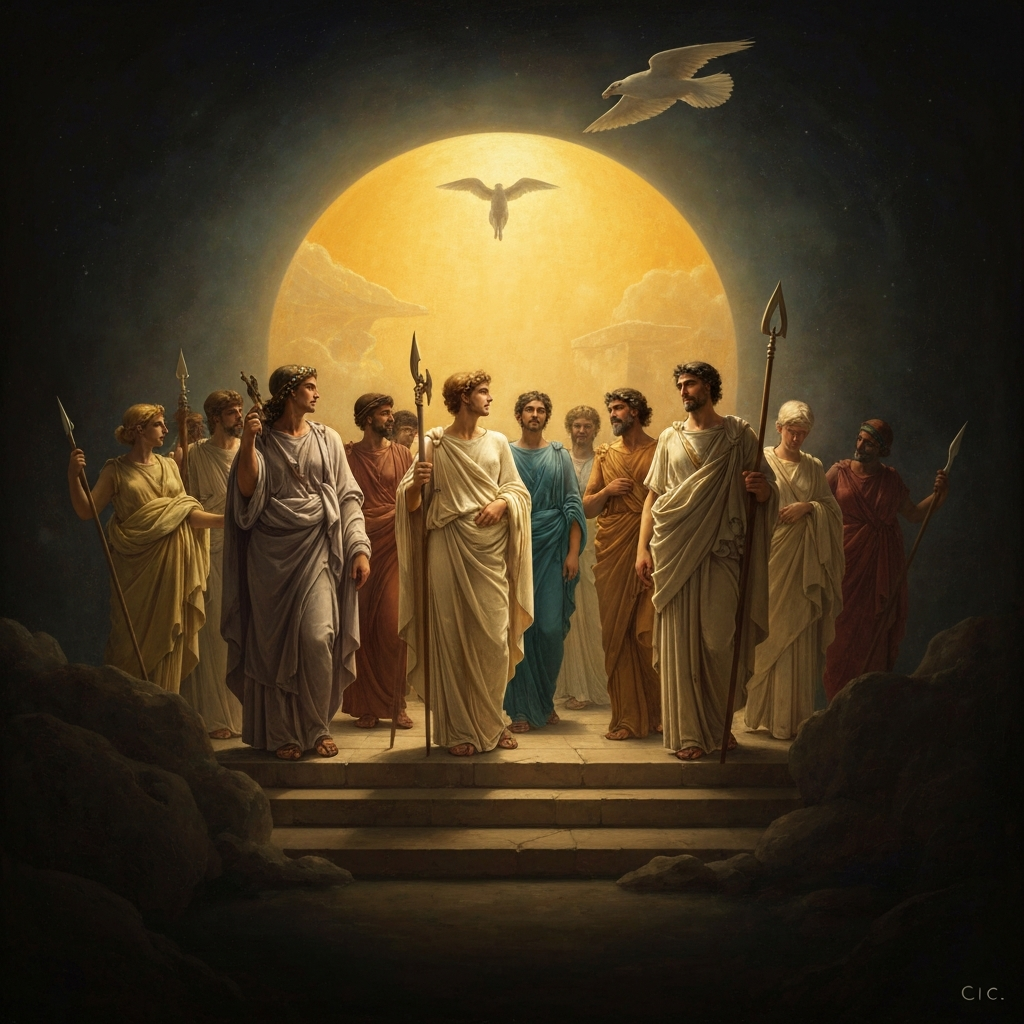
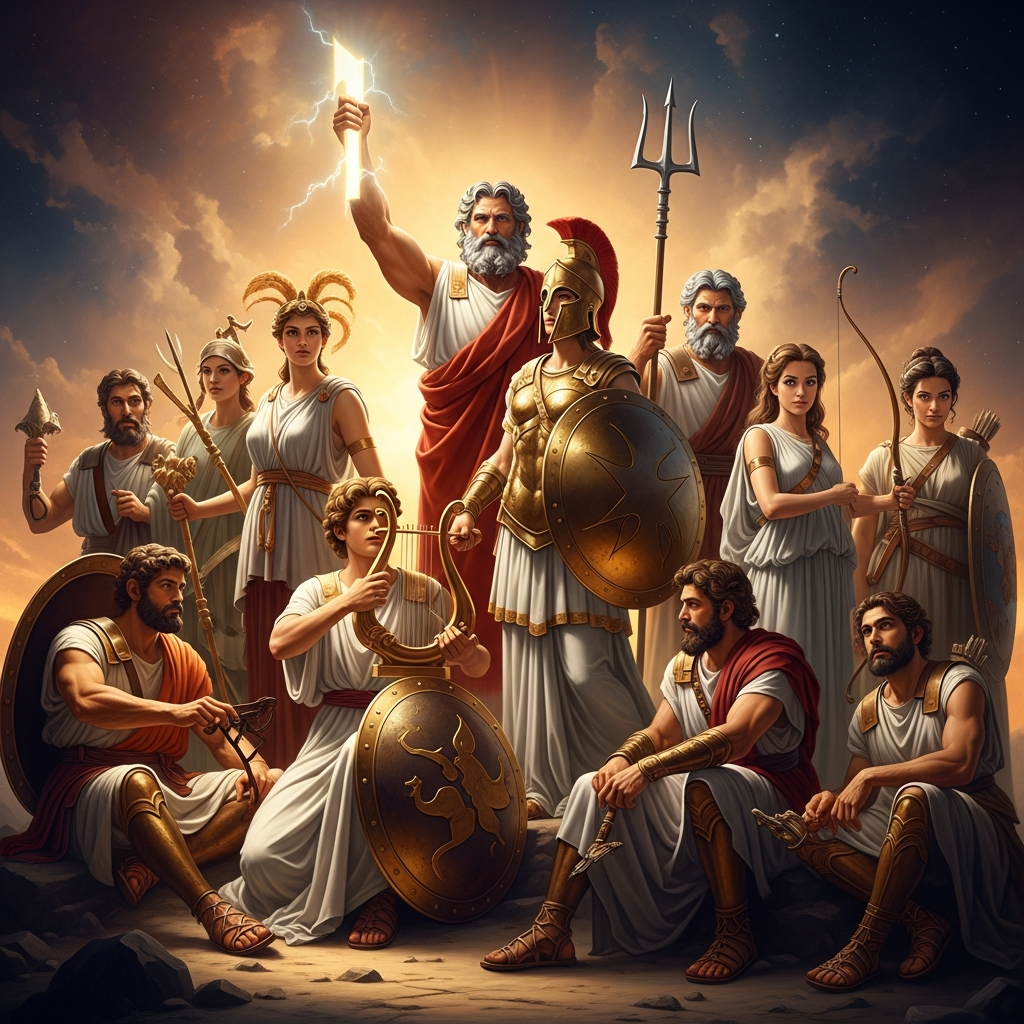
In the central panel: the twelve great gods on Olympus, enthroned in dignity, Zeus presiding. In the corner panels: scenes of mortals who had presumed against the gods, and what had been done to them — exempla of pride punished. The piece was technically magnificent. The colors were correct. The compositions were balanced. It was the kind of tapestry one would expect from the goddess of crafts: didactic, balanced, beyond reproach. It said, in image, the gods are great, and presumption is destruction.
Arachne’s tapestry was something else.
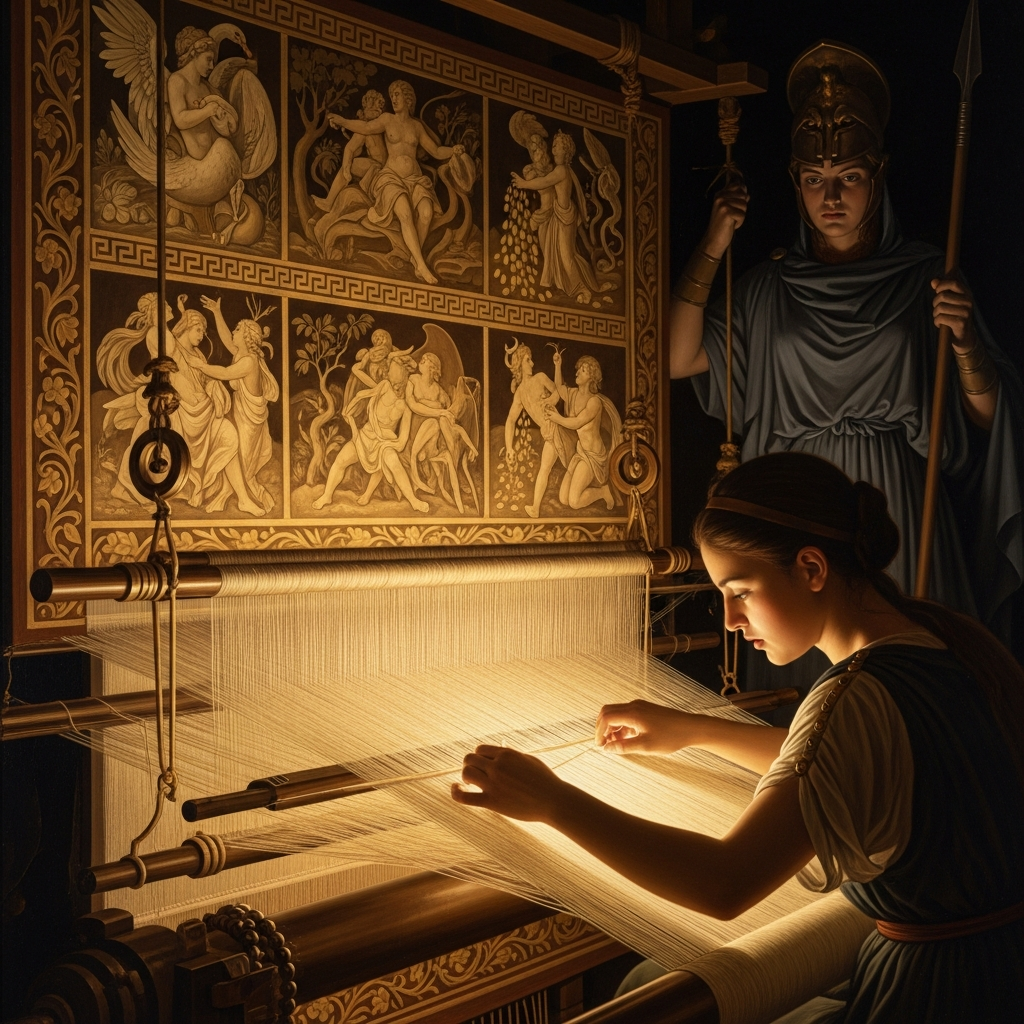
Ovid lists the panels for half a hundred lines. Each panel was a god committing rape on a mortal woman. Zeus as a bull mounting Europa, the girl’s terror perfectly rendered. Zeus as a swan over Leda, the violence of the act not concealed. Zeus as a shower of gold raining onto Danaë in her bronze tower. Zeus as a satyr mounting Antiope. Zeus as a flame upon Aegina. Zeus as a serpent. Zeus as a shepherd. Zeus as Amphitryon over Alcmene. Then Poseidon as a bull, as a horse, as a ram, as a river, as a dolphin. Then Apollo. Then Bacchus. Then Saturn.
Twenty-one panels. Each one woven with photographic exactitude. Each one truthful: the women’s expressions of terror, the gods’ expressions of indifferent appetite. The borders were ivy and flowers, exquisitely woven.
The tapestry was, technically, perfect.
Even Athena could not find a flaw. She walked along the length of it, her face hardening. The thread-count was finer than her own. The dye-work was more nuanced. The figures were drawn with greater life. Worst of all — Arachne had told the truth. The gods had done all those things. The catalog was accurate.
Athena could not bear it.
She picked up the boxwood shuttle from her own loom and struck Arachne across the forehead — three or four times, hard, breaking the skin. Arachne staggered. She did not weep. She looked at the goddess and saw, in the goddess’s face, the look of someone who had been beaten in the only contest that mattered and had retreated to physical violence.
Arachne went to a corner of the workshop. She found a rope. She tied a noose. She tied the other end to a beam. She put her head in the loop.
She was kicking the stool away when Athena, half in pity, half because the suicide was about to deny her the pleasure of judgment, intervened. Live, the goddess said. Live. But you will weave forever, and you will weave hanging.
She poured over the girl the juice of an herb of Hecate. Arachne’s body began to shrink. Her hair fell out. Her nose and ears shriveled. Her head became tiny against her body. Her arms attached themselves to her sides and became legs — four extra legs sprouted where they had been, eight legs in all. Her belly swelled into a sac. From her belly a thread emerged.
She was a spider.
She climbed up the rope she had tied. She kept climbing, into the rafters. She found a corner, and she began to weave.
Spiders’ webs are her tapestries now. The radial geometry, the perfect tension, the fineness of thread that no human could match — Arachne, in her diminished form, has been weaving this for three thousand years, in every corner of every house, in barns, in caves, between two leaves of grass. Her name, in modern biology, names the entire class of these creatures: Arachnida. The taxonomic memory is older than the science.
The myth keeps a question open. The story does not say Arachne was wrong. It does not say she lost the contest. Ovid, writing for an audience under Augustus — an emperor whose iconography presented him as nearly divine and whose reign tolerated little embarrassment — was making a case that art audiences could read.
The artist who tells the truth about power is not punished for telling lies. She is punished for telling truths whose accuracy cannot be answered. The goddess wins, in the end, by being a goddess. The girl wins, in the end, by being on the page of the poem you are reading. The web in the corner of your ceiling, this morning, is part of an argument that has not finished.
Scenes
Arachne's workshop, light slanting through wide doors
The completed tapestries hang side by side
Athena strikes the girl across the forehead with the boxwood shuttle
Echoes Across Traditions
Entities
- Arachne
- Athena
- Zeus
- Idmon
Sources
- Ovid, Metamorphoses VI.1-145
- Virgil, Georgics IV.246-247
- Pliny the Elder, Natural History VII.196