Apollo and Daphne: The God Who Cannot Catch the Girl Who Becomes a Tree
c. 700 BCE (mythic time) · Thessaly, the banks of the river Peneus, the woods of Mount Olympus's lower slopes
Contents
The god of light, music, and prophecy mocks the boy-god Eros, who answers with two arrows: one to make Apollo love, one to make the nymph Daphne hate him. Apollo pursues her through the woods. At the river's edge, with his hand on her shoulder, she prays — and the bark closes over her body.
- When
- c. 700 BCE (mythic time)
- Where
- Thessaly, the banks of the river Peneus, the woods of Mount Olympus's lower slopes
It begins with a god being unkind to a child.
Apollo had just killed the Python — the great serpent who had haunted Delphi since the world began. He was young, recently arrived in his power, full of himself. He came down from Parnassus and saw, in a glade by a river, the boy-god Eros stringing a tiny bow.
Apollo laughed.
What is a brave boy doing with a man’s weapon? he said. Leave the bow to me, Cupid. I just killed a serpent the size of a hill with mine. The bow is for warriors, not for striking love into anyone’s heart with little arrows. Go play.
Eros looked up. Eros, in Greek myth, was older than the universe and considerably older than Apollo. The boy form was a costume, not a fact. He smiled in a way Apollo did not register.
Your bow may strike everything, Eros said, but mine strikes you.
He flew up to the peak of Parnassus. From his quiver he took two arrows. One was sharp and gold-tipped; it ignited love in whoever it struck. The other was blunt and lead-tipped; it killed love in whoever it struck. He nocked one in the bowstring, drew, and shot. The gold arrow buried itself in Apollo’s chest.
He fitted the second arrow. He shot it into the heart of a young woman walking along the bank of the river Peneus, far below.
Her name was Daphne. She was the daughter of the river-god Peneus. She was beautiful in the wild Thessalian way — long-limbed, fast, the kind of girl who chased deer with her hair untied and refused to braid it for any festival. She had asked her father, more than once, for the same gift Diana had: never to marry, never to love. He had told her to be patient. Such a face, he said, will not let you have your wish.
The lead arrow struck her. The asking became absolute.
The gold arrow struck Apollo. He saw her, that same instant, walking along the riverbank below. He had loved nothing before — he had been the cool god of music and prophecy and unbreakable distance — and now he was on fire from the chest outward. He came down the mountain in three strides. He reached the riverbank.
She turned. She saw a god approaching her — golden hair, marble shoulders, eyes that did not blink. She turned and ran.
Apollo called after her. He used what he believed was reason. Stop! I am not your enemy. Do you know who I am? I am the son of Jupiter. The oracle at Delphi is mine. The Muses are mine. Medicine was invented by me. Music. Archery. The healing of every wound — except, it appears, the one I have just received.
He kept calling. He kept running. I do not pursue you as a wolf pursues a lamb. I pursue you because I love you. Slow down — the brambles will tear your skin — slow down, I beg you—
She did not slow down. She had been hit by the lead arrow. She would not have slowed down anyway.
He gained on her. His running was the running of a god — tireless, accelerating — and her running was the running of a young woman through underbrush. The gap closed. She could feel his breath on her hair. She could feel the air pushed forward by his outstretched hand on the back of her neck.
She came to the river.
The river was her father’s river. The water was running fast. She had nowhere to go. She raised her arms and shouted to the river, to her father, to the earth itself: Father — help me! If your rivers have any divinity — if I am your child — destroy this body that has betrayed me! Take it from me! Change me! I do not want to be wanted!
The change began at her feet.
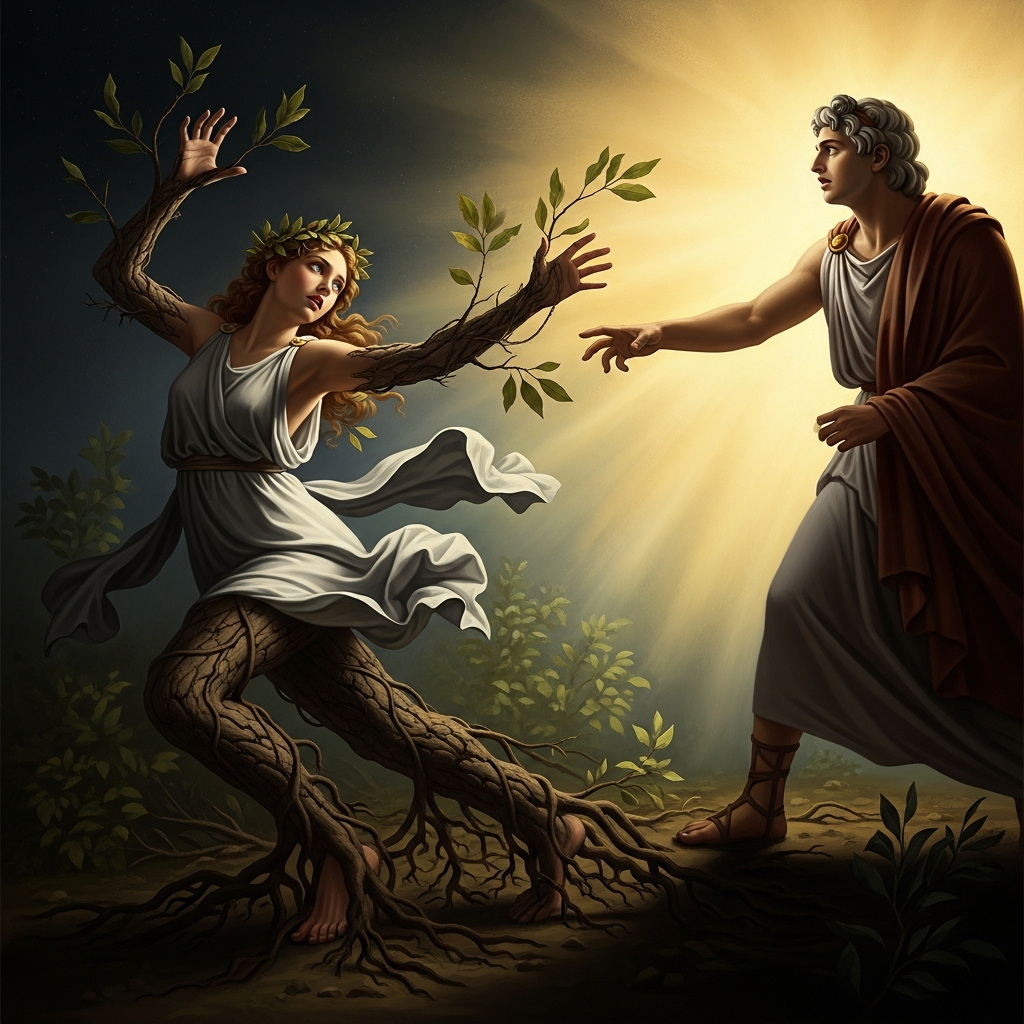
A heaviness ran up her legs. She looked down and her toes were lengthening into the soil — long, pale, root-like, splitting the earth. Bark was climbing her shins. Bark was over her knees. She tried to lift her arms and her arms were stiffening, branching at the elbows. Her hair burst into long narrow leaves. Her skin became pale gray. The bark closed over her belly, her chest, her throat. Her face was the last thing — eyes, mouth, the small green leaves bursting from her hairline — and then the bark sealed even that.
A laurel tree stood at the riverbank.
Apollo arrived. He stopped. His hand, still outstretched, came to rest on the bark of the trunk. He could feel, beneath his palm, a heart still beating, very slowly, fading.
He pressed his face against the trunk. He kissed the bark. The bark drew back from him.
He spoke.
Since you cannot be my wife, he said, you will at least be my tree. The laurel will be sacred to me. My hair will be wreathed in your leaves. The lyre I play will be wreathed in your leaves. The quiver I carry will hang on your branches. Generals returning to Rome in triumph — when Rome exists — will wear crowns of your leaves. Poets crowned for their songs will be crowned with you. You will be evergreen, because youth, in the form I knew you, must not die from the world. Wherever I am praised, you will be there.
The tree, very slightly, moved its top branches in what Ovid says was assent.
Apollo turned and walked back upstream toward his mountain. He had become a god of grief. He carried his lyre. The laurel stood unmoving at the river’s edge.
The gods after this began to wear laurel crowns. Roman emperors would wear them, eight hundred years later. Caesar would wear one to hide a balding scalp; Augustus would wear one to suggest divinity; Petrarch would wear one to crown a poet for the first time in a thousand years. Every laurel wreath traces back to the bark closing on a frightened woman beside her father’s river.
The boy with the bow had made his point. The god of poetry had been taught what it costs to love what does not love you back. Daphne, somewhere in the bark, had her wish: she would never be touched. Apollo, every time he looked at his crown, would remember why.
Scenes
Apollo, golden-haired and laughing, mocks Eros for handling weapons too large for a child
Daphne flees through the dark woods
At the river's edge: bark climbing her thighs, leaves bursting from her fingertips, her hair becoming branches
Echoes Across Traditions
Entities
- Apollo
- Daphne
- Eros
- Peneus
Sources
- Ovid, Metamorphoses I.452-567
- Hyginus, Fabulae 203
- Pausanias, Description of Greece X.7.8