Contents
Amaterasu and Susanoo settle a dispute about his intentions by creating deities from each other's possessions — and the children born from the contest become the ancestors of Japan's ruling house.
- When
- Age of the Gods — before historical time, Kojiki cosmogony
- Where
- The Plain of High Heaven — the celestial domain of Amaterasu
He arrives weeping and she is afraid.
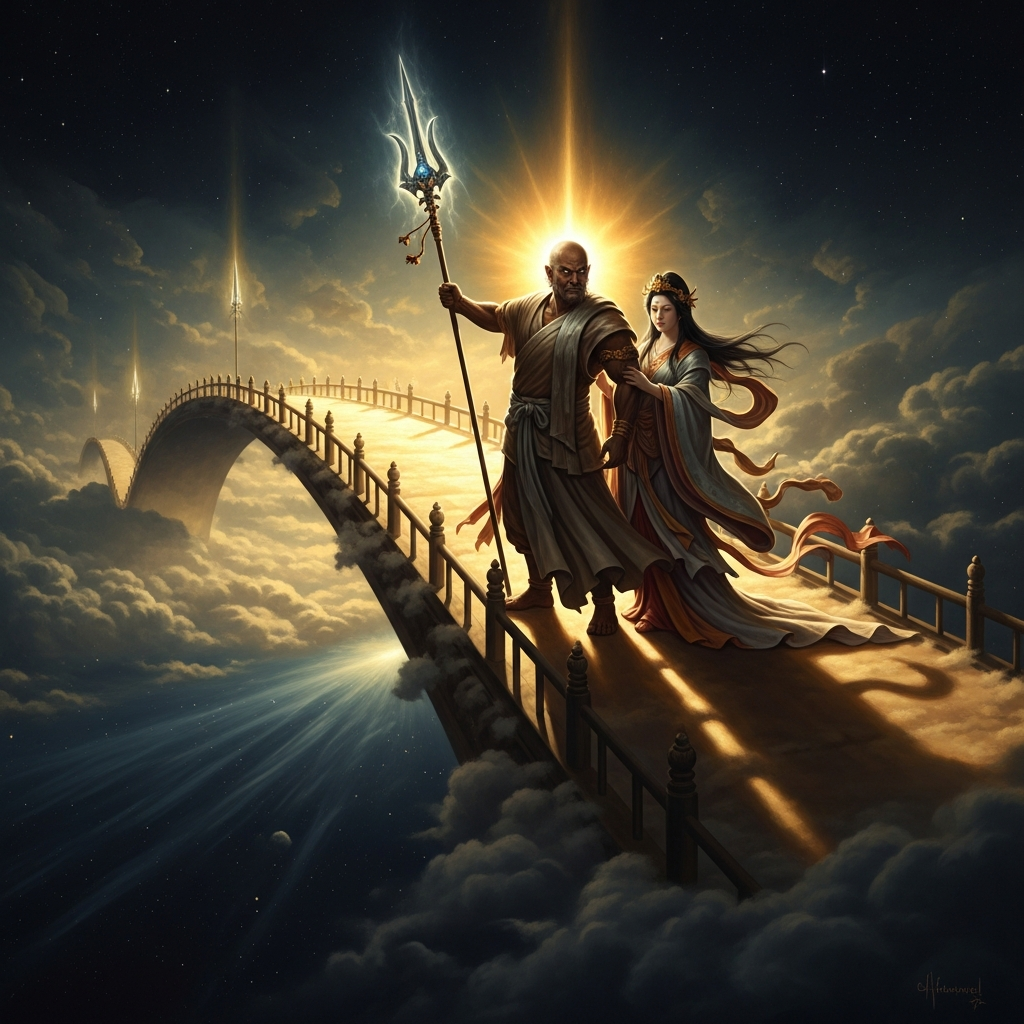
Susanoo comes to the Plain of High Heaven and Amaterasu, watching him approach, suspects the worst. He is coming to take the heavens, she thinks. He is coming in conquest. He has wept so loudly that the land has shaken and the seas have surged and the mountains have shuddered, and now he is here at the border of her domain with that weeping storm-presence, and Amaterasu readies herself. She strings her bow. She stamps the earth so hard that her feet sink in and kick up spray. She is a war-goddess for this moment, prepared for her brother’s aggression.
But Susanoo says: I do not come to take. I come to say goodbye before I go to my mother.
He means Izanami. He means the underworld, the Root Country, where the dead woman who bore him lives now in her maggot-body behind the great boulder. He is weeping because he misses his dead mother and cannot stop missing her, and the weeping has been so powerful that it has damaged the world. He does not want heaven. He wants to look at his sister once more before he goes somewhere he will not return from.
Amaterasu says: Prove it.
The proof she demands is creation.
She takes his sword — the ten-span sword he wears at his side — and she breaks it into three pieces. She chews the pieces, and then she breathes out the chewed fragments and from the breath three goddesses are born: Takirabime, Ichikishimahime, Takitsuhime. They are beautiful deities, sea-goddesses, and they will be worshipped at Munakata Shrine on the northern Kyushu coast for centuries as protectors of the crossing between Japan and the continent.
Susanoo takes the five-hundred jewels from Amaterasu’s necklace, the curved magatama beads she wears at her neck. He chews them in his turn and breathes out and five male deities are born. The first-born is Ame-no-Oshihomimi — the Heavenly-August-Grand-Master — who will be the father of Ninigi, who will descend to earth as the grandfather of Japan’s first emperor.
The logic of the contest determines who owns the children.
Amaterasu claims the five male deities, because they were born from her jewels. Susanoo claims the three female deities, because they were born from his sword.
But Susanoo then says: I have won. He says this because the male deities born from his action were pure, undefiled, virtuous — proof that he came in peace, that his intentions were not corrupt. Amaterasu disputes the logic. The texts are ambiguous about who is right, and the Japanese commentators have argued about this ever since. What is not ambiguous is what happens next.
Susanoo wins the argument, or believes he wins it, and the victory unleashes something in him.
He begins to destroy.
He fills the rice paddies. He tears down the divisions. He desecrates the weaving hall. A weaving maiden dies. And Amaterasu, who welcomed him and shared the creative contest with him, retreats into the cave that will plunge the world into darkness.
The contest that proved his peace precedes the violence that proved its own undoing. Creation and destruction are not opposites in this cosmology; they come from the same source, the same divine being, sometimes within the same divine moment. The goddesses born from his sword are beautiful. The horse he throws through the roof is a catastrophe. The same hand does both.
The children of this contest — the five boys, the three girls, born from chewed jewels and chewed sword — spread out across the divine genealogy of Japan, appearing in shrine dedications and imperial ancestry documents and mythological accounts for the next fifteen hundred years. The contest between a suspicious sister and a grieving brother produced the ancestors of an empire.
Amaterasu had been right to be afraid.
She had been wrong about why.
Echoes Across Traditions
Entities


Sources
- Kojiki (Record of Ancient Matters), compiled 712 CE, Book I, Sections 13-14
- Nihon Shoki (Chronicles of Japan), compiled 720 CE
- Donald Philippi, *Kojiki* (University of Tokyo Press, 1968)
- Joseph Kitagawa, *On Understanding Japanese Religion* (Princeton, 1987)