Contents
While the world sits in divine darkness, eight million gods gather outside Amaterasu's cave and persuade her to emerge with the one thing she cannot resist: the sound of the other gods laughing.
- When
- Age of the Gods — before historical time, Kojiki cosmogony
- Where
- The entrance to the Rock Cave of Heaven (Ama-no-Iwato) on the Plain of High Heaven
The preparations are elaborate.
Futodama assembles the sacred objects: a large curved jewel, a mirror made in the likeness of the sun, a mulberry tree with branches hung with jewels and white cloth, a sword. The mirror is important — it is called Yata no Kagami, the Eight-Hand Mirror, and it has been made by the divine smiths for a specific purpose. The purpose will become clear only later.
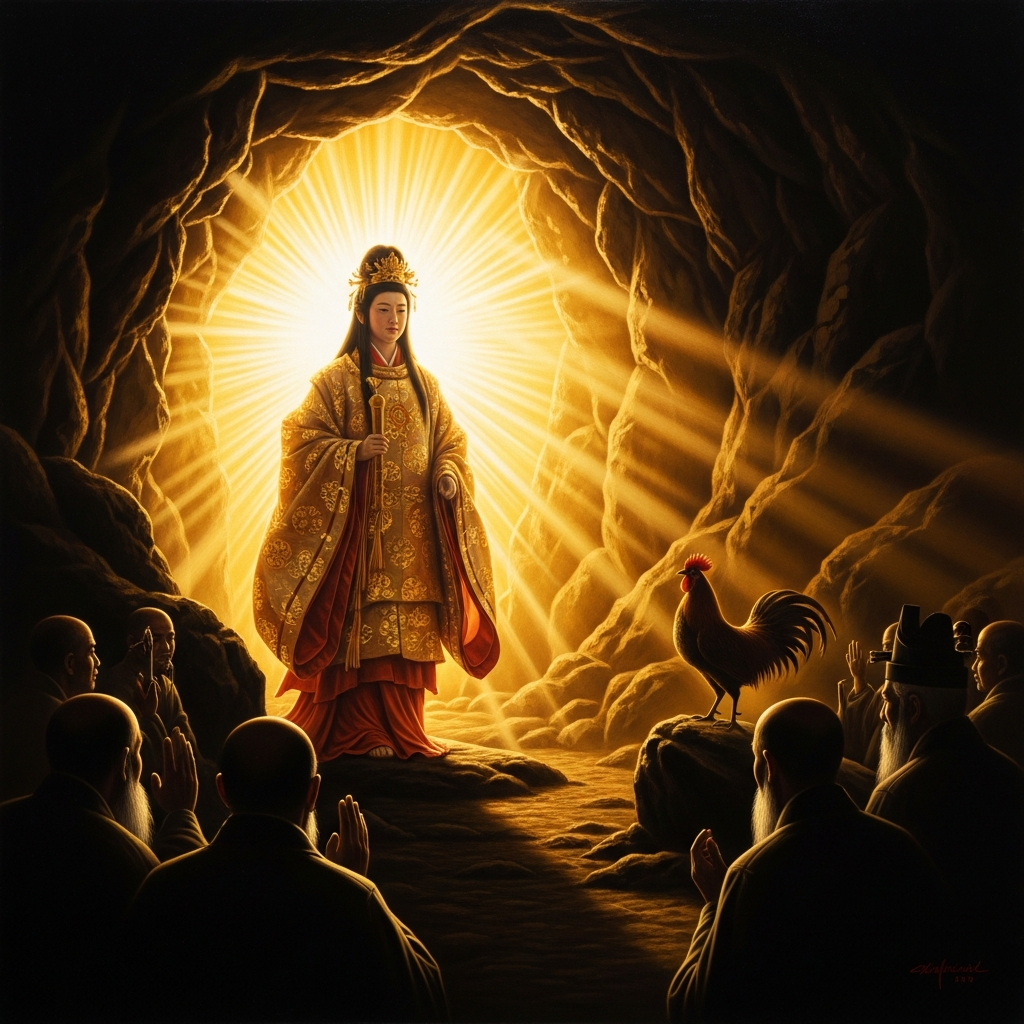
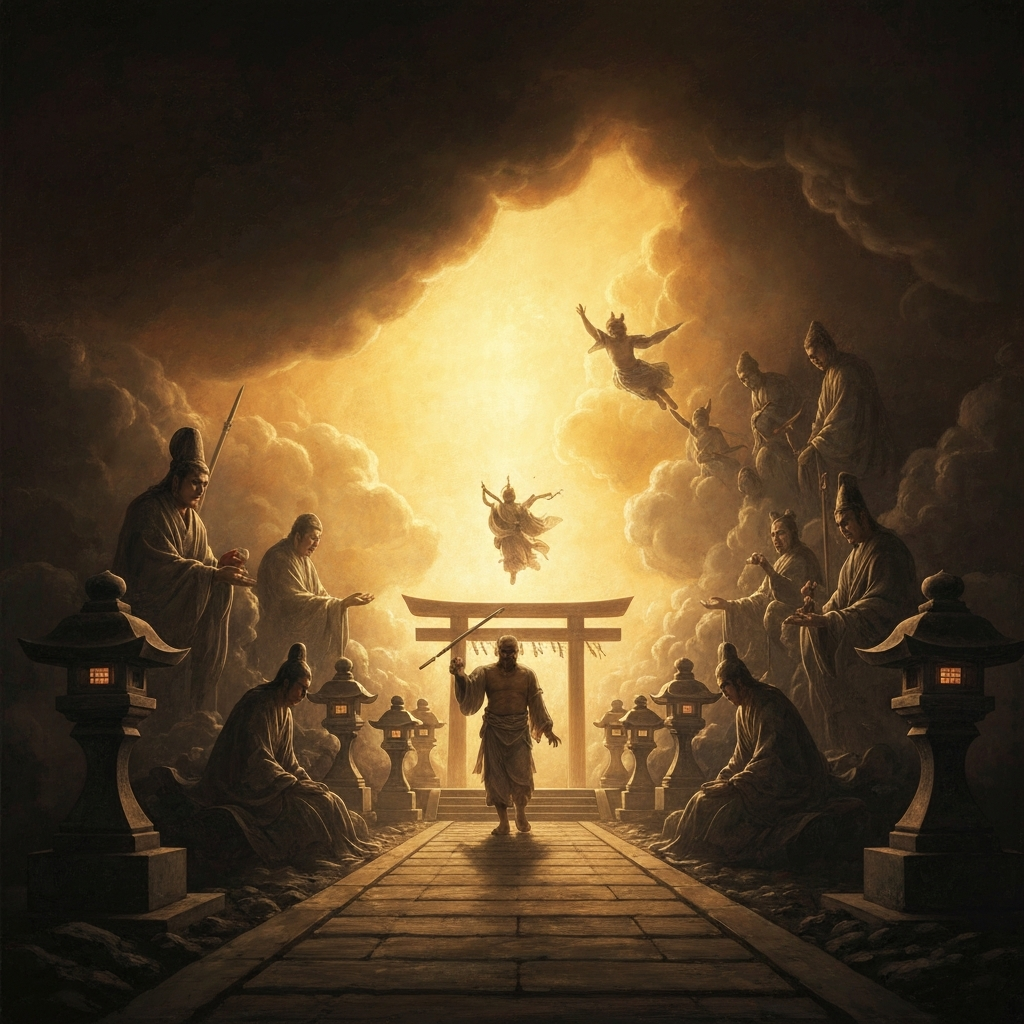
The gods plant the sacred sakaki tree with its branches and decorations before the cave entrance. They light bonfires. Eight hundred cocks are gathered to crow — because cocks crow at dawn, and they need to remind the darkness that dawn is a thing that can happen. Eight million deities arrange themselves on the plain of heaven in the positions of a ceremony, though no ceremony like this has ever been performed before.
Then Ame-no-Uzume climbs onto an overturned washtub and begins to dance.
She is the Dawn Maiden, the Skydancer, and what she does on that overturned washtub is not a dignified temple performance. The Kojiki describes it with a word — tawamure — that means something between play and lewdness. She stamps. She goes into trance. She lets her clothes fall open. The hakata of her sash comes undone and drops. She is possessed, or she is performing possession, or the two are not different things in this context.
The eight million gods watch. And then something extraordinary happens.
They laugh.
The sound of eight million divine beings laughing fills the Plain of High Heaven. The laughter is not polite or restrained; it is the full-throated laughter of beings who have been sitting in darkness and terror and suddenly see something absurd and alive and human. It shakes the heavens. It echoes.
Inside the cave, Amaterasu hears it.
She has been in the dark since the death of her weaving maiden. She has sealed herself away from a world where her brother’s violence is the operating principle. She has good reasons to stay where she is. But the laughter does not sound like a world in crisis. It does not sound like eight million frightened beings performing a desperate ritual. It sounds like joy.
She rolls the stone slightly aside. Not open — just aside. Enough to look.
She asks: Why is Ame-no-Uzume dancing in this manner? Why are all the deities laughing?
Uzume answers without pausing the dance: We are laughing because there is a deity more illustrious than you present among us.
In that moment, Ame-no-Tajikarao — the Strong-Armed Deity, who has been hidden beside the cave entrance specifically for this moment — reaches in and grabs Amaterasu by the hand. Another deity stretches the sacred rope of shiri-kume-nawa across the cave entrance so she cannot retreat. And as she emerges, blinking, into the light she herself is generating, she sees the mirror.
The mirror shows her her own face.
This is the trick. The magnificent deity Uzume described is Amaterasu herself, reflected in the mirror made in her likeness. She has been drawn out by the promise of something more radiant than herself, and what she finds is her own radiance, confirmed and returned by a polished surface that knows how to show the sun what it looks like.
The light returns. The crops can grow. The evil spirits retreat back into the corners they came from.
And Ame-no-Uzume’s dance, performed on an overturned tub in the darkness of the divine night, becomes the template for every kagura performance in every shrine in Japan from that moment forward: the sacred dance that moves the gods, the ritual where the human body becomes the instrument by which the divine is called back into the world.
Echoes Across Traditions
Entities
- Amaterasu
- Ame-no-Uzume
- Ame-no-Tajikarao
- the eight million deities
- Futodama

Sources
- Kojiki (Record of Ancient Matters), compiled 712 CE, Book I, Section 17
- Nihon Shoki (Chronicles of Japan), compiled 720 CE
- Nishiyama Matsunosuke, 'The Development of Kagura Dance,' *Acta Asiatica*, 1990
- Royall Tyler, *Japanese Tales* (Pantheon, 1987)