Contents
After her brother Susanoo's rage destroys her sacred weaving hall and kills one of her maidens, the sun goddess seals herself inside a cave — and the world falls into a darkness that invites every evil.
- When
- Age of the Gods — before historical time, Kojiki cosmogony
- Where
- The Rock Cave of Heaven (Ama-no-Iwato) on the Plain of High Heaven
The weaving hall is the center of heaven’s order.
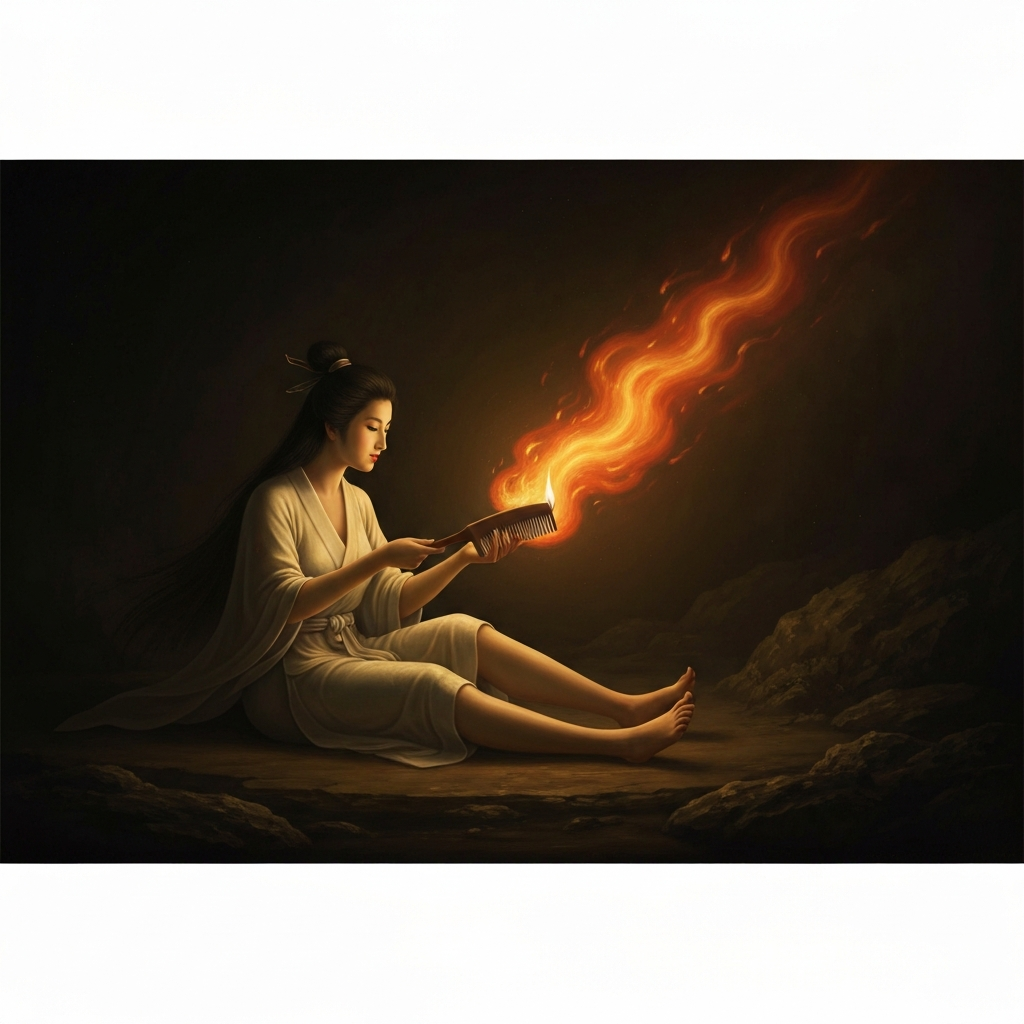
Amaterasu’s divine weaving maidens sit at their looms in the sacred hall, weaving the garments of the gods, keeping the cosmic industry that underlies the Plain of High Heaven moving. The looms are holy. The cloth is holy. The women at the looms are under the goddess’s protection. This is the ordered world: the sun goddess above all, her maidens at their work, the fabric of heaven being made.
Then Susanoo arrives.
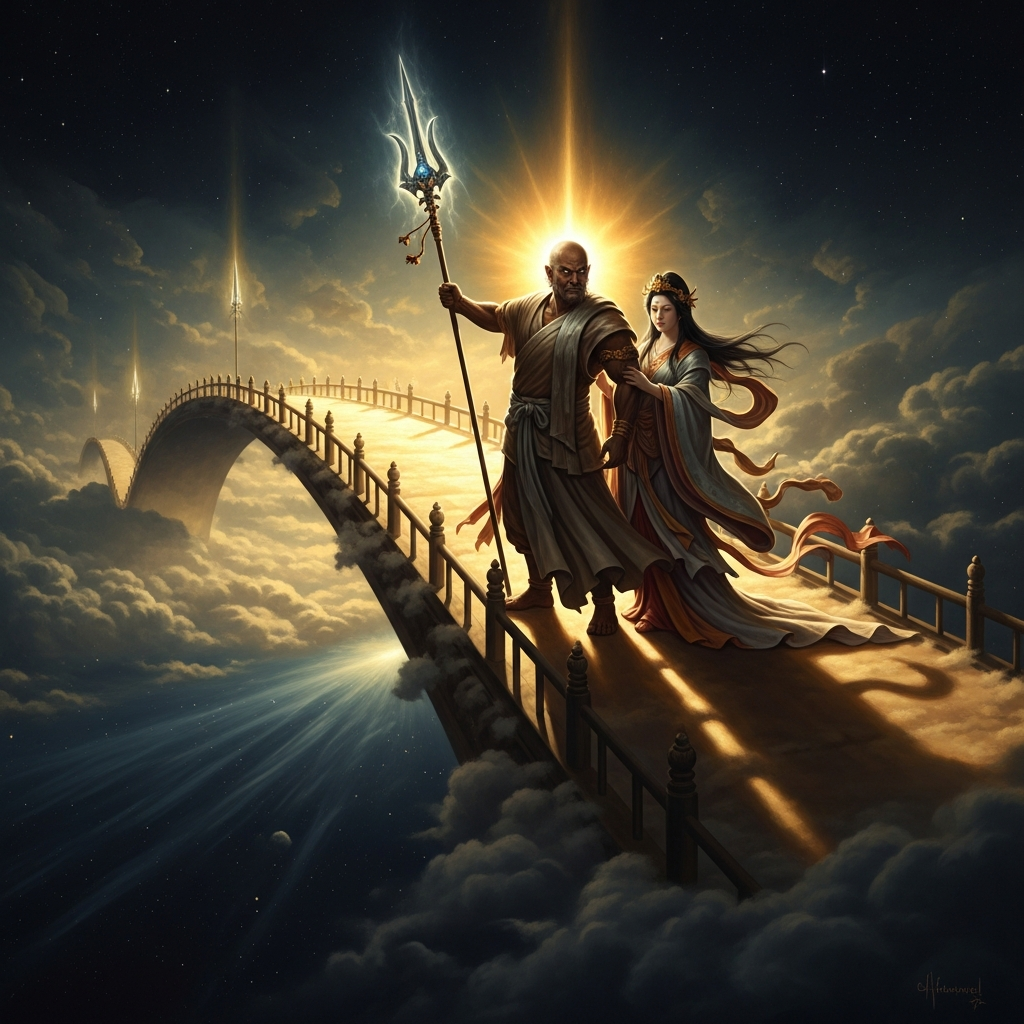
He has been weeping. He has been weeping for so long — roaring and weeping in the way that storms roar and weep — that the mountains have shaken and the seas have risen and the trees of the earth have begun to die. He has been expelled by his father Izanagi for this weeping, told to leave heaven and go rule the ocean he was assigned, but he refuses to go until he has visited his sister one last time. He comes to heaven. He comes to the sun goddess’s domain.
And whether out of grief or rage or simply the nature of a storm that has been contained too long, he begins to destroy.
The Kojiki lists what he does in the enumerated way it lists all divine outrages: he fills in the rice paddies Amaterasu has cultivated. He destroys the divisions between them. He covers over the irrigation ditches. He defecates in the sacred hall where the harvest rites are performed. At first Amaterasu makes excuses for him — perhaps he filled the paddies by accident, perhaps his intentions are not violent, perhaps the excrement is not excrement but something else. She is a patient goddess or a devoted sister; the Kojiki does not distinguish between the two.
But then Susanoo does something that cannot be reinterpreted.
He flays a piebald horse — a spotted horse, a sacred horse — and throws it through the roof of the weaving hall.
The maidens are at their looms. The horse falls among them. In the shock and chaos, one of them — some texts say it is Amaterasu herself, some say it is a weaving maiden — strikes herself with the shuttle. The wound kills her. A weaving maiden of heaven dies in a hall that was meant to be protected.
Amaterasu retreats.
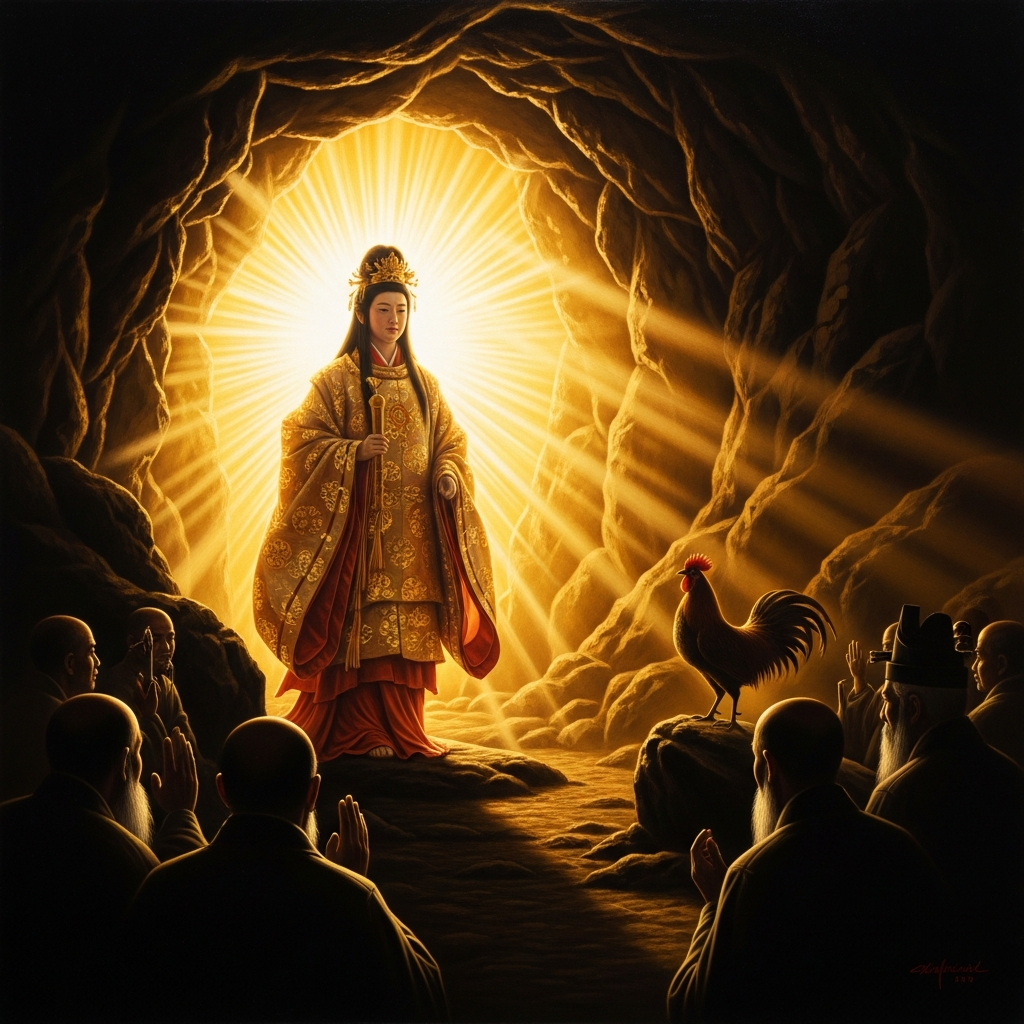
She seals herself inside the Rock Cave of Heaven — Ama-no-Iwato — and rolls a great stone across the entrance. This is a conscious act, not a panic. She has understood what her brother’s presence means. She has understood that heaven, as currently constituted, is not safe for the things she cares for. She withdraws.
The consequence is immediate.
The Plain of High Heaven goes dark. The world below — the middle land, Japan — goes dark with it. Without the sun goddess, there is no light. Without light, the crops do not grow. Without the crops, nothing can eat. The Kojiki adds a detail of particular horror: without the sun, the voices of the evil spirits fill the world. Every evil being that had been driven back by the light now moves freely in the permanent night. The world is not neutral in darkness; it is actively hostile.
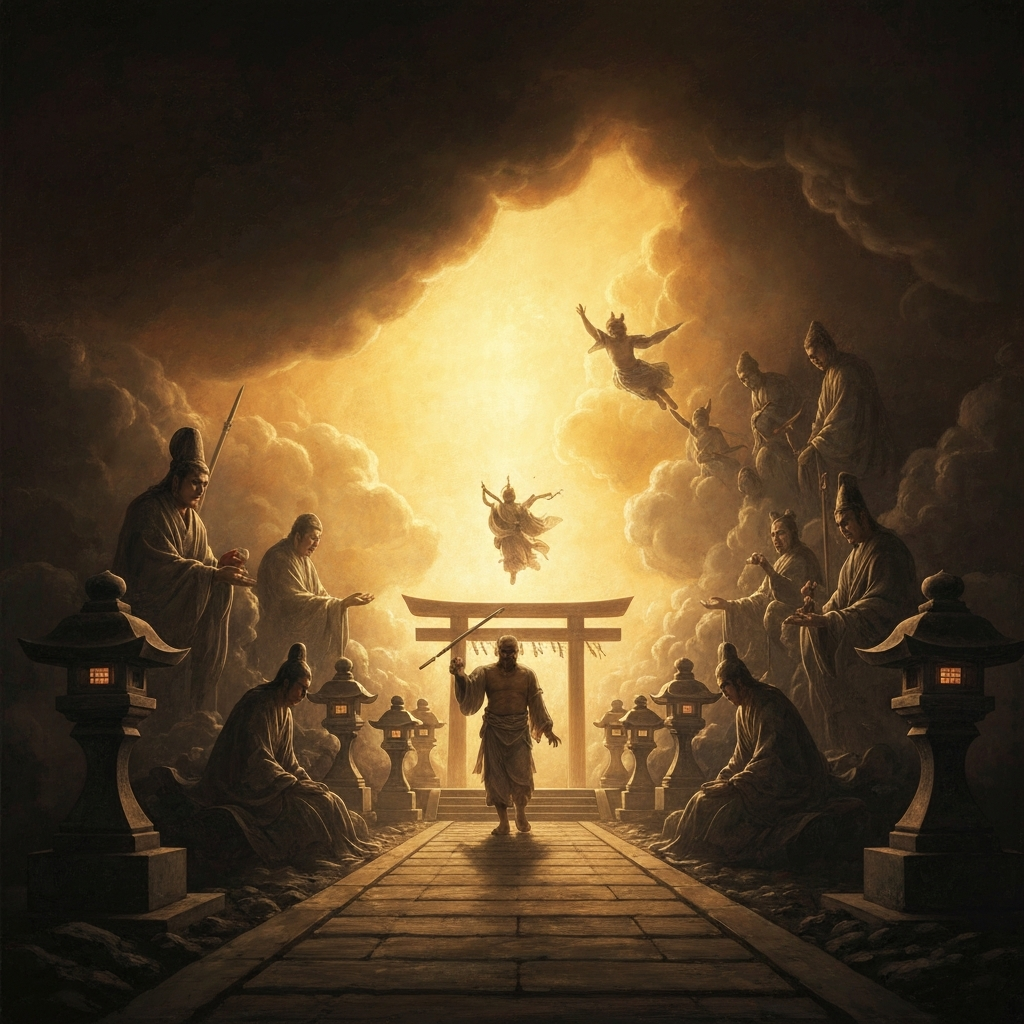
Eight million deities gather on the riverbed of heaven. They must call her back. They must find a way to make the sun want to return.
The problem they face is one that religion faces in every tradition: how do you call back a god who has good reason to stay hidden? What can you offer a deity who has seen the worst of what divine life can produce and chosen the safety of the dark cave over the dangerous light of the world?
The answer the eight million gods arrive at will not involve force or argument or theology.
It will involve laughter.
The world is dark. Every demon is abroad. The crops are failing. Eight million gods stand on the riverbed of heaven in the dark, and they are going to try something that has never been tried before.
They are going to throw a party.
Echoes Across Traditions
Entities


Sources
- Kojiki (Record of Ancient Matters), compiled 712 CE, Book I, Sections 16-17
- Nihon Shoki (Chronicles of Japan), compiled 720 CE
- Felicia Bock, *Classical Learning and Taoist Practices in Early Japan* (Arizona State University, 1985)
- Mark Teeuwen and Fabio Rambelli, eds., *Buddhas and Kami in Japan* (Routledge, 2003)