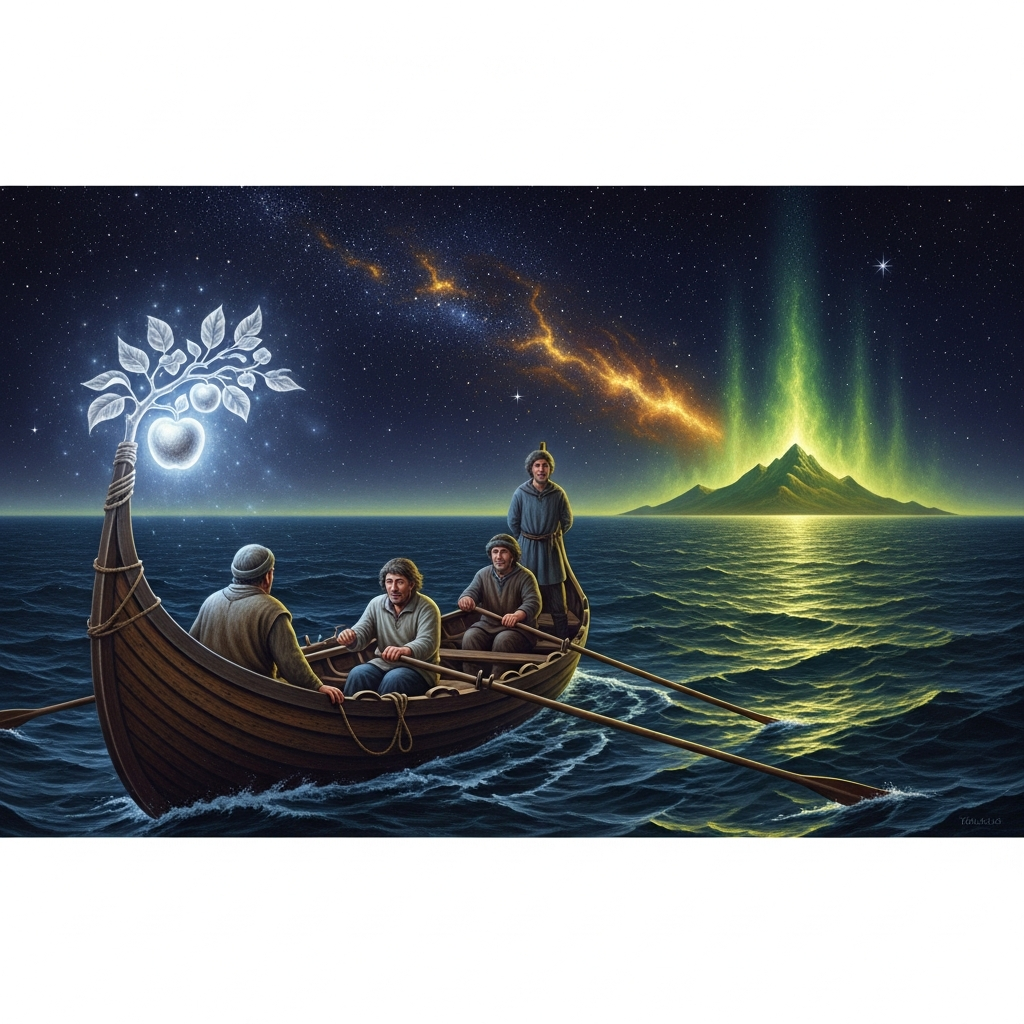
The Voyage of Bran to the Isle of Women
circa 700 BCE — the mythic voyaging age of pre-Christian Ireland · Ireland, then the western Atlantic ocean, then the Isle of Women (Tír na mBan), then the Isle of Joy
Contents
A supernatural woman appears in Bran's hall carrying a silver branch from the apple trees of the Otherworld and sings the description of a land so beautiful that Bran launches his currach westward into the Atlantic — and sails off the edge of the known world into an island where there is no death.
- When
- circa 700 BCE — the mythic voyaging age of pre-Christian Ireland
- Where
- Ireland, then the western Atlantic ocean, then the Isle of Women (Tír na mBan), then the Isle of Joy
The branch falls from nowhere.
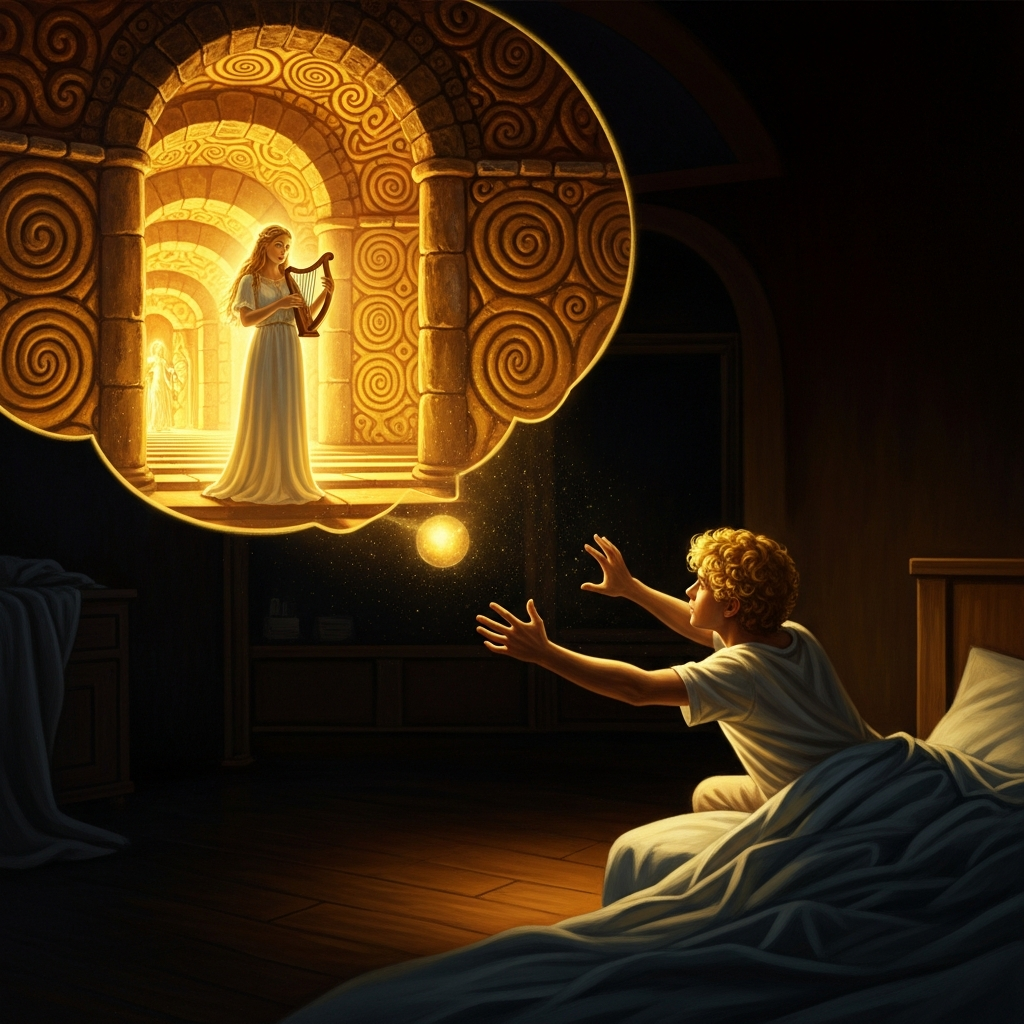
Bran Son of Febal is asleep when the sound wakes him — the most beautiful music he has ever heard, the kind of music that comes from somewhere else and makes the room it enters feel temporary. He cannot locate the source. He follows it through his hall and through the night and falls asleep again, and when he wakes there is a silver branch on the floor beside him.
The branch is from the apple trees of Emain Ablach — the apple-land of the Otherworld — and it is blossom and fruit simultaneously, which is the way the Otherworld’s time works: not sequential, not before-and-after, but everything at once. It is the most beautiful object he has ever seen. It smells like the air of a place where no one has ever been cold or hungry.
A woman appears in his hall that evening — comes through a closed door, which is one of the ways the Otherworld makes itself known. She is from that apple-land. She has been sent to invite him. She sings.
The song describes a land where there is no winter, no age, no death, no sorrow — the usual description, the description every Irish poem about the Otherworld offers, the inventory of absences that is also an inventory of what the living world costs. But this particular song has specific geographical detail that the other descriptions lack: the sea-road, the islands passed, the characteristics of each one. It is a sailing direction encoded in verse.
Bran takes twenty-seven men and his three foster-brothers and puts them in a currach.
They sail west.
On the open ocean they pass Manannán Mac Lir driving his chariot across the waves — he is driving over the sea-surface as if it were a plain, and the waves break around his horses’ knees, and he stops alongside the currach and speaks with Bran as one traveler to another. He is going to Ireland, to the woman who will be the mother of a son. He tells Bran: the sea you think you’re sailing is a plain of flowers to me. What you see as waves, I see as blossoming flowers.
Two perspectives on the same crossing. The Otherworld doesn’t look like the Otherworld from the inside.
They find the Isle of Women. The queen throws a ball of thread to Bran from the shore and when he catches it the thread sticks to his palm and she draws the currach to shore. This is the arrival: called, caught, drawn in.
They stay. The hospitality is perfect. The time doesn’t pass. A year goes by that isn’t a year.
One man, Nechtán, becomes homesick. He cannot be the first to say it — homesickness in a place of perfection is an embarrassment — but he says it, and Bran feels it too, and they go.
The queen warns them: do not touch the ground of Ireland.
They sail back. They find Ireland, but it is a different Ireland — people at the shore who don’t recognize the name Bran Son of Febal except as a name from the old stories.
Nechtán leaps from the currach onto the shore.
The same thing that happens to Oisín on the horse happens to Nechtán on the beach: three centuries arrive in an instant. He becomes dust.
Bran calls his story from the currach to the people on the shore — calls it without landing, without touching the ground of a world that has moved on without him. They write it down. It is the oldest story he had, and it is the one he is telling from the middle of the sea, going away.
He turns the currach west again. The silver branch is still with him. The Isle of Women is still where the setting sun touches the water. He is going back. He does not return.
Echoes Across Traditions
Entities
- Bran Son of Febal
- Manannán Mac Lir
- The woman of the Otherworld
- Nechtán
Sources
- Séamus Mac Mathúna, *Immram Brain: Bran's Journey to the Land of the Women* (Niemeyer, 1985)
- Jeffrey Gantz, trans., *Early Irish Myths and Sagas* (Penguin, 1981)
- Thomas Owen Clancy and Gilbert Márkus, *Iona: The Earliest Poetry of a Celtic Monastery* (Edinburgh University Press, 1995)