The Golden Age Is Gone: World Ages and the Myth of Decline
Hesiod's Five Ages in Works and Days c. 700 BCE; Hindu Yuga doctrine in Mahabharata (c. 400 BCE) and Puranas (c. 400-1000 CE); Aztec Five Suns in Nahuatl texts codified c. 16th century CE; Plato's Great Year in Timaeus c. 360 BCE · The cosmic time that precedes and contains all historical time — not a location but a duration, the framework within which all events have meaning
Contents
Hindu Yugas, Hesiod's Five Ages, the Aztec Five Suns, the Platonic Year: every civilization has imagined time degenerating from a golden origin. The structure reveals a universal anxiety.
- When
- Hesiod's Five Ages in Works and Days c. 700 BCE; Hindu Yuga doctrine in Mahabharata (c. 400 BCE) and Puranas (c. 400-1000 CE); Aztec Five Suns in Nahuatl texts codified c. 16th century CE; Plato's Great Year in Timaeus c. 360 BCE
- Where
- The cosmic time that precedes and contains all historical time — not a location but a duration, the framework within which all events have meaning
Hesiod, writing in Boeotia sometime around 700 BCE, puts his authorial complaint directly into the poem: “Would that I were not among the men of the fifth generation, but either had died before or been born afterward.”
He is a man of the iron age. It is the worst age. He knows this because he can enumerate the better ages that preceded it — the golden race who lived without toil, the silver race who were at least more interesting than his own contemporaries, the bronze race who at least had the dignity of destroying themselves in battle, the heroic race of Achilles and Odysseus who at least got to go to the Isles of the Blest when they died. His own race gets nothing. They labor, grow old, and die, surrounded by people who cannot tell justice from injustice and don’t particularly care.
He wishes he had missed it.
This complaint — it was better before, we are living in the worst of times, the world has been running down since the beginning — is one of the most universal expressions in human literature. It appears in Hesiod. It appears in the Hindu Puranas. It appears in the Aztec cosmological texts. It appears in Zoroastrian doctrine. It appears in every generation’s literature, so reliably that social historians have noted the evidence: people in every era believe they are living in the worst era. The decline is always already in progress.
What is mythologically interesting is what this universal sense of decline means structurally — not whether it is empirically true, but what function the story of decline serves for the cultures that tell it.
The Mathematical Perfection of the Yugas
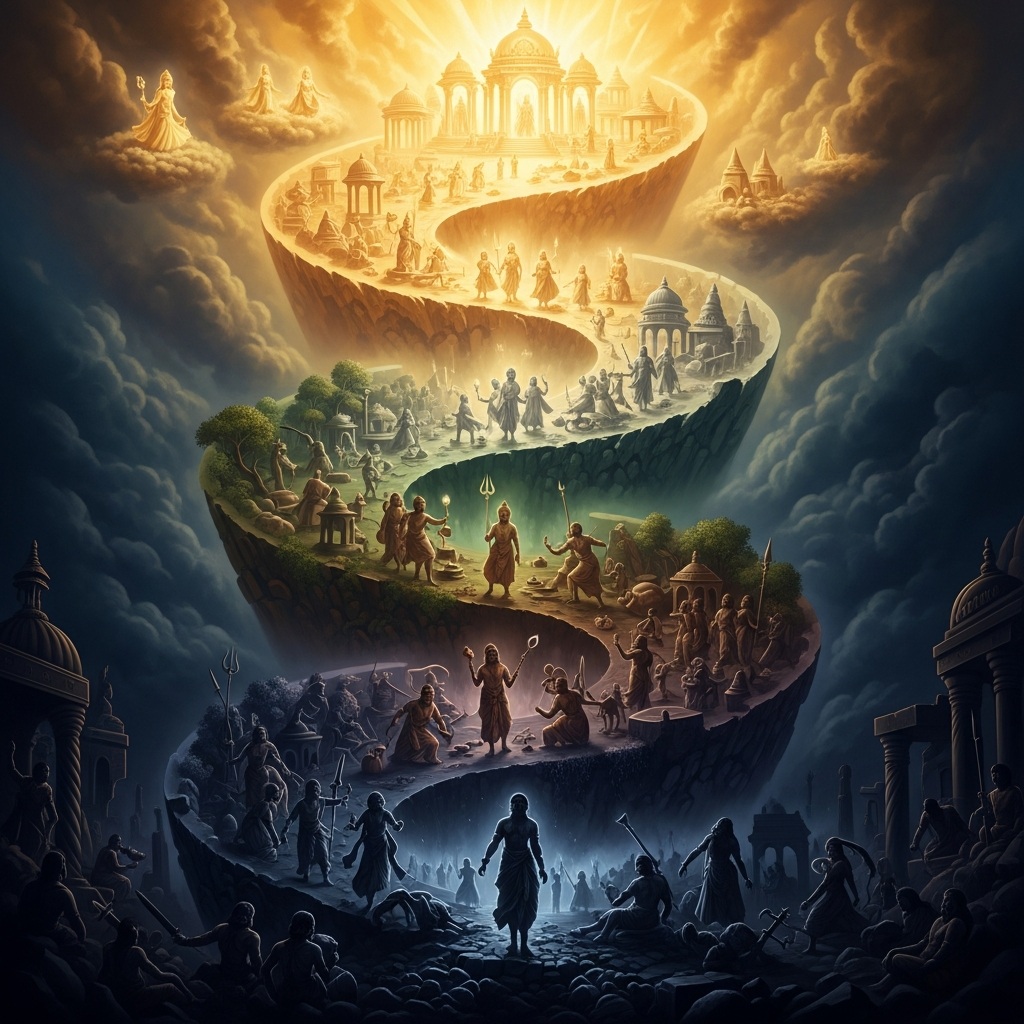
The Hindu Yuga system is the most elaborately quantified world-ages scheme in any tradition. The four Yugas have lengths in the ratio 4:3:2:1, which maps onto the four faces of the standard dice used in ancient Indian gambling. This is not a random parallel: the dice game was the central metaphor for cosmic chance and fate in the Vedic and Epic traditions — the catastrophic dice game in the Mahabharata that leads to the Pandavas’ exile is the central hinge of that epic.
The lengths are precise: Krita Yuga (1,728,000 years), Treta Yuga (1,296,000 years), Dvapara Yuga (864,000 years), Kali Yuga (432,000 years). These add to 4,320,000 years for one Mahayuga. One thousand Mahayugas make a Kalpa (one Day of Brahma). A full Brahma-day-and-night is 8,640,000,000 years — interestingly close to modern estimates of the earth’s age (4.5 billion years for the earth, 13.8 billion for the universe). The correspondence is probably coincidental but has attracted considerable attention.
The Kali Yuga began, by the traditional reckoning, at midnight on February 17/18, 3102 BCE — the date that the medieval Indian astronomer Aryabhata calculated for the alignment of the planets that marked the age’s beginning. By this calculation, we are currently in year 5,127 of the Kali Yuga, which has approximately 426,873 years remaining. The numbers are large enough to be functionally irrelevant to any individual human life, and this is precisely the point: the cosmic timescale provides a perspective in which all of recorded human history is a brief and relatively undistinguished period in a very long decline.
Hesiod’s Five Races: The Problem of the Heroes
The standard reading of Hesiod’s world-ages as a simple decline from gold to silver to bronze to iron is complicated by the fact that Hesiod inserts a fourth race — the race of heroes, the demigod generation of the Trojan War — between the bronze and iron races. The heroes are better than the bronze race that preceded them and better than the iron race that follows. They go to the Isles of the Blest.
Why interrupt the four-metal decline with an anomalous heroic race?
The most persuasive explanation (developed by Gregory Nagy, among others) is that the heroic race is an ideological insertion. Hesiod’s audience included people who considered themselves the descendants of those heroes and who maintained hero-cults at the graves of Achilles, Agamemnon, and others. To place the heroes simply in the bronze age, descending smoothly toward the iron age, would be theologically unacceptable. The heroes needed a better fate. Hesiod gives them the Isles of the Blest as a diplomatic accommodation.
The awkward seam where the heroic race interrupts the metal sequence reveals that the world-ages mythology is not a neutral cosmological theory. It is produced and edited by people with interests — audiences who need their ancestors honored, political establishments who need their mythological heritage included.
The Five Suns: Geology as Cosmological Record
The Aztec Five Suns cosmology is unique in explicitly connecting the destruction of previous world-ages with observable physical features of the current world. The First Sun (populated by giants) was destroyed by jaguars — and jaguars, in Aztec iconography, are associated with the night sky and with the earth’s primordial darkness. The Second Sun was destroyed by wind — and the Aztec wind-god Quetzalcoatl-Ehecatl is understood to have literally swept the people of that era away, those who survived becoming monkeys. The Third Sun was destroyed by fiery rain of volcanic material — and the volcanic mountains and basalt landscapes of central Mexico are the remains of that destruction. The Fourth Sun was destroyed by flood — and the great lake system of the Valley of Mexico, the extensive alluvial deposits, the mythology of surviving figures are the physical traces.
Each previous world is not simply gone. It is visible. The landscape is a palimpsest of world-destructions. The geological record and the cosmological record are the same record.
The current fifth sun — born when the gods sacrificed themselves at Teotihuacan — is destined to end in earthquakes (4 Movement, or Nahui Ollin). The Aztec calendar’s central concern with tracking dangerous dates (especially days with the sign Ollin, Movement) is directly related to this cosmological knowledge: the earthquakes that will end the world can, perhaps, be averted through the proper ritual maintenance of the sun’s daily journey. The sacrificial system is preventive cosmological maintenance.
The Platonic Year and the Self-Steering Cosmos
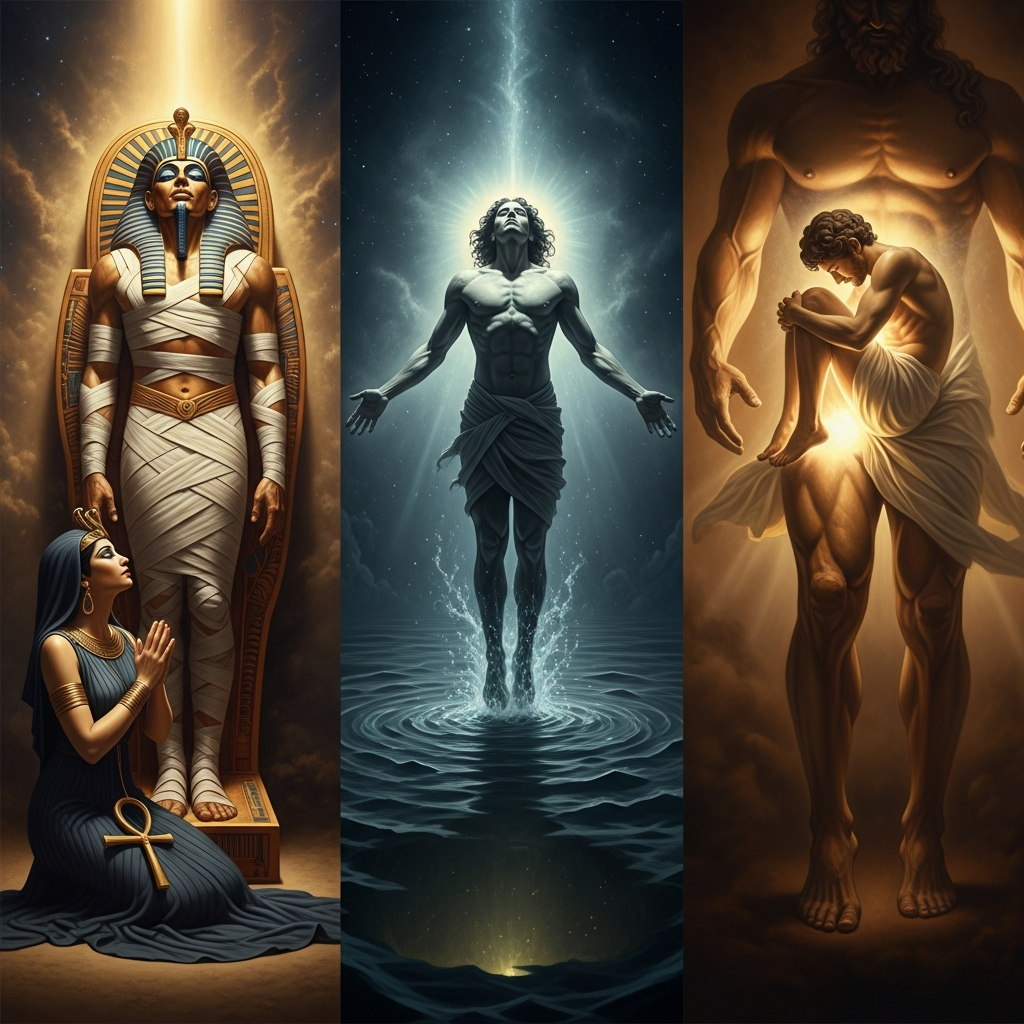
Plato’s Statesman contains a creation myth of unusual philosophical sophistication: the cosmos is steered by a divine hand for an age, then released to run by its own momentum for an equal period. During the divinely steered age, everything runs in reverse — people are born from the earth old and grow younger, eventually becoming children who disappear back into the ground. During the self-steering age, the normal direction of time resumes, but the cosmos gradually degenerates without divine guidance.
We are, Plato implies, in a self-steering age. The gods have let go. We are running on accumulated momentum, and the momentum is running down.
The Platonic myth is doing philosophical work: it is explaining why the world as currently experienced is inferior to the world as theoretically designed. The divine designer produced something perfect; what we have is that perfect thing running in its own momentum, accumulating error. The world-ages mythology is here pressed into the service of a philosophical theory of the cosmos’s temporal structure.
What the Decline Story Solves
The world-ages mythology is the oldest known solution to theodicy — the problem of why suffering and injustice exist in a divinely ordered universe. Its solution is temporal rather than philosophical: the world is not as the divine design intended, because time has accumulated corruption. We are not in the world as designed. We are in the world as it has decayed into.
This answer has several advantages over alternatives. It does not require the divine power to be limited or impotent. It does not require the divine power to be malicious. It does not require injustice to be illusory. It simply locates us late in a process of decline that was always going to happen.
The secondary advantage is the golden age: the knowledge that things were once better is not merely a source of nostalgia but a source of normative standards. The memory of the golden age (or its mythological reconstruction) tells you what the world should be like. The present can be measured against the past, and the measurement generates the ethical demand to restore, resist, rebuild.
Hesiod wishes he had been born into a different age but does not stop writing. His poem ends with instructions for virtuous agricultural and social practice — the things you can do in the iron age to live with some dignity. The myth of decline does not produce paralysis. It produces instructions for how to live in a fallen world while remembering what an unfallen world would look like.
That is not a small thing.
Echoes Across Traditions
Entities
- Brahma
- Vishnu
- Kalki
- Hesiod
- Cronus
- Quetzalcoatl
- Plato


Sources
- Hesiod, *Works and Days* 109-201 (Five Ages)
- *Mahabharata*, Book 3 (Vana Parva), 148-149 (Yuga doctrine)
- *Vishnu Purana* I.3 (Yuga doctrine and Kalki)
- Codex Chimalpopoca, *Leyenda de los Soles* (Aztec Five Suns)
- Plato, *Timaeus* 39d (Great Year); *Statesman* 268d-274e (cosmic alternation)
- Bundahishn (Zoroastrian cosmological text)
- Mircea Eliade, *The Myth of the Eternal Return* (1949)
- Gregory Nagy, *The Ancient Greek Hero in 24 Hours* (2013)
- Inga Clendinnen, *Aztecs: An Interpretation* (1991)