Zarathustra Crosses the River
circa 1500–1000 BCE — early Iranian Bronze Age, eastern steppes or Bactria · The Daiti River, somewhere on the eastern Iranian plateau — possibly near Bactria or the Aral Sea basin
Contents
A young priest wading across the Daiti River at dawn receives a vision of a shining figure — Vohu Manah, Good Mind — who leads him into the presence of Ahura Mazda and changes the course of religious history.
- When
- circa 1500–1000 BCE — early Iranian Bronze Age, eastern steppes or Bactria
- Where
- The Daiti River, somewhere on the eastern Iranian plateau — possibly near Bactria or the Aral Sea basin
The river is the color of hammered bronze in the early light.
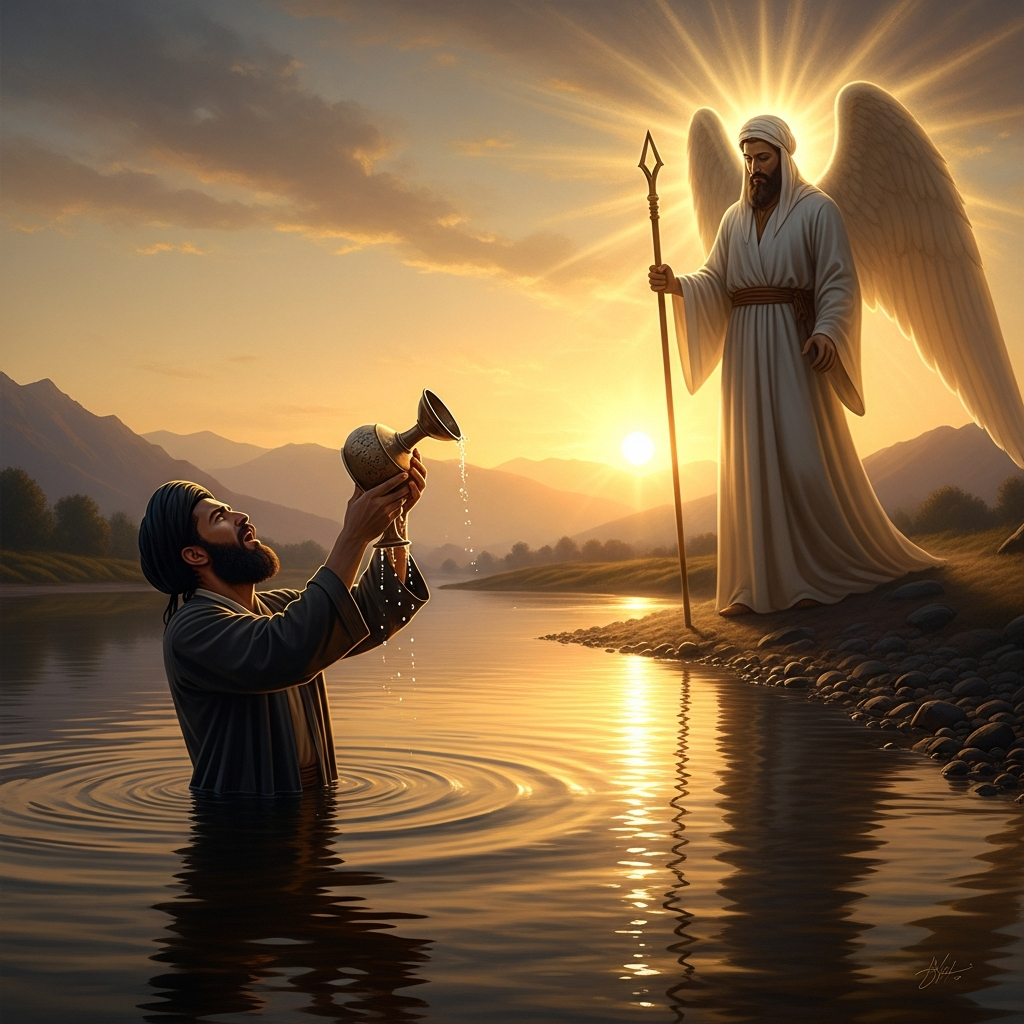
It is spring on the eastern plateau, and Zarathustra, son of Pourushaspa, has come to the Daiti before sunrise to fetch water for the dawn ritual. He is a zaotar — a priest of the old sacrificial order — and the ritual requires clean water drawn at the moment the darkness concedes to day. He has performed this rite a hundred times. He knows the ford by feel, knows where the current runs shallow over the gravel bed, knows how to hold the ritual vessel above the waterline as he wades.
He is thirty years old and has been asking questions his tradition cannot answer.
The questions are not mild curiosities. They are the kind that keep a man awake in the felt tent while the fire burns low — questions about whether the daeva-spirits the priests propitiate are truly divine, or whether their appetite for blood offerings conceals something darker. Questions about why the strong take from the weak so consistently, and whether the cosmic order endorses or merely tolerates this. He has spoken these questions to his elders and received answers that satisfied no one, least of all himself. He has gone on performing the rites because the rites hold the world together, or so everyone says, and he is not yet certain enough to stop.
Now he is in the river at dawn, the cold current pressing against his shins, the ritual vessel held steady in both hands.
The figure appears on the eastern bank.
It is nine times the height of a man and its radiance makes the rising sun look like a lamp in daylight. Later, when Zarathustra attempts to describe it, he will say only that it approached in the form of a beautiful youth and that the beauty was not the beauty of a body but the beauty of a principle — the way mathematical truth is beautiful, or the way a just verdict is beautiful after a long injustice. The figure identifies itself as Vohu Manah: Good Mind, Best Mind, the first and highest of the divine qualities.
Who are you? Vohu Manah asks. From whom do you come?
The question is not a request for biographical information. It is a question about substance — about what a man is made of, what he has chosen, what he serves. Zarathustra answers: he is a servant of Ahura Mazda, the Wise Lord. He has always been this, even when he did not have words for it. The answer, spoken aloud in the middle of the cold river, is the first moment he knows it is true.
Vohu Manah leads him.
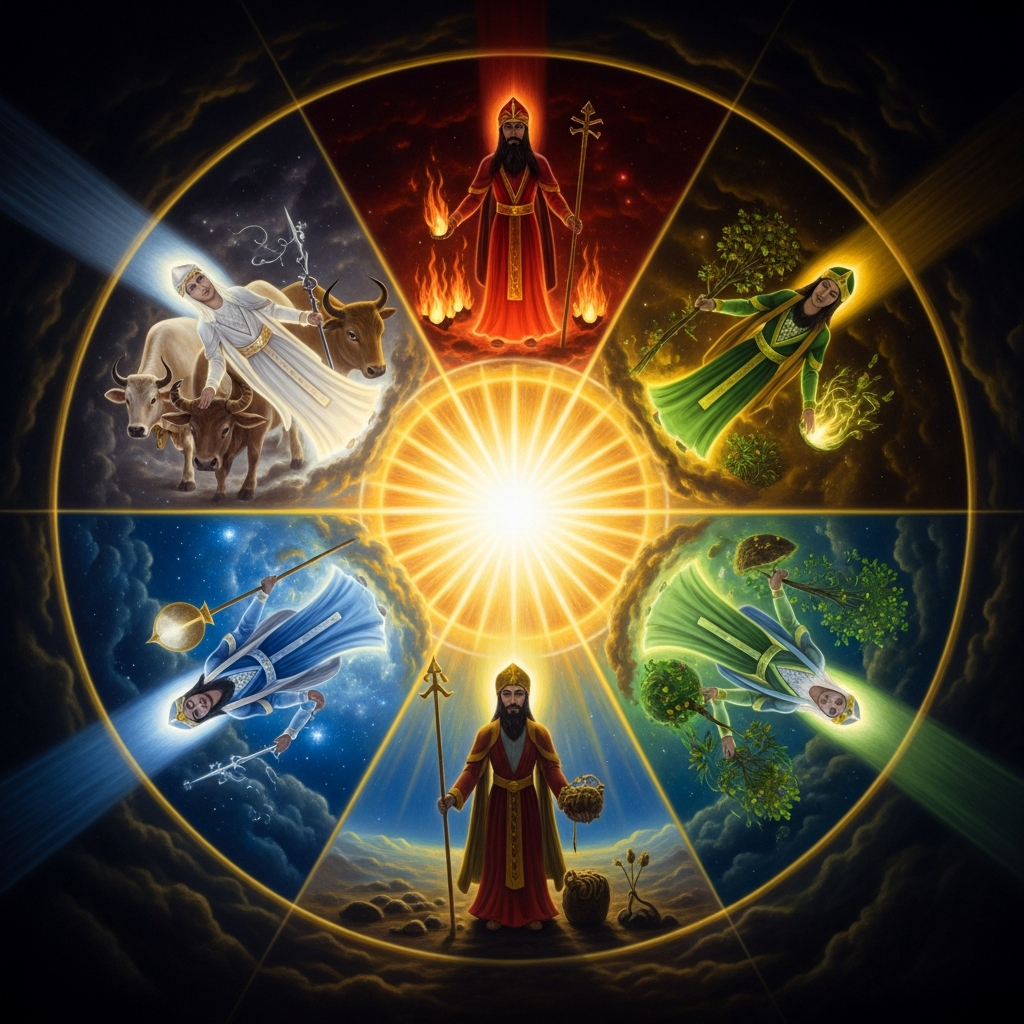
What follows is described in the Gathas — the seventeen hymns Zarathustra composes over the next years, the oldest parts of the Avesta — in language that is deliberately dense and visionary, resistant to literal reading. He enters the presence of Ahura Mazda and of the six divine qualities that surround the Wise Lord like light surrounds a flame: Vohu Manah (Good Mind), Asha Vahishta (Best Righteousness), Khshathra Vairya (Desirable Dominion), Spenta Armaiti (Bounteous Devotion), Haurvatat (Wholeness), and Ameretat (Immortality). Together they are the Amesha Spentas, the Bounteous Immortals, and in their presence Zarathustra understands that they are not external beings to be propitiated with blood but qualities to be embodied, to be chosen, to be built into the fabric of a life.
He understands, in this moment, the thing that will animate every sermon he preaches for the rest of his life: that the universe is not a neutral arena in which gods and humans perform ritual transactions, but a moral contest between two primal choices — Asha, truth and righteousness, and Druj, the lie and its consequences. Every creature, divine and mortal, has chosen one or the other. The daeva-spirits chose the lie. Ahura Mazda chose truth. And now Zarathustra, standing wet-footed on the gravel bar at dawn, must choose which side he will spend his life on — and must convince everyone around him to choose too.
He wades back across the river.
The vessel in his hands still holds its water. The ritual has not been abandoned; it has been transfigured. He will perform it differently now — not as a propitiation of hungry spirits but as a consecration of the day to the principle of Asha, a small daily act of alignment with truth.
The questions that kept him awake do not disappear. They deepen. But now they have a frame, and a direction.
He goes back to the tent to begin the years of preaching that no one, at first, will want to hear.
Echoes Across Traditions
Entities
- Zarathustra (Zoroaster)
- Vohu Manah
- Ahura Mazda


Sources
- The Gathas of Zarathustra, *Yasna* 28–34, 43–51, 53 — the seventeen hymns attributed directly to the prophet
- Mary Boyce, *A History of Zoroastrianism*, Vol. I (Brill, 1975)
- Prods Oktor Skjærvø, *The Spirit of Zoroastrianism* (Yale, 2011)
- Almut Hintze, 'The Cow that Came to Zarathustra,' *Journal of the Royal Asiatic Society* (2007)