Rishabha: The First Teacher
First tirthankara of the current cosmic cycle; dates given in Jain texts range from millions to billions of years ago; possible Rig Veda reference c. 1200 BCE · Ayodhya (birthplace and kingdom); the forests of renunciation across the subcontinent; Ashtapada mountain (liberation)
Contents
Before Mahavira, before Parshva, before the twenty-two tirthankaras between them, there was Rishabha — Adinatha, the First Lord — who taught humanity how to farm, how to write, how to cook, how to govern. Then he renounced all of it. He walked away from the kingdom he had organized, pulling out his own hair in five handfuls rather than shave it, and wandered for a year without food before achieving omniscience. He is the ancestor not just of Jain religion but, in Jain cosmology, of civilization itself.
- When
- First tirthankara of the current cosmic cycle; dates given in Jain texts range from millions to billions of years ago; possible Rig Veda reference c. 1200 BCE
- Where
- Ayodhya (birthplace and kingdom); the forests of renunciation across the subcontinent; Ashtapada mountain (liberation)
At the beginning of this cosmic age, when the wish-fulfilling trees that had fed and clothed and sheltered humanity for millions of years began to wither — when for the first time humans found themselves hungry without knowing how to plant, cold without knowing how to weave, arguing over land without knowing how to adjudicate — Rishabha watched and understood what was required.
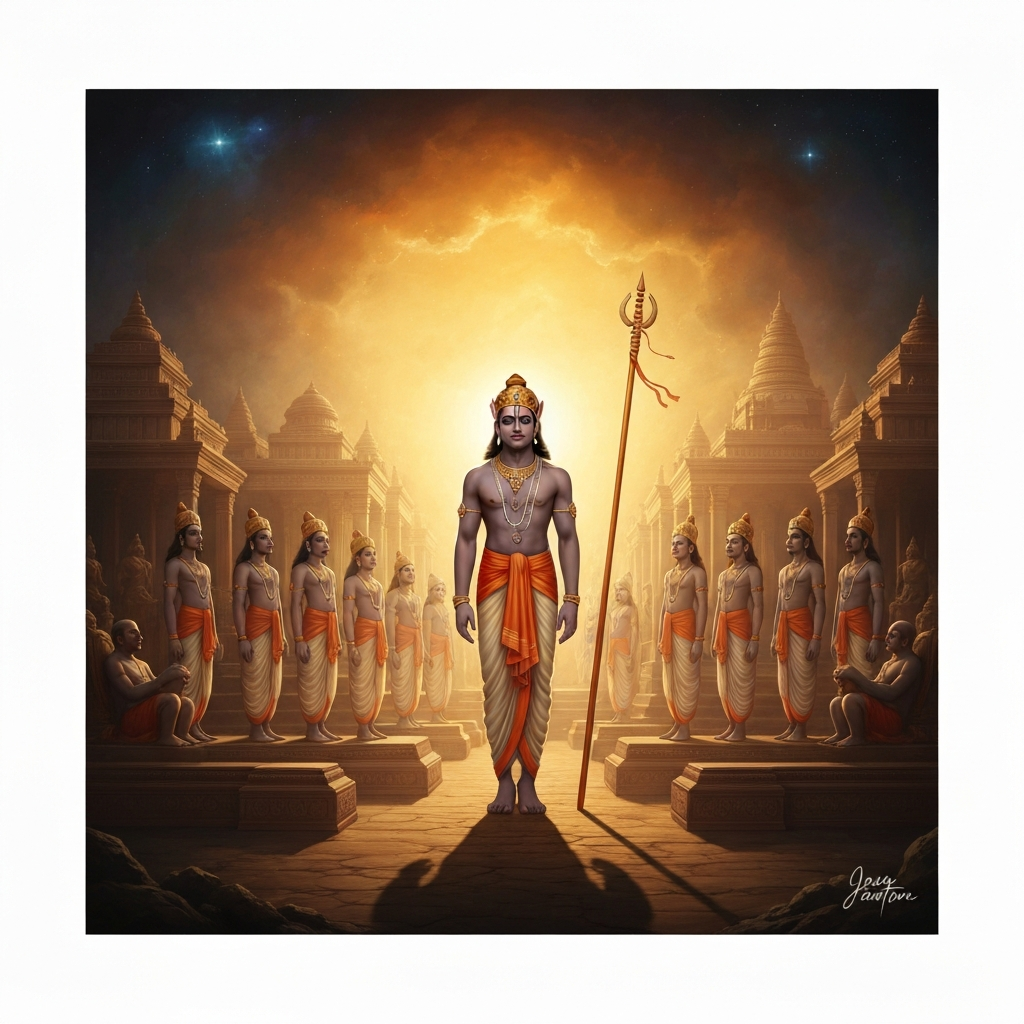
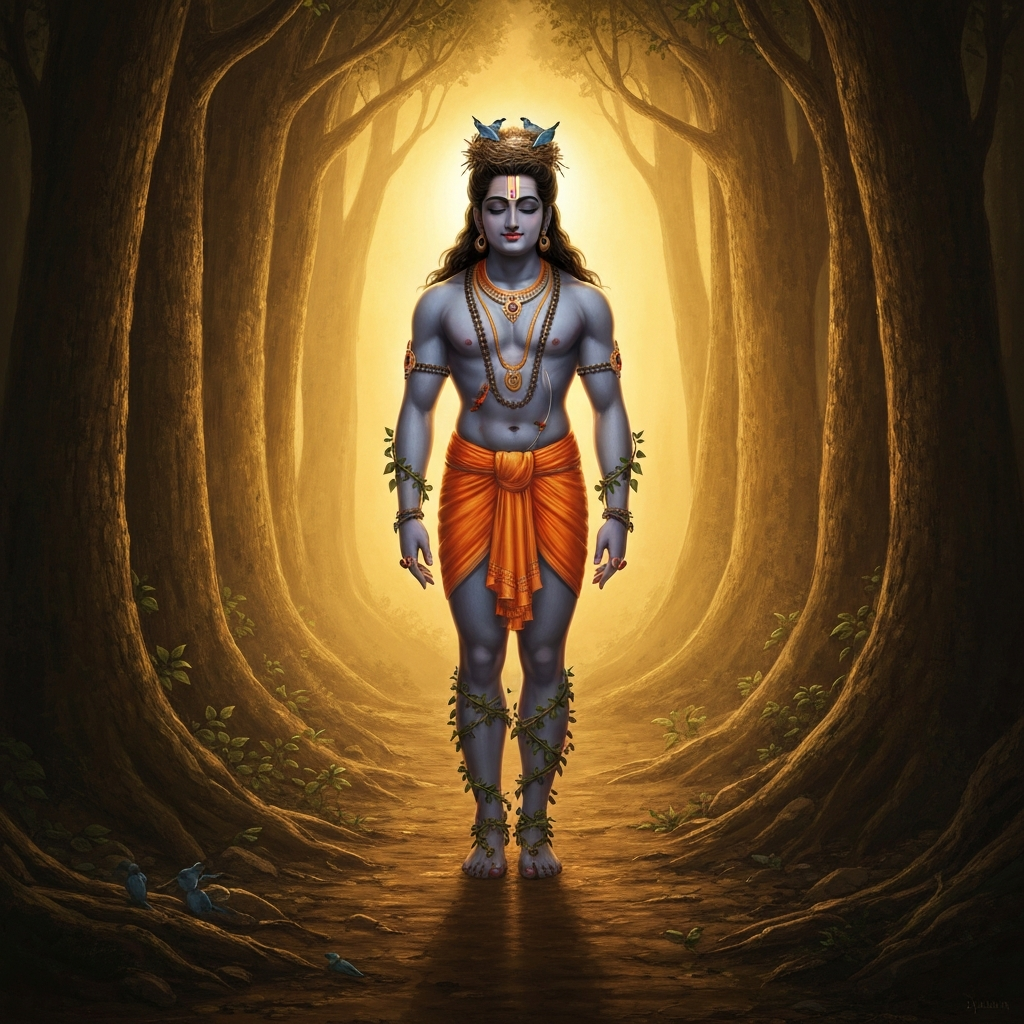
He was a king, born in Ayodhya, the son of the last couple of the golden age. He had a thousand sons and two daughters. His eldest son Bharata would give his name to the entire subcontinent. His son Bahubali would stand motionless on a hilltop for so long that vines grew up his legs. His daughters Brahmi and Sundari he taught to write and to count — to Brahmi the alphabet, to Sundari the numerals — and in the Jain account these are not metaphors but the literal moment of literacy’s origin: a father teaching a daughter, a daughter learning the first letters.
He taught his sons the seventy-two arts. He taught them to till and to sow and to reap. He taught them pottery and masonry, the smithing of iron, the governance of cities, the keeping of accounts, the administration of justice. He organized the population into the four social divisions — not the rigid castes that came later, but functional groupings based on capacity, fluid enough that they could be crossed. He established the first king’s court, the first system of law, the first principle of property that was also the first principle of theft.
He did this without being asked, because he saw that it was necessary, and without pride, because he understood what it meant.
A civilization is a very large karma-accumulating machine.
Every act of governance required decisions that harmed some to benefit others. Every system of property required the concept of theft. Every system of justice required the concept of punishment. Rishabha built these structures because without them his people would starve, but he built them with perfect awareness of what they cost — awareness that a soul accumulates weight in proportion to its entanglement with the world, and that he was building, deliberately and for good reason, a world of maximum entanglement.
The Adipurana — the great Sanskrit Jain epic written by Jinasena in the ninth century — is the most complete account of Rishabha’s life, and it is almost unbearable in its lucidity about this. The First Lord is not a naive king who discovers renunciation late. He is a being who knows from the beginning what the end must be. He builds the world with one hand and with the other, always, keeps the door to the forest open.
The trigger, when it comes, is small.
He is in his court. A dancing girl — Nilanjana, the texts name her — collapses mid-performance and dies. She dies in front of the king, in the middle of the music, with the garlands still on. The performance does not stop. The other dancers step around her and continue. The courtiers look straight ahead. The musicians do not miss a beat, because in a court a performance is a political fact and a political fact must continue.
Rishabha watches the body of Nilanjana on the floor with the dancers moving around it and understands, finally, what kind of machine he has built. A machine that has no pause button. A machine that processes life the way a mill processes grain, without sentiment, without acknowledgment, because the grinding is the point.
He stands up and walks out.
Outside the palace gates he stops, takes the royal cloth from his shoulders, drops it, reaches up and takes the first fistful of his own hair at the root.
The gesture is deliberate. He has a thousand royal barbers. He could be shaved by servants with golden razors and sandalwood paste, with ceremony, with music, with witnesses recording every detail for the dynastic annals. He tears his own hair out in five fistfuls because the point is not transition but rupture. He is not retiring. He is not abdicating. He is performing the one act that cannot be incorporated into the court’s administrative machinery: the public declaration that the self the court was built to serve has been surrendered.
His sons watch from the palace steps. Bharata, who will conquer the entire subcontinent — who the Jain Chakravartin tradition names the first universal emperor — watches his father walk away from everything Bharata is about to receive, and does not call him back. He understands. The Jain tradition is unusual in the clarity of this moment: the son who inherits everything witnesses his father choose nothing, and both acts are honored.
Rishabha walks for a year without eating.
This is not a figure of speech. He wanders through the kingdoms and forests of the early world, and the people along the way bring him gifts — gold, jewels, elephants, the currencies of the world he organized — because they do not understand what he is doing. He does not speak to explain. He cannot receive gifts. He is a monk seeking alms: food placed into his cupped hands by a donor who has not killed for him, not prepared it specially for him, not harbored an unkind thought in the moment of giving. These conditions are almost never met. He walks through village after village with his hands empty.
For a year he eats nothing.
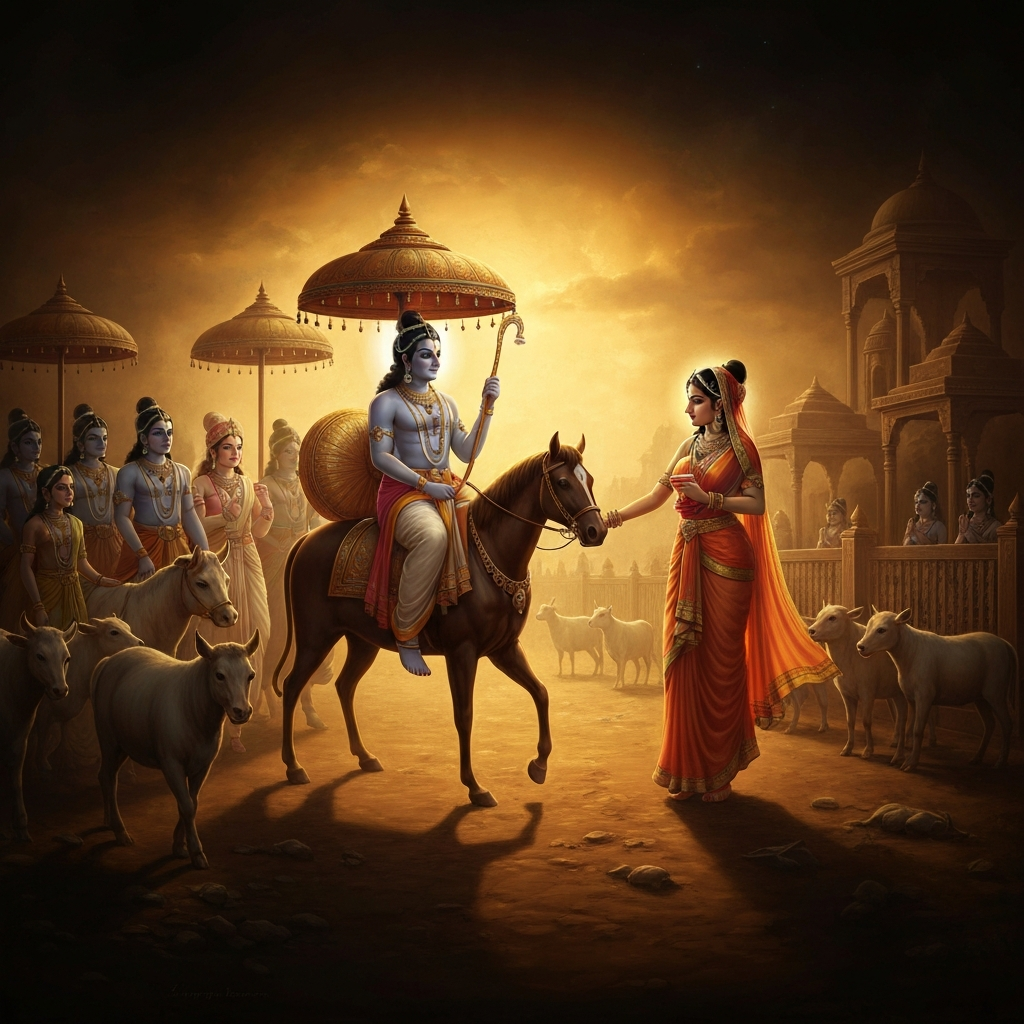
Then his grandson Shreyans — the texts are exact about the genealogy — is pressing sugarcane juice when Rishabha walks past, and Shreyans recognizes, in a flash of memory that the tradition calls the awakening of a previous-life recollection, exactly what is needed. He fills a clay pot with sugarcane juice. He walks out to the road. He pours it into his grandfather’s cupped hands. No violence. No preparation for the wanderer. No pride in the giving. Pure surplus, freely offered, thought of neither before nor after.
Rishabha drinks. He breaks his year of fasting with sugarcane juice offered by a child at a roadside.
The Aksaya Trtiya — the Jain spring festival on which this day falls — is still commemorated in this way: Jains break a ritual fast by receiving sugarcane juice from another person’s hands, the act re-enacting the moment the First Lord accepted that the world contains, alongside its machinery of accumulation, the possibility of pure giving.
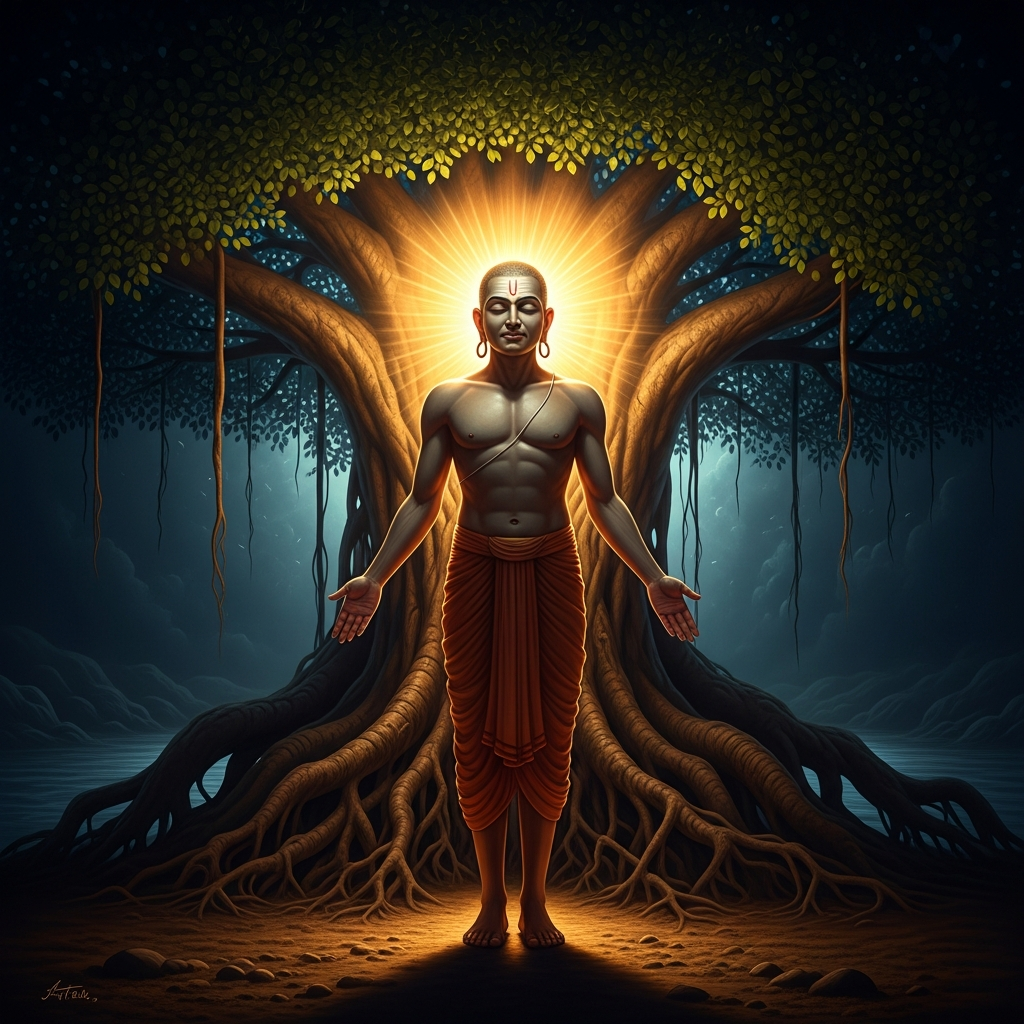
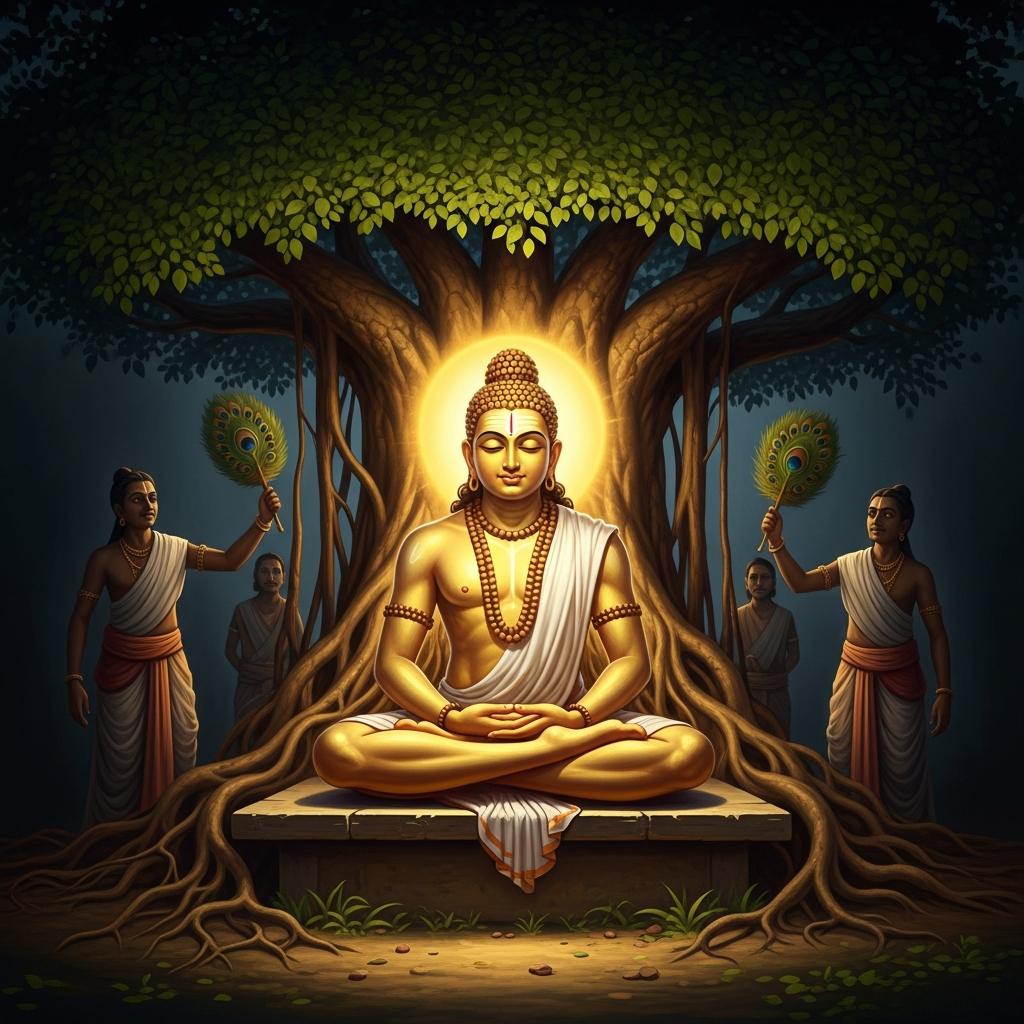
The omniscience comes under a banyan tree.
After the year’s fast, after the sugarcane juice, he resumes his wandering and his practice, and the karma — the weight of those early years of kingship, the decisions and the administration and the building of a civilization’s bureaucracy — burns away with the precision of a fire that knows exactly what it is consuming. The kevala-jnana opens. The total knowledge. He sees every soul in every realm simultaneously, without angle, without effort, without the body’s distortion.
He teaches for a hundred thousand years — the Jain texts give enormous lifespans to figures of the earlier cosmic ages — and his congregation eventually numbers in the tens of thousands. He teaches the five great vows. He teaches ahimsa, non-violence, to people who learned agriculture from him and who are now told that even the soil teeming under the plow is alive and therefore owed consideration. He teaches the most extreme version of the ecological duty first articulated when he showed them how to farm.
He dies on Ashtapada mountain in the posture of body-abandonment. The Jain tradition records that one million monks and thirty million nuns took the vows during his teaching. Historians cannot verify these numbers. The point the numbers make is theological rather than demographic: the first teacher found enough to teach.
What the Rishabha story insists on — and what makes it stranger than most founding myths — is the sequence. He does not renounce because civilization failed. He renounces because civilization succeeded. He built exactly what he set out to build, handed it to his son, and left. The most productive human being in history turns out to be the one who built everything and kept nothing.
His daughters’ alphabets are still in use. Brahmi script is the ancestor of every writing system across South and Southeast Asia — Devanagari, Bengali, Tamil, Tibetan, Khmer. The letters you are reading now descend, through thirty-three centuries of copying and transformation, from what a king taught a daughter in Ayodhya before he walked out of his own palace into the forest.
He is the Rig Veda’s naked wanderer, the wrapped ascetic the hymns call by a bull’s name. He is the oldest figure in the oldest Indian religious literature who might be a historical person, or a memory of one, or the name given to the insight that all civilization is a preparation for leaving it.
Echoes Across Traditions
Entities
- Rishabha (Adinatha)
- Bharata
- Bahubali
- Brahmi
- Sundari
- King Shreyans

Sources
- *Acaranga Sutra* (Jain canonical text; Hermann Jacobi trans., *Sacred Books of the East* vol. 22, 1884)
- *Kalpa Sutra* (Bhadrabahu, c. 4th century BCE)
- *Adipurana* (Jinasena, c. 9th century CE) — the fullest account of Rishabha's life
- Rig Veda 10.136 — possible reference to Rishabha as naked ascetic
- Paul Dundas, *The Jains* (Routledge, 2nd ed. 2002), ch. 1
- Padmanabh S. Jaini, *The Jaina Path of Purification* (University of California Press, 1979)