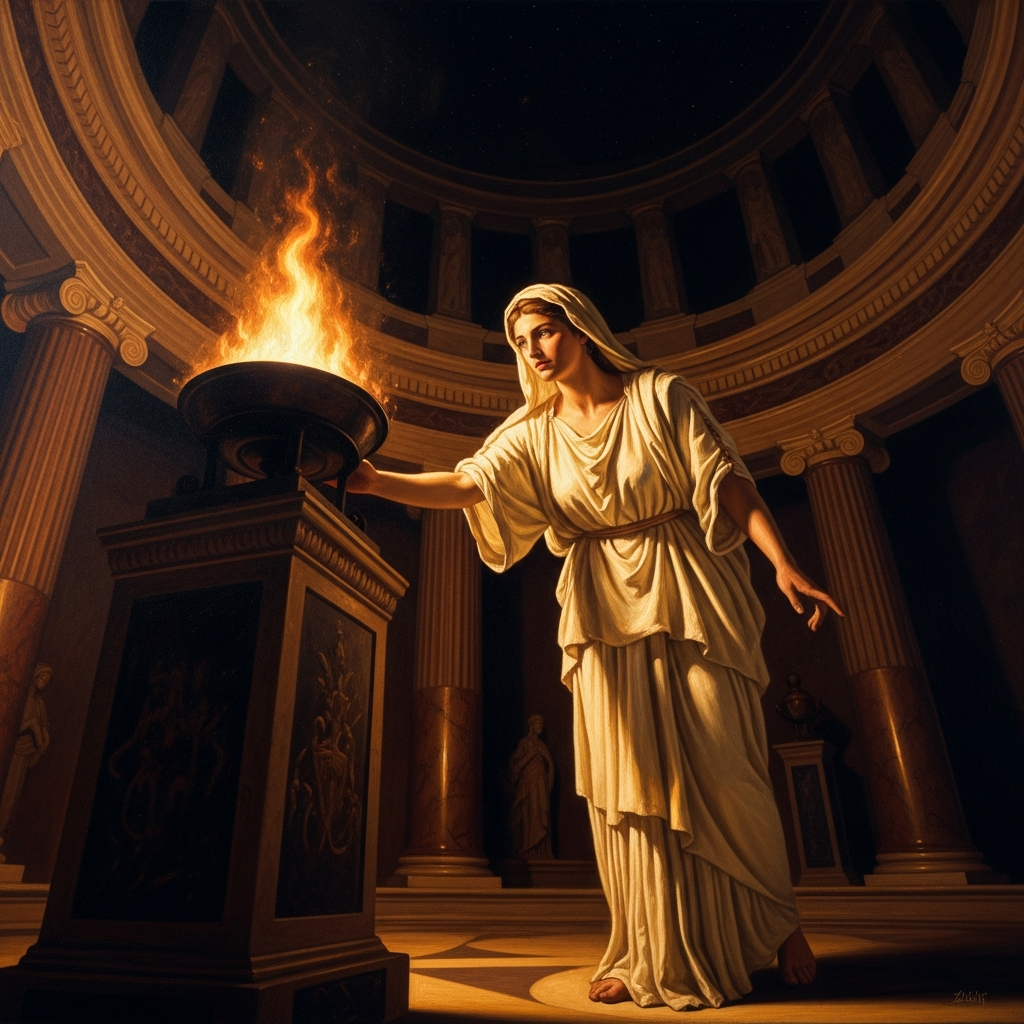
The Vestal Virgins and the Eternal Fire
Traditional founding by King Numa Pompilius c. 715 BCE; the order disbanded by Theodosius in 391 CE — over a thousand years of unbroken service · The Aedes Vestae, the round temple in the Forum Romanum, and the adjoining Atrium Vestae where the priestesses lived
Contents
Six women, taken from their families as small girls, sworn to thirty years of celibacy, kept the sacred flame of Vesta burning at the heart of the Forum. Without that fire Rome could not stand. A Vestal who let it die was beaten in the dark; a Vestal who broke her vow was lowered alive into a small underground chamber and the door sealed above her.
- When
- Traditional founding by King Numa Pompilius c. 715 BCE; the order disbanded by Theodosius in 391 CE — over a thousand years of unbroken service
- Where
- The Aedes Vestae, the round temple in the Forum Romanum, and the adjoining Atrium Vestae where the priestesses lived
She is six years old. She is between six and ten, by the law that King Numa is supposed to have written down in the second century after the city was founded. Her father presents her, a free-born girl of unblemished family, to the Pontifex Maximus, and the Pontifex takes her by the hand and says the formula that strips her, in that moment, from her father’s household forever.
Te, Amata, capio. I take you, Beloved.
After that she is not her father’s anymore. She is not her family’s. She is the city’s. She walks across the Forum to the Atrium Vestae — the long building beside the round temple — and her childhood ends at its door.
There are six of them.
Six at any one time, ranked by seniority. The youngest are still being taught the rites; the middle ones perform them; the eldest teach. The term of service is thirty years — ten as student, ten as priestess, ten as instructor — and at the end she may, if she chooses, leave the order, marry, return to the world. Most do not. Thirty years inside the rhythm of the temple has, in most cases, made the world outside it thin and unrecognizable, and the women who could marry usually stay.
While she serves, she wears the stola and the suffibulum, the white veil pinned beneath her chin. Her hair is bound in the seni crines, six braids — the same hairstyle a Roman bride wears on her wedding day, because that is what she is: a bride of the city, with the city as her husband and the fire as her child.
She walks the streets with a lictor, an officer of the state, in front of her. Consuls step out of her path. If she crosses a condemned criminal on his way to execution, the criminal is freed — not symbolically, actually; the meeting is taken as a sign from Vesta and the sentence is voided.
She is the only woman in Rome who can make a will, give legal testimony, sit in the cavea at the games among the senators. She is the only woman in Rome whom the consuls will rise for.
And she is the only woman in Rome whose body, if entered, will be killed for it.
The fire is not a symbol. The fire is the point.
It burns on the round hearth at the centre of the Aedes Vestae — the temple is round because hearths are round, the architecture is the architecture of a house, not of a state shrine — and it has been burning, by the order’s own reckoning, since the city was founded. Numa lit it. The Vestals have kept it. If it goes out, Rome is on fire of a different kind.
There are no images of Vesta inside the temple. The fire is the goddess. Romans who walk past the temple at night see the flicker through the open door and know the city is still in covenant.
Each March 1st, on the Roman new year, the Vestals extinguish the fire deliberately — under controlled conditions, in the presence of the Pontifex Maximus — and re-kindle it from sunlight focused through a bronze mirror, or by friction of two pieces of felix arbor, the lucky tree. The kindling is a ceremony. The dying out, on any other day, is a catastrophe.
When it does happen — when a priestess on watch falls asleep, or the wood is bad, or the wind comes wrong through the door — the Pontifex Maximus comes. The Vestal who let it die is taken into a dark place. She is stripped to the waist. She is beaten with rods, the flagrum, by the Pontifex himself, behind a screen, so that no man’s eye sees her body. Then the fire is rekindled and the city’s covenant is restitched, and life continues.
That is the punishment for the lesser fault.
The greater fault has its own architecture.
Outside the Colline Gate, on a low rise, there is a small underground chamber. It is built and ready. Inside is a bed, a lit lamp, a small loaf of bread, a jug of water, a little oil. It is prepared. It exists in case it is needed and is rebuilt if it is used.
If a Vestal is accused of incestum — of having broken her vow — she is tried by the college of pontiffs. There is no public trial; the matter is not the city’s to know in detail. If she is condemned, she is dressed as a corpse, laid on a covered litter, and carried in funeral procession through the Forum she once walked as the city’s untouched daughter. The crowds line the streets in absolute silence. Plutarch says it is the most terrible spectacle the city ever produces and that on those days the calendar marks the day as black.
The litter reaches the Colline Gate. The Pontifex Maximus prays — silently, his face covered. The Vestal climbs down a ladder into the chamber. The lamp is lit; the bread is on the table; the jug is full. She lies down or she sits or she stands as she chooses. The ladder is withdrawn. The opening is closed with a stone. The earth is shovelled over the stone until the rise is level.
The man who could be said to have shared in her crime is beaten to death with rods in the Forum the same day, but he is killed cleanly. She is left in the dark with food and oil so that the Roman state can say, technically, that they did not execute her — the gods did, by whatever means the gods chose. The legal fiction is that the chamber is not a tomb; it is a residence. The Vestal will, in due course, be found by Vesta herself.
This happens. Livy records it; Dionysius records it; Plutarch records it. The names of the women are preserved: Oppia in 483 BCE, Minucia in 337, Sextilia in 273, Floronia and Opimia after Cannae in 216 when the city was so terrified by Hannibal that it executed two of them in a single panicked spring. The chamber is rebuilt and used and closed and rebuilt for a thousand years.
Most Vestals never face it.
Most live the long quiet life of the order — the fire in the morning, the rituals through the year, the festival of the Vestalia in June when the temple is opened and the women of Rome come barefoot to the threshold, the gathering of grain for the mola salsa (the salted meal sprinkled on every Roman sacrifice and made by the Vestals’ own hands). They keep the Palladium — the wooden image of Athena that Aeneas was supposed to have brought from Troy — in an inner chamber so secret that no man may enter and they themselves only enter it veiled and barefoot.
They live in the Atrium Vestae beside the temple. The atrium has its own pool, its own statues, its own kitchen. The senior Vestal, the Virgo Vestalis Maxima, is one of the most powerful women in the empire. Senators put their wills in her keeping; emperors take her advice; Cicero and Caesar and Augustus all dealt with her. When the empire became Christian, the order was the last great institution of the old religion to fall.
In 391 CE, Theodosius extinguished the fire.
The Vestals walked out of the Atrium for the last time. The chamber outside the Colline Gate was never rebuilt again. The round temple still stands in the Forum, half-ruined, the hearth empty, the door open to the wind.
For more than a thousand years before that, every night in Rome, six women had been awake in turn making sure a small fire did not go out.
The Vestal order is not exotic. It is the deepest layer of Roman religion exposed — older than the Republic, older than the city’s empire, the priesthood that the kings instituted before there were consuls. Numa supposedly founded it. Romulus, in some traditions, had inherited it. The Vestals were the city before the city had its own myth of itself.
The terms are extreme because the office is extreme. The Romans believed — really believed, with no metaphor — that their state’s continued existence depended on a handful of women keeping a flame lit on a hearth in the Forum. If the flame failed, the gods withdrew their consent. If a Vestal was unchaste, her body had introduced contamination into the channel between the city and Vesta, and the only way to reseal the channel was to put the body in the earth. The chamber outside the Colline Gate was, in the Roman mind, a piece of structural engineering. It existed for the same reason a fuse exists in a circuit.
What the order also did, in passing, was create a class of women who held legal rights no other Roman woman would hold for two thousand years. Vestals could own property, write wills, give evidence, walk the streets unaccompanied except by their lictor, sit in the front rows at the games. The price of those freedoms was thirty years of sealed celibacy and the chamber waiting outside the gate.
The fire burned for over a millennium. When Theodosius finally put it out, he was not putting out a metaphor; he was putting out the longest continuously tended fire in European history. The hearth in the Forum had been alight, by Roman reckoning, since before the Trojan war.
A small fire. Six women. A round temple. A chamber, prepared and waiting.
Echoes Across Traditions
Entities
- Vesta
- The Vestal Virgins
- Pontifex Maximus
- Numa Pompilius

Sources
- Livy, *Ab Urbe Condita* 1.20, 8.15, 22.57
- Plutarch, *Life of Numa* 9-11
- Pliny the Elder, *Natural History* 28.3
- Dionysius of Halicarnassus, *Roman Antiquities* 2.64-69
- Ovid, *Fasti* 6.249-348
- Ariadne Staples, *From Good Goddess to Vestal Virgins* (1998)
- Robin Lorsch Wildfang, *Rome's Vestal Virgins* (2006)


