Contents
When Izanagi kills the fire-god Kagutsuchi with his sword, the blood that falls from the blade becomes Takemikazuchi, the god of thunder and lightning and swords — born from the intersection of death and divine violence.
- When
- Age of the Gods — born from Kagutsuchi's killing, Kojiki Book I
- Where
- The moment of Kagutsuchi's death — then Kashima in Hitachi Province (modern Ibaraki Prefecture)
He is born from blood.
When Izanagi draws his ten-span sword and kills the fire-god Kagutsuchi — whose birth burned Izanami to death — the blood that flies from the sword does not simply fall. It becomes. Each drop of blood from the cutting and the dying of the fire-deity lands on different rocks and different peaks and becomes a different deity. Eight deities in total, born from the death of fire.
The blood from the tip of the sword hits the rocks at the river Ame-no-Yasu and becomes Takemikazuchi-no-Ō — the Great Brave-August-Thunder. His alternative names are precise: he is called the Mighty-Thunder in Heaven, and he is called Futsunushi’s companion, and he is associated with the blade and the bolt as the same phenomenon.
Lightning is a sword.
This is the organizing perception of Takemikazuchi’s nature: the bolt that splits a tree is the same action as the blade that splits a body. The precision of the cut, the speed that is faster than any countermeasure, the power that comes from somewhere above the human level and arrives without negotiation — these are the qualities of both, and the god who embodies them is both simultaneously.
He is worshipped at Kashima Shrine in what is now Ibaraki Prefecture, one of the oldest and most important shrines in Japan. The Kashima style of swordsmanship — Kashima Shintō-ryū — traces itself to divine instruction from Takemikazuchi himself, the tradition holding that the god of swords gave the first swordsmanship to the shrine’s keepers, who transmitted it to the warriors of the Kantō region.
The practical consequence: for much of Japanese military history, the warriors whose swordsmanship was most feared trained in the tradition ultimately attributed to a deity born from the blood of a fire-god killed by a grief-mad father.
His political function is as significant as his martial one.
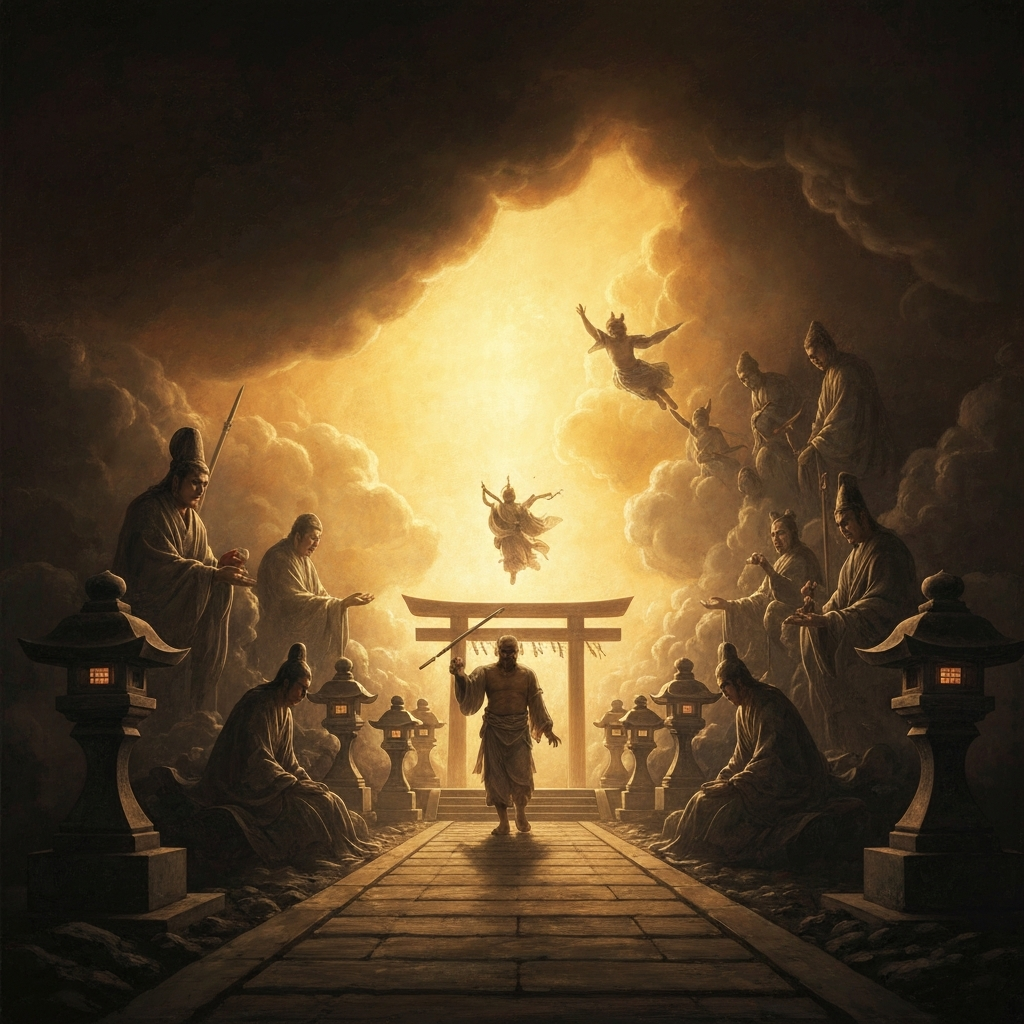
When the heavenly deities decide that Ōkuninushi must yield the earth he built, they send Takemikazuchi as the one who delivers the demand. He is not sent first — the first two envoys failed to return. But when the time for military diplomacy is over and the time for a being capable of actual divine force arrives, Takemikazuchi is the answer.
He plants his sword upside down in the waves of the Izumo coast and sits on its pommel. He addresses Ōkuninushi and his sons. His presence is the argument that does not need to be made in words: this is what heaven will do if the earth does not comply.
The earth complies.
The sword is still in the sea at Izumo, or its memory is — the Kojiki notes that the sword Futsunushi was enshrined at the place where Takemikazuchi performed the negotiation, a permanent record of the moment heaven’s martial authority compelled the earth to yield.
Born from blood.
Used to negotiate the world.
Worshipped for giving swords their purpose.
Echoes Across Traditions
Entities
- Takemikazuchi
- Izanagi
- Kagutsuchi
- Futsunushi
Sources
- Kojiki (Record of Ancient Matters), compiled 712 CE, Book I, Sections 5, 27-33
- Nihon Shoki (Chronicles of Japan), compiled 720 CE
- Philippi, Donald, *Kojiki* (University of Tokyo Press, 1968)
- Kashima Jingū Shrine records, Ibaraki Prefecture