Gods of War: Ares, Odin, Skanda, Huitzilopochtli, and Sekhmet
Ancient, across all periods — Homeric Greece through Aztec imperial period · Mount Olympus, Asgard, the Hindu heavens, Tenochtitlan, the Egyptian delta
Contents
Not all war gods are the same. Some are despised, some revered. The difference between a god of war and a god who wages war reveals everything about what a culture thinks violence is for.
- When
- Ancient, across all periods — Homeric Greece through Aztec imperial period
- Where
- Mount Olympus, Asgard, the Hindu heavens, Tenochtitlan, the Egyptian delta
Not all war gods are the same, and the difference between them reveals something essential about the civilizations that made them.
There is a distinction worth drawing at the outset: a god of war is a deity who embodies or governs the phenomenon of combat — who represents violence as a cosmic principle. A god who wages war is a deity who fights — who goes to battle as a personal act. The distinction sounds subtle but it produces radically different theological figures. Ares is a god of war who wages war. Odin wages war but is not simply its embodiment. Athena — the Greeks’ preferred war deity — wages war strategically but is primarily a goddess of wisdom. The profile depends on what question the culture was asking about violence.
Ares: The War God No One Liked
The most striking thing about the Greek god of war is that his own pantheon cannot stand him.
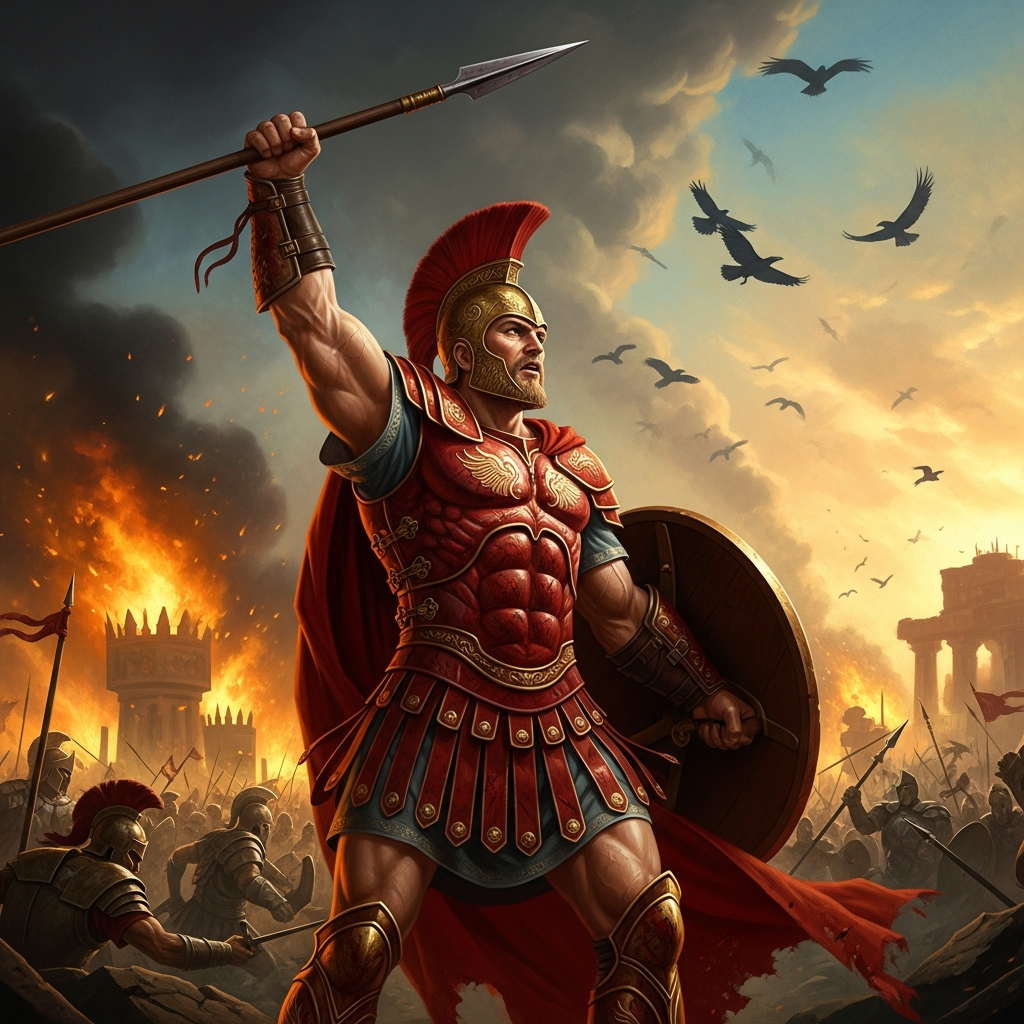
In the Iliad, Zeus says to Ares directly: “Most hateful to me are you of all gods that hold Olympus. Forever is strife dear to you and wars and fighting.” This is not a villain speech. It is a father’s exasperated condemnation of a son he finds both necessary and contemptible. Ares exists; violence exists; but neither the gods nor the Greeks who worshiped them pretend this is good.
Ares fights on the Trojan side in the Iliad and is wounded twice. Once Diomedes, a mortal, drives a spear into his side with Athena guiding the blow — and Ares retreats to Olympus howling. Once Heracles wounds him. The war god is not invincible. He is not even particularly effective. He is strong and relentless and bestial, but he lacks the capacity to adapt, to plan, to read a battlefield as a problem to be solved rather than a target to charge.
The contrast with Athena is the key. Both deities are associated with war. But Athena is the war deity that Greek cities actually invoked — Athens named itself for her, not for Ares. Athena represents war as a problem of intelligence: tactics, engineering, the right moment to strike, the diplomatic arrangement that avoids unnecessary battle. Ares represents war as pure appetite, combat for its own sake, the experience of killing divorced from any purpose.
The Greeks, a civilization that both glorified martial virtue and built the world’s most sophisticated philosophical tradition, had a war god they despised because they understood the difference between war that serves a purpose and violence that has none. Ares is what war becomes when you strip away the reason for it.
Odin: The War God Who Collects the Dead
Odin’s relationship to war is not about combat. It is about the harvest.
Odin is the Allfather, the god of wisdom, of poetry, of runic knowledge — but he is also the god of death-in-battle, and his interest in war is fundamentally eschatological. He does not go to war because he enjoys fighting. He goes to war — or more accurately, he engineers war — because he needs the dead.
The Einherjar are the warriors who die in battle and are chosen by Odin’s Valkyries to be brought to Valhalla. In Valhalla they feast and fight endlessly, practicing the skills of combat, healing their wounds each evening, preparing for Ragnarok — the final battle at the end of the world in which even Odin himself will fall, swallowed by Fenrir the wolf. Every battlefield death is, from Odin’s perspective, a recruitment. He is building his army.
This makes Odin uniquely unsettling among war deities: he grants victory not to the side that deserves it but to the side from which he needs the dead. In the Volsunga Saga, Odin gives Sigmund his sword and then, when the time comes, takes it back — breaking the blade with his spear, allowing Sigmund to be killed, because Sigmund is now more useful to him dead. The war god’s favor is not a blessing. It is a temporary arrangement.
The Norse war theology is honest about something other traditions preferred to obscure: the divine patron of warriors does not ultimately care about you. He cares about his project, which transcends your survival.
Skanda: The Commander Born for One Purpose
Hindu mythology has multiple war deities, but Skanda (also called Karttikeya, Murugan, and other names across South Asia) is the most purpose-built of them.
The gods faced a crisis: the demon Taraka could only be killed by the son of Shiva, and Shiva was in perpetual meditation after the death of his first wife Sati. The gods needed to generate a crisis serious enough to interrupt Shiva’s meditation, cause him to fall in love with the reincarnated Sati (now Parvati), and produce a divine son capable of defeating Taraka. The entire cosmic apparatus was mobilized to accomplish this. Skanda is the result.
He is born, in some accounts, from Shiva’s fire, carried by the Pleiades, raised by the Krittikas (the star-mothers). He is immediately and fully a general — the Devasena-pati, the commander of the divine army — and his first act is the destruction of Taraka for which he was created.
What makes Skanda’s war theology distinctive is its precision. He is not the embodiment of combat as a phenomenon. He is the embodiment of the correct use of force in service of cosmic order. His weapon, the Vel (divine spear), does not represent indiscriminate destruction but targeted, purposeful violence. The war god who was built to solve a specific problem is, in some respects, the most interesting kind: a deity whose entire mythology is about proportionality.
Huitzilopochtli: The War God Who Keeps the Sun Moving
The Aztec theology of war is the most cosmologically demanding in this survey, because it eliminates the possibility of a world without war.
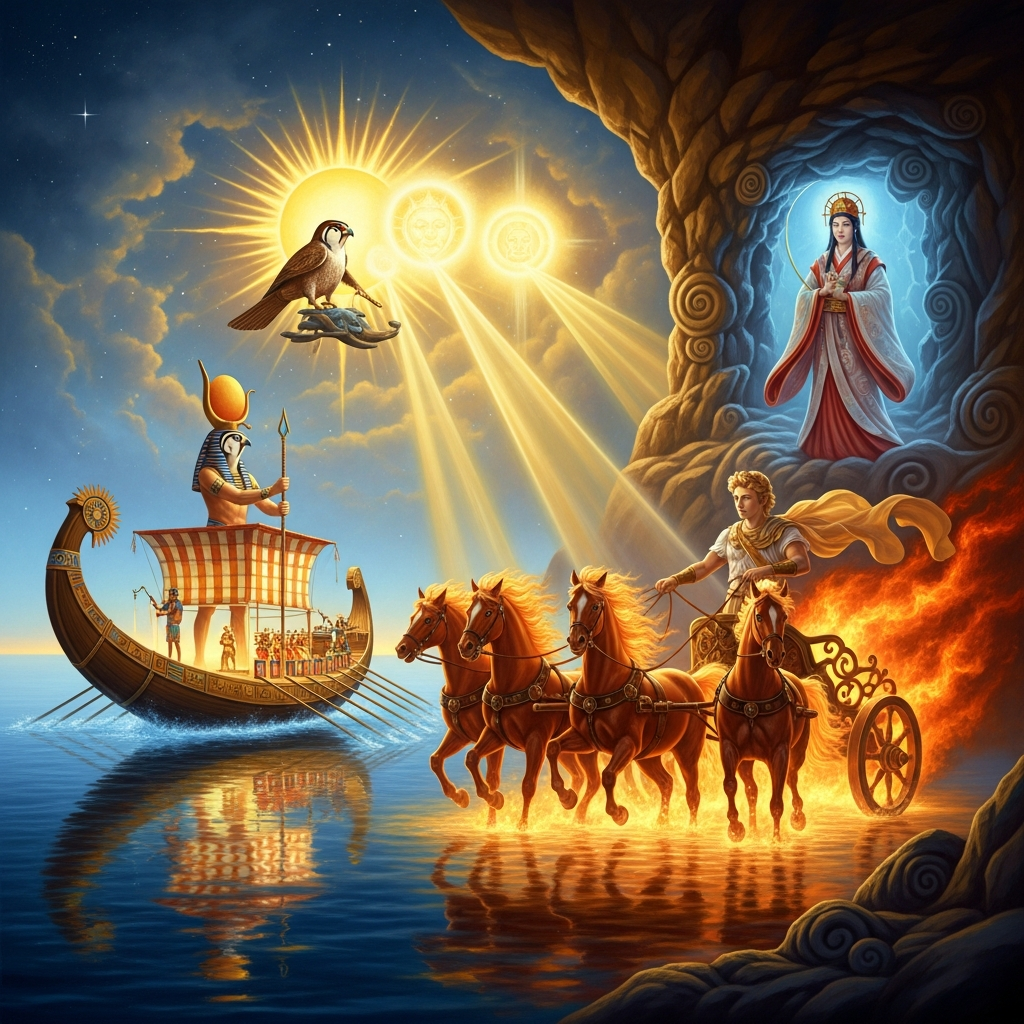
Huitzilopochtli is simultaneously the god of war and the sun. These are not two roles; they are one role. The sun is a living entity whose journey across the sky requires fuel — specifically, human blood and hearts taken in sacrifice. Without that fuel, the sun stops. The world ends. Darkness and chaos return.
War, therefore, is not a political option. It is a cosmic obligation. The Aztecs conducted the “flower wars” — xochiyaoyotl — which were formalized conflicts with neighboring states designed specifically to take prisoners for sacrifice rather than to destroy the enemy. The goal was not territorial conquest or political dominance in the conventional sense, but the maintenance of the solar cycle. War was liturgical.
Huitzilopochtli’s birth myth encodes this directly: he is born from Coatlicue, the earth goddess, in the act of defending himself against his sister Coyolxauhqui and his four hundred brothers who attempt to kill him at the moment of birth. He defeats them all, drives Coyolxauhqui to the base of the mountain (she becomes the moon), and scatters his brothers as stars. This is not just a myth about the sun defeating the night — it is a justification for eternal cosmic conflict. The sun must always be fighting. It was fighting from the moment it was born.
Sekhmet: The War Goddess Who Almost Ended Humanity
Sekhmet arrives at the war deity role from an unexpected direction: she is sent to destroy humanity as an act of divine punishment.
When Ra learned that humanity was conspiring against him, he sent Sekhmet — the lioness, the Eye of Ra — to punish them. She went further than ordered. She tasted blood and could not stop. She was destroying all of humanity when Ra intervened by flooding the fields with beer dyed red, which Sekhmet drank thinking it was blood. She fell into a stupor, and humanity survived.
The myth encodes something the Egyptians knew: that destructive force, once unleashed, is difficult to control and tends toward totality. Sekhmet does not distinguish between the guilty and the innocent once she has tasted blood. The war goddess’s nature is not strategic — it is overwhelming, consuming, total. Her management required ritual attention; her priests performed daily rites to appease her.
But Sekhmet is also a healer. She governs medicine and the magical reversal of harm. The destroyer is also the physician. This dual nature is not contradictory in Egyptian theology — it is the same force used differently. The power that causes disease also, in the hands of a skilled practitioner, cures it.
What War Gods Reveal About War
Ares is despised because the Greeks valued purpose over violence. Odin is unsettling because the Norse were honest about the transactional nature of divine favor. Skanda is admired because Hindu theology valued precision and cosmic order over raw force. Huitzilopochtli is inescapable because Aztec theology made violence cosmologically mandatory. Sekhmet is terrifying and healing simultaneously because Egyptian theology refused to separate destructive and curative force.
Each war god is a reflection of what the culture believed war was actually doing in the world. The most honest question a war god’s mythology can pose is the question the Greeks built into their dislike of Ares: is this violence serving something, or is it only itself?
Echoes Across Traditions
Entities
- Ares
- Odin
- Skanda
- Huitzilopochtli
- Sekhmet
- Athena
- Mars
- Karttikeya


Sources
- Walter Burkert, *Greek Religion* (1985)
- H.R. Ellis Davidson, *Gods and Myths of Northern Europe* (1964)
- Wendy Doniger, *The Hindus: An Alternative History* (2009)
- David Carrasco, *City of Sacrifice: The Aztec Empire and the Role of Violence* (1999)
- Richard Wilkinson, *The Complete Gods and Goddesses of Ancient Egypt* (2003)