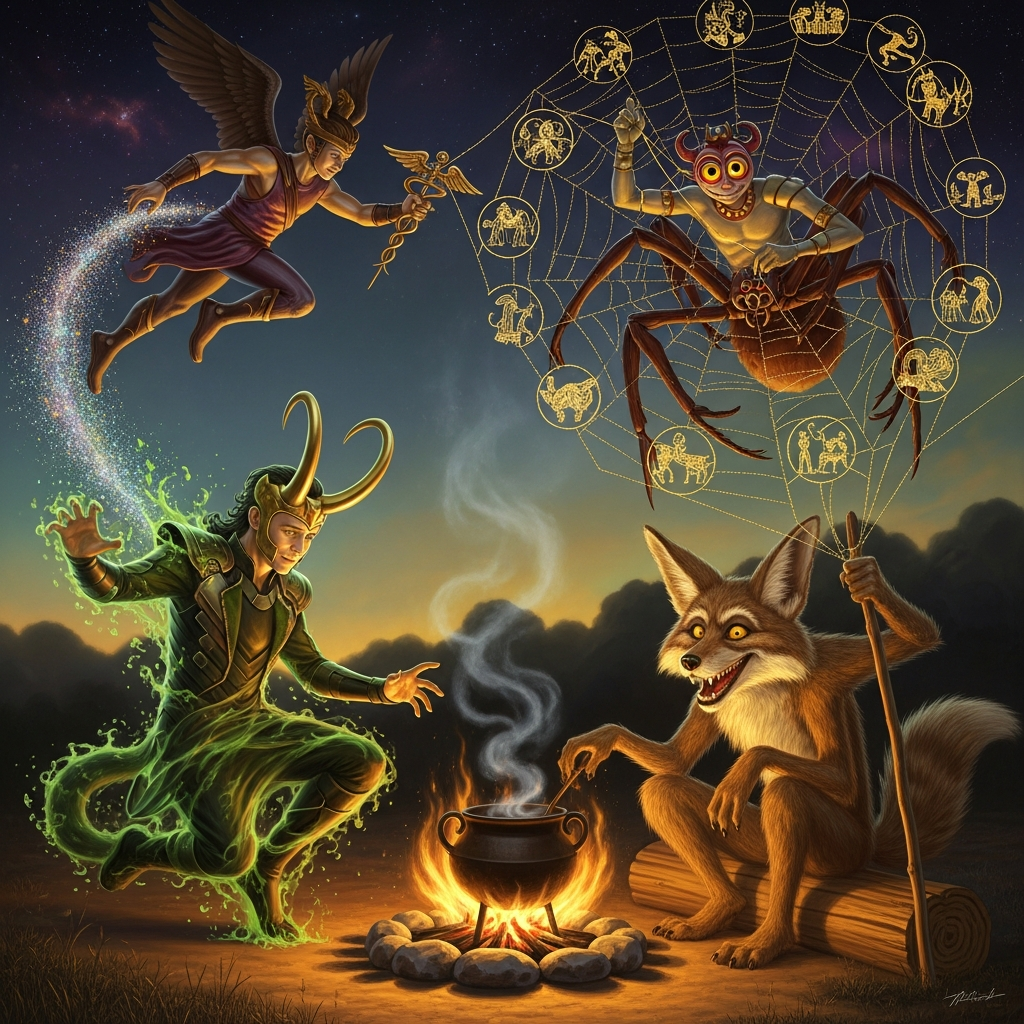
The Trickster Across Traditions: Loki, Anansi, Coyote, Hermes, and Eshu
Mythic time · traditions spanning 3000 BCE to present · Asgard, the Akan sky kingdom, the American Southwest, Mount Olympus, the Yoruba crossroads — every mythology's margin
Contents
Every culture invents a trickster. The shape-shifter who breaks the rules, crosses the uncrossable, and — in the chaos — makes the world more interesting than the gods intended.
- When
- Mythic time · traditions spanning 3000 BCE to present
- Where
- Asgard, the Akan sky kingdom, the American Southwest, Mount Olympus, the Yoruba crossroads — every mythology's margin
Every mythology has a rule-breaker. The figure goes by different names — Loki in the Norse sagas, Anansi in the Akan tradition, Coyote in the American Southwest, Hermes in the Greek pantheon, Eshu-Elegba among the Yoruba — but the structural role is identical across cultures that had no contact with one another. This convergence is one of the most telling patterns in comparative mythology. If one culture invented a trickster, that might be chance. If every culture independently invented the same figure, something deeper is at work.
The trickster is not defined by evil or by good. He is defined by movement. He crosses the boundaries that the rest of the mythology has agreed to hold fixed: between the human and the divine, between life and death, between sacred and profane, between one social category and another. He is the figure who is always on the margin, always moving, always turning the expected situation into something the gods themselves did not predict.
Loki: The Shape-Shifter Who Saved and Doomed the Gods
The Norse Loki begins as an asset.
He is Odin’s blood-brother — not a god by birth but elevated by the bond — and his primary function in the early sagas is exactly what Odin needs him for: he is smarter than the situation and willing to break whatever rule is in the way. When the builder of Asgard’s walls demands the sun, the moon, and Freyja as payment, it is Loki who disguises himself as a mare to seduce the builder’s stallion and ruin the schedule. When Thor loses his hammer to the giant Thrym, it is Loki who devises the plan to retrieve it. When the gods need something impossible, Loki is the one they send.
The same cleverness that serves them eventually turns against them. Loki engineers the death of Baldr — the beloved, the untouchable, the one god the rest of the pantheon agreed could not be harmed — by finding the one loophole in the protection: the mistletoe that was too young to be asked for its oath. He guides the blind god Hodr’s hand, throws the sprig, and kills the one figure whose death will set Ragnarok in motion.
The Norse answer to the trickster is tragedy. He starts by solving problems. He ends by creating the final and unsolvable one. The lesson embedded in Loki is that cleverness without loyalty is a weapon with no safe end to hold.
Anansi: The Spider Who Stole the Stories
In the Akan tradition of West Africa, the world before Anansi had no stories.
All the world’s stories — every narrative, every explanation, every tale — were owned by Nyame, the sky god. Nyame kept them locked away, and the price he set for purchasing them was deliberately impossible: Anansi had to deliver the hornets Mboro, the python Onini, and the leopard Osebo. These were not tasks for a small spider.
Anansi paid all three. He tricked the hornets into a gourd by pretending to shelter them from rain. He tricked the python into proving his length by lying down alongside a straight branch and being tied to it. He trapped the leopard in a pit and hauled him up in a net. Nyame, amused, honored the deal.
Everything that can be told came from this transaction. The Anansi myth is not just a trickster story but an origin story for narrative itself — for the human ability to make sense of the world through tales. The trickster does not merely cause chaos; in the Akan reading, he is the one who made meaning possible. Without his theft, the world would still be wordless.
Coyote: Creator and Fool
Coyote appears in the oral traditions of dozens of North American nations — Navajo, Crow, Chinook, Blackfoot, Nez Perce — and his nature varies by tradition while his structure remains constant.
In some versions, Coyote helped shape the world. He placed the stars in the sky. He brought fire down to humans. He showed the first people how to plant and hunt. These are not the actions of a chaos agent — they are the actions of a benefactor deity, the kind of creator-figure that every tradition needs.
In other versions — sometimes from the same tradition, sometimes the same story — Coyote introduced death. He did it carelessly. In some tellings, he actively argued for mortality at the council of creation, insisting it would be better for the world if people did not live forever. When the first death came — often the death of his own son, as a direct consequence of his decision — he changed his mind and wept. But the rule was already set. His reasoning had prevailed.
This is the deepest version of the trickster: the figure who is simultaneously responsible for the world’s best gifts and its fundamental wound. Coyote holds both ends at once. He cannot be reduced to benefactor or destroyer because he is genuinely both.
Hermes and Mercury: The Divine Thief Made Official
Hermes is born in a cave on Mount Cyllene and commits his first theft before sunset on the day of his birth. He finds Apollo’s cattle, drives them backward so the hoofprints point the wrong direction, sacrifices two of them, invents the lyre from a tortoise shell, and is back in his cradle looking innocent when Apollo arrives to accuse him.
Apollo brings the case to Zeus. Hermes denies everything with the practiced confidence of an infant who has not yet learned that denying the obvious is not a defense. Zeus laughs — and here the myth makes its key move. Zeus does not punish the theft. He brokers a deal: Hermes gives Apollo the lyre and receives the cattle. Apollo, charmed by the music, gives Hermes his golden staff. The exchange formalizes the trickster’s position in the divine order.
Hermes becomes the messenger god, the guide of souls, the patron of travelers, merchants, and thieves — the official divine figure presiding over every human activity that involves crossing a boundary, literal or figurative. The Greeks domesticated their trickster by making him indispensable. He is not marginalized or punished; he is given an office. His boundary-crossing becomes the precondition for the gods communicating with the human world at all.
Eshu-Elegba: The Gatekeeper Who Must Come First
In the Yoruba tradition, Eshu-Elegba is not optional.
He is the Orisha of the crossroads, of communication, of chance, of beginnings. No prayer reaches any other Orisha until Eshu has been addressed. No ritual proceeds without his permission. He is propitiated first in every ceremony, not as an afterthought but as a cosmological requirement: he is the opening through which all divine communication passes.
He is also unpredictable, easily offended, and capable of misdirecting messages if disrespected. He can carry a prayer to the wrong Orisha. He can delay a blessing for years. He teaches proper behavior not through punishment but through the withdrawal of connection — when Eshu is displeased, the line goes silent.
This is the most structurally honest version of the trickster in any tradition: the figure who causes chaos is also the one whose cooperation is required for order. There is no working around him. You honor the unpredictable precisely because its unpredictability cannot be eliminated — only negotiated.
Why Every Culture Needs a Trickster
The convergence across these traditions is not coincidence and not borrowing. It is the independent discovery of the same structural problem.
Every religious and social system produces rules. Rules are necessary — they prevent violence, distribute resources, maintain the relationships that make collective life possible. But rules produce edges. There are situations the rules did not anticipate. There are boundaries between categories that are real in language but blurry in the world. And there is change itself: the world is always producing situations that the existing rules were not written for.
The trickster is the mythological answer to the edges. He lives there. He is the figure who, by breaking the rules, reveals where they actually sit — what they protect and what they cannot protect. Loki’s treachery shows the Norse gods that cleverness without loyalty is just destruction on a delay. Anansi’s theft gives humans the cognitive tools to make sense of what Nyame’s order could not explain. Coyote’s introduction of death is also the gift of seriousness — without it, nothing was at stake. Hermes domesticated makes every divine transaction possible. Eshu unappeasable teaches what it means to honor the unpredictable.
The trickster is not the enemy of the sacred order. He is what the sacred order produces at its own margins, and cannot survive without.
Lewis Hyde, in his landmark study of the archetype, puts it this way: the trickster is the “mythic embodiment of ambiguity and ambivalence, doubleness and duplicity, contradiction and paradox.” He is the figure who stands at the point where the boundary is the thinnest and shows you what is on both sides.
Every culture that has thought carefully about the world has needed exactly that. The names change. The function does not.
Echoes Across Traditions
Entities


Sources
- Paul Radin, *The Trickster: A Study in American Indian Mythology* (1956)
- Lewis Hyde, *Trickster Makes This World: Mischief, Myth, and Art* (1998)
- Carl Jung, *The Archetypes and the Collective Unconscious* — shadow and trickster (1959)
- Roger D. Abrahams, *African Folktales* (1983)
- Snorri Sturluson, *Prose Edda* (c. 1220 CE)
- Walter Otto, *The Homeric Gods* (1954)
- Robert Pelton, *The Trickster in West Africa* (1980)
- Åke Hultkrantz, *The Religions of the American Indians* (1967)